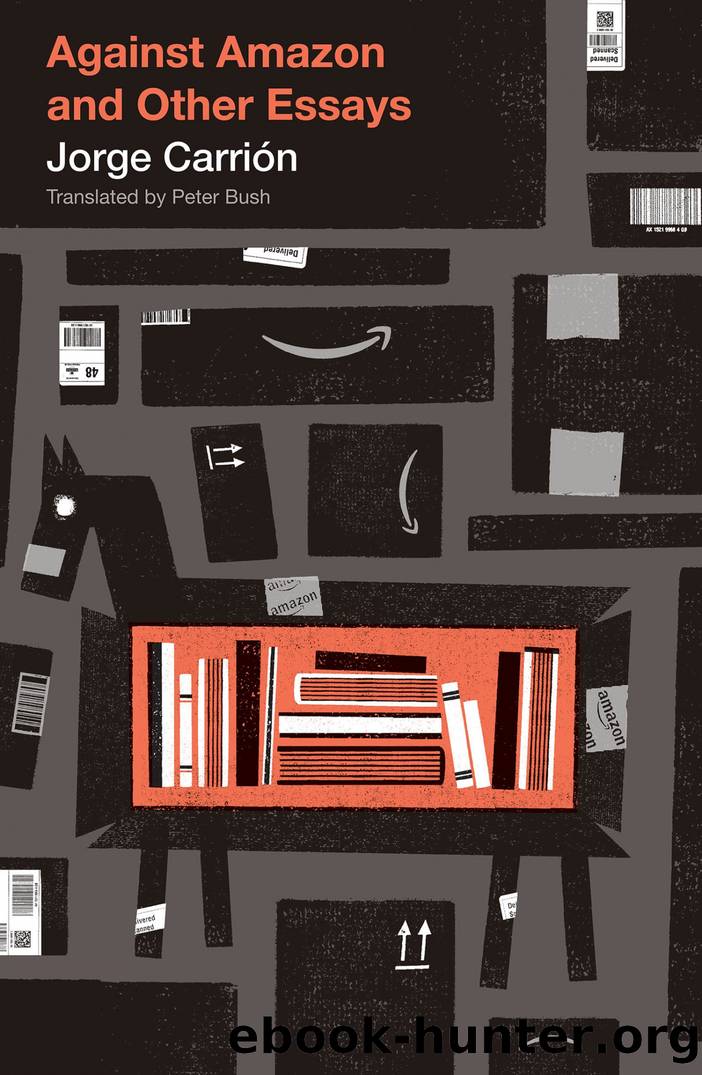
Against Amazon by Jorge Carrión
Author:Jorge Carrión
Language: eng
Format: epub
Tags: nonfiction books;gifts for readers;gifts for book lovers;independent book store;local bookstore;shop small;book shopping;big data;jeff bezos;Borges;Barcelona;Melbourne;Readings;Capri;The English Bookshop;Hoepli;Helsinki;Sanlian Bookhouse;travel;guide;pilgrimage;Shakespeare and Co;books about books;bibliophilia;book lore;community;culture;history;biographies and memoirs;translation;Spain;Spanish
Publisher: Biblioasis
Published: 2020-08-24T15:49:26+00:00
âThe Dogs of Capri
âI The Selfie House
Curzio Malaparte didnât bark at the moon, but at the dogs on this island. He recounts, in Diary of a Foreigner in Paris, that he learned to talk to dogs when he was banished in the thirties to Lipari, one of the Aeolian Islands, Sicilyâs younger sisters: âI didnât have anyone else to talk to.â He would go up to the terrace of his gloomy house by the sea and spend long hours âbarking at the dogs, who answered me, and the fishermen of Marina Corte called me the dog.â
He continued to do that in Paris, in 1947, after fourteen years in Italian exile, where he was punished and imprisoned time and time again by Mussoliniâs regime, whose first steps he had supported as intensely as he would reject them later on. But he was answered only by the cats on the Rue Galilée: âI had to stop talking to the cats in the language of dogs, because the cats didnât like that, and insulted me.â
But above all, it was here in Capri where the author of Kaputt barked and barked and went on barking, even though the islanders called him a madman and complained to the American soldiers, who asked him to stop doing it. But when Malaparte asked to see Admiral Morse, the officer in charge, he was told: âYou have the right to bark, if you want to, because Italy is now a free country. Mussolini has gone. You may bark.â
Is all this really true? I wonder as I disembark after the hour-long ferry journey from Naples. Compulsive liar and narcissist are two of the adjectives that tend to accompany the name Kurt Erich Suckert, born in Tuscany in 1898 of a German father and an Italian mother, who died exactly sixty years ago, whose pseudonym was an ironic riff on Napoleonâs surname, and whose profoundly European life and work were contradictory and extraordinary: half chronicle and half novel, half incredible experiences and likely imaginings; a life narrated by himself in the key of what for the last forty years we have known as autofictionâa form he practised long before anyone else.
These crowds are very real; they give me a lacklustre welcome. A travel writer knows that a reader isnât interested in tourism. So I wonât describe whatâs hitting the port at nine in the morning: the people queuing up to get on the ferries to Ischia, Sorrento, or Naples; the queue forming for the excursion to the Grotta Azzurra, or to get the cable car that, for two euros, takes you to the town of Capri or the convertible taxi that follows the same zigzagging route in the same amount of time, for twenty euros plus tip.
Iâll switch paragraphs, and, via the art of ellipsis, Iâm already on the path that will take me to a cinematic panorama, to a mythical house, when seen from afar. Iâve come in search of dogs and a gaze. The grandchildren of the dogs with which Malaparte conversed and the gaze that led me to his house.
Download
This site does not store any files on its server. We only index and link to content provided by other sites. Please contact the content providers to delete copyright contents if any and email us, we'll remove relevant links or contents immediately.
Twisted Games: A Forbidden Royal Bodyguard Romance by Ana Huang(4034)
The Push by Ashley Audrain(2705)
Den of Vipers by K.A Knight(2701)
Win by Harlan Coben(2667)
Echo by Seven Rue(2248)
Baby Bird by Seven Rue(2224)
Beautiful World, Where Are You: A Novel by Sally Rooney(2181)
A Little Life: A Novel by Hanya Yanagihara(2155)
Iron Widow by Xiran Jay Zhao(2127)
Leave the World Behind by Rumaan Alam(2100)
Midnight Mass by Sierra Simone(2017)
Bridgertons 2.5: The Viscount Who Loved Me [Epilogue] by Julia Quinn(1796)
Undercover Threat by Sharon Dunn(1791)
The Four Winds by Hannah Kristin(1775)
Sister Fidelma 07 - The Monk Who Vanished by Peter Tremayne(1671)
The Warrior's Princess Prize by Carol Townend(1632)
Snowflakes by Ruth Ware(1602)
Dark Deception by Rina Kent(1570)
Facing the Mountain by Daniel James Brown(1556)
