After Suburbia by Roger Keil;Fulong Wu; & Fulong Wu
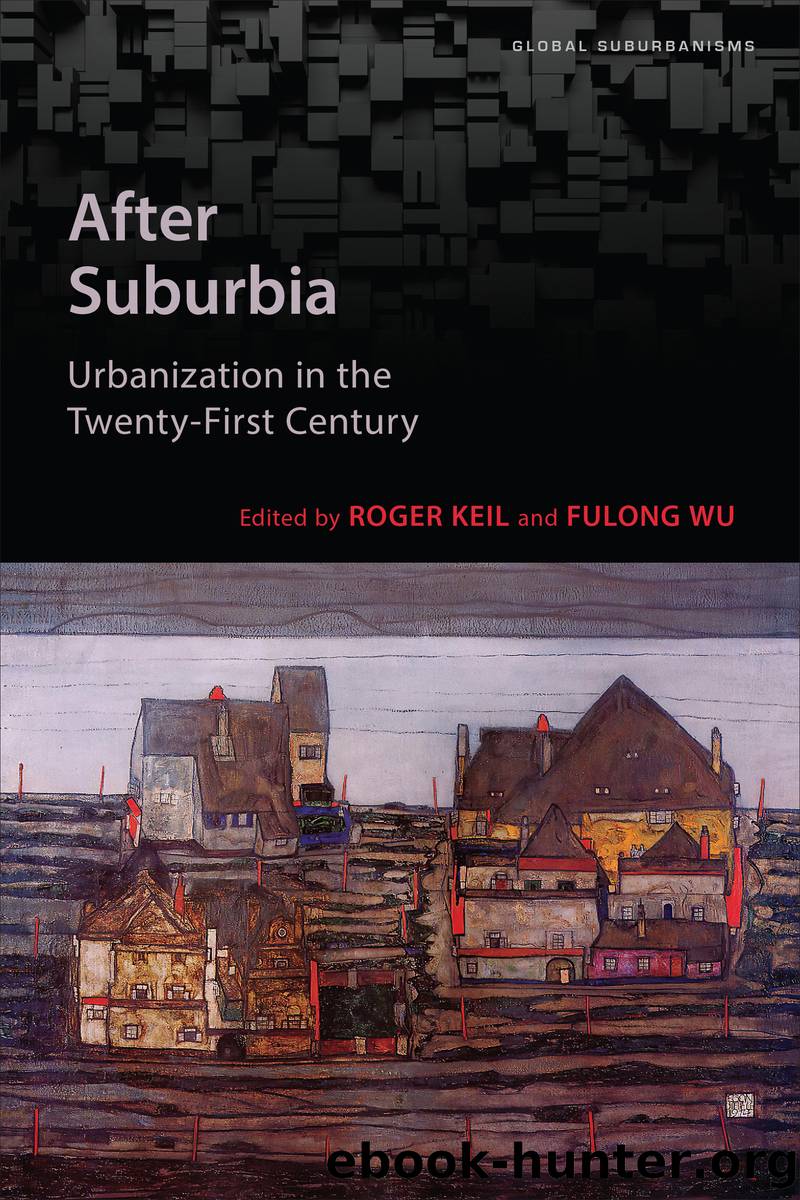
Author:Roger Keil;Fulong Wu; & Fulong Wu
Language: eng
Format: epub
Tags: Urbanization – Case studies, Suburbs – Case studies, City planning – Case studies, Case studies
Publisher: University of Toronto Press
Settler Colonial Society
In North America, the role of settler colonization in clearing and assembling land is evident. Histories of places written by European settlers focused on what OâBrien (2010) calls âfirsting and lastingâ â that is, naming the first settlers and categorizing Indigenous occupants as the last of their cultures, thus naturalizing the takeover of areas by the new arrivals. Drawing on empirical research in Australia and North America, settler colonial studies critiques Eurocentric political economy and history (Wolfe, 1999). It demonstrates the role of occupying land as a precondition to accumulation by dispossession and as a spatial fix for capitalism (Harvey, 2005). Colonialism is at the centre of Western economic history and essential to understand the success of capitalism. Settler colonialism eliminates residents or Indigenous populations who are replaced by settlers and/or slaves and other migrants (Wolfe, 1999, 2006, 2011). As Tuck and Yang (2012) explain, âSettler colonialism implicates everyone.â It denies âthe existence of Indigenous peoples and the legitimacy of claims to land ⦠the long-lasting impacts of slavery ⦠[and] requires arrivants to participate as settlersâ (as cited in Tuck & McKenzie, 2015, pp. 69â70).
A growing literature over the last two decades on urban studies and indigeneity has developed well beyond work on the social and health problems of Indigenous city dwellers (Auger, 1999; Browne et al., 2009; Peters, 2004). The new contributions of settler colonial studies to the disciplines of history, sociology, geography, and planning are still not in the mainstream (Patrick, 2015, p. 534), but a growing chorus of scholarship now considers cities and suburbs as Indigenous land. This empirical research is changing our perspectives on cities such as Chicago (Bang et al., 2014; LaGrand, 2002), Detroit (Mays, 2015), Sydney (Gulson & Parkes, 2009), and San Diego (Pulido, 2000).
Thrushâs (2016, 2017) analyses of Seattle and London show that even imperial centres were taken up and partly shared by Indigenous geographies and cultural networks. His Indigenous history of the Seattle area argues that Indigenous title to the land has been reduced and encroached upon to remake Seattle and Tacoma into cities where Indigenous heritage and people are repressed (Thrush, 2017). By appropriating this invisibility and repression, however, Indigenous writers and cultures more broadly have sought to replace a sense of absence, urban haunting, and settler guilt with âIndigenous mourning, and imagined spectral ancestries with actual genealogies embedded in the landâ (Boyd & Thrush, 2011, p. xx; see also Thrush, 2013, 2016). As Coulthard (2014) has shown, these writers, activists and researchers try to activate the remaining interspatiality of previous patterns of occupation and land use:
Place is a way of knowing, experiencing, and relating with the world ⦠ways of knowing often guide forms of resistance to power relations that threaten to erase or destroy our senses of place. This ⦠is precisely the understanding of land and/or place that not only anchors many Indigenous peoplesâ critique of colonial relations of force and command, but also our visions of what a truly post-colonial relationship of peaceful coexistence might look like.
Download
This site does not store any files on its server. We only index and link to content provided by other sites. Please contact the content providers to delete copyright contents if any and email us, we'll remove relevant links or contents immediately.
| Anthropology | Archaeology |
| Philosophy | Politics & Government |
| Social Sciences | Sociology |
| Women's Studies |
The Secret History by Donna Tartt(19105)
The Social Justice Warrior Handbook by Lisa De Pasquale(12197)
Thirteen Reasons Why by Jay Asher(8921)
This Is How You Lose Her by Junot Diaz(6894)
Weapons of Math Destruction by Cathy O'Neil(6285)
Zero to One by Peter Thiel(5808)
Beartown by Fredrik Backman(5769)
The Myth of the Strong Leader by Archie Brown(5513)
The Fire Next Time by James Baldwin(5454)
How Democracies Die by Steven Levitsky & Daniel Ziblatt(5225)
Promise Me, Dad by Joe Biden(5157)
Stone's Rules by Roger Stone(5091)
A Higher Loyalty: Truth, Lies, and Leadership by James Comey(4967)
100 Deadly Skills by Clint Emerson(4932)
Rise and Kill First by Ronen Bergman(4797)
Secrecy World by Jake Bernstein(4756)
The David Icke Guide to the Global Conspiracy (and how to end it) by David Icke(4724)
The Farm by Tom Rob Smith(4517)
The Doomsday Machine by Daniel Ellsberg(4493)
