Affect Theory, Genre, and the Example of Tragedy by Duncan A. Lucas
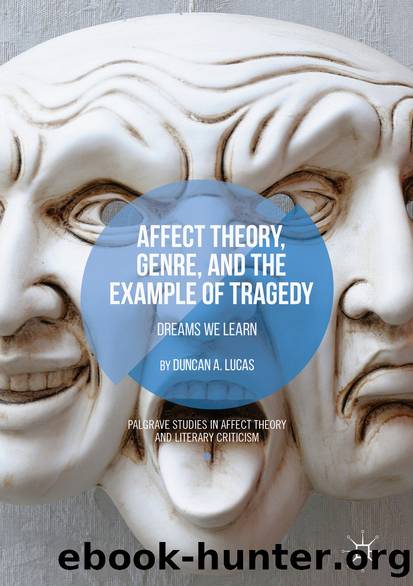
Author:Duncan A. Lucas
Language: eng
Format: epub
ISBN: 9783319948638
Publisher: Springer International Publishing
Oedipus’ Tragic Script
Turning now to the play, we can trace Oedipus’ tragic, psychological process of change from ignorance to knowledge, and from beloved ruler to reviled pharmakos , in terms of script formations. Before proceeding however, there is a disclaimer. I am not a classicist; I do not read Greek; I propose no solution to or final meaning for the drama. There is no final meaning, clearly, for more ink has been spilled on contending proofs of understanding than blood has been spilled in all tragedy. This is an exploration of the dimensions and implications of the trope of disgust in Oedipus and in tragedy. Disgust as discussed in this exposition is a modern concept and a vital affect-emotion in the psychological model here employed. If one accepts the bio-evolutionary conditions of human existence (which does not forbid theistic possibilities), then the trope of disgust can be applied to readings of disparate cultural products. As one of the five, or six, or eight broadly accepted base emotions, disgust is trans-cultural and trans-historical, as is the scripting process.2
Tomkins’ theory tells us that the affects mean nothing until scripted into and by a life’s dynamic scenes. What do we know of Oedipus’ pre-Thebes life? What does that early life tell us about his personality? Held as “greatest of the citizens” (Sophocles 1991a, 45)3 as Thebes’ tyrannus , he was raised in Corinth by loving adoptive parents whom he also loves and respects, thereby suggesting an affect-affluent childhood. From his strength and intelligence, we can reasonably assume that he is well-educated, both athletically and intellectually. When he kills Laius and his entourage, and solves the riddle of the Sphinx, Oedipus demonstrates both martial force and mental cunning, two highly valued skills in the warrior culture of Ancient Greece. In terms of affect motivations, then, along with his family affluence, there are also indicators of a “dark side” to his personality.
In one scene, Oedipus remembers his early life and an occasion when he was called a “bastard” (45) by a drunken man during a feast. Like Tomkins’ “nuclear” scene, an experience in which “a very good scene turns very bad” (1995, 376), the pleasures of a dinner gathering are deeply damaged by a humiliating insult. Though “furious,” says Oedipus, he held his “temper under for that day” (Sophocles 1991a, 45). Still, “rankled always,” he goes to the Oracle of Delphi for guidance, but he is sent away “unhonoured” (45). Worse, he is prophesied to kill his father and marry his mother. Independent scenes are now affectively connected, thus magnifying relevant negative affect-scripts: the anger evoking insult is associated with a fearful future. Given the terrifying prophecy, distress prompts remedial action, and to protect his loving, adoptive parents and himself, he abandons Corinth, his home.
During the same monologue, Oedipus also recalls an occasion when he killed a man, whom we of course know to be his birth father, Laius. Encountering Laius’ entourage at a crossroads, Oedipus is insulted and humiliated as he is ordered out
Download
This site does not store any files on its server. We only index and link to content provided by other sites. Please contact the content providers to delete copyright contents if any and email us, we'll remove relevant links or contents immediately.
4 3 2 1: A Novel by Paul Auster(12535)
The handmaid's tale by Margaret Atwood(7848)
Giovanni's Room by James Baldwin(7452)
Asking the Right Questions: A Guide to Critical Thinking by M. Neil Browne & Stuart M. Keeley(5848)
Big Magic: Creative Living Beyond Fear by Elizabeth Gilbert(5846)
Ego Is the Enemy by Ryan Holiday(5553)
The Body: A Guide for Occupants by Bill Bryson(5199)
On Writing A Memoir of the Craft by Stephen King(5012)
Ken Follett - World without end by Ken Follett(4808)
Adulting by Kelly Williams Brown(4632)
Bluets by Maggie Nelson(4630)
Eat That Frog! by Brian Tracy(4622)
Guilty Pleasures by Laurell K Hamilton(4527)
The Poetry of Pablo Neruda by Pablo Neruda(4178)
Alive: The Story of the Andes Survivors by Piers Paul Read(4091)
Fingerprints of the Gods by Graham Hancock(4073)
The Book of Joy by Dalai Lama(4056)
White Noise - A Novel by Don DeLillo(4053)
The Bookshop by Penelope Fitzgerald(3906)
