Adolfo Bioy Casares by Posso Karl.;
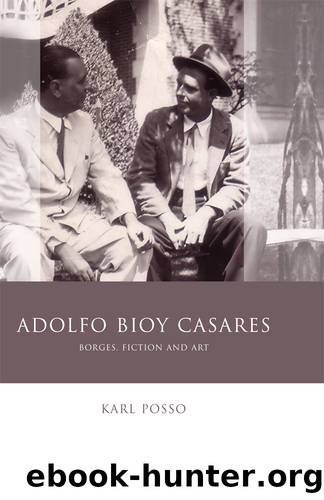
Author:Posso, Karl.;
Language: eng
Format: epub
Publisher: Book Network Int'l Limited trading as NBN International (NBNi)
The later novels: the prison of marriage
El sueño de los héroes, drenched in irony, is recounted by an intrusive narrator of almost postmodern self-consciousness. Even in the early 1950s, it was difficult to accept with a straight face the vision of Argentinian masculinity that the novel proposes. Bioyâs nostalgic evocation of the Buenos Aires of three decades earlier acts as a shelter from the authoritarian modernization of Perónâs government, refuting the âvulgarâ cultural forces that fed Peronism. The domestication Gauna undergoes at Claraâs hands may be read as a harsh critique of the elevation of women in the home promoted by Peronist legislation. The novelâs costumbrismo relegates it to being a period piece, however elegant, crippling its capacity to offer a pertinent, contemporary revision of patriarchal masculinity. The fifteen-year gap between El sueño de los héroes and Diario de la guerra del cerdo â the longest lapse between novels in Bioyâs career â testifies to his struggle in reformulating his narrative obsessions at novel length in the context of a rapidly modernizing society. The fall of Perón in 1955 failed to restore a world of caballeros and gauchos, as he had hoped: four years later, Latin America would be convulsed by Castroâs revolution in Cuba. The impact in Bioyâs inner circle was immediate: in 1961 José Bianco, the editor of Sur (âsouthâ), was forced by the publisher, Victoria Ocampo, to resign from his job after he declared his allegiance to the Cuban Revolution and travelled to Havana to judge a literary contest. The ensuing scandal âmeant the loss of cooperation of intellectuals who were closely identified with the Revolutionâ (Sorensen, 2007, p. 127), intensifying the alienation of Bioy and his conservative friends in Sur from the dominant currents in both society and literature. Bioy perceived the mass movements of the 1960s as an upsurge of disorder which, in the tradition of Rosas or Perón, threatened a barbarism that would retard âprogressâ. The paradox in this outlook, in terms of the traditional Argentinian dichotomy between âcivilizationâ and âbarbarismâ, is that the gaucho, the historical point of origin of âbarbarismâ, shrank by contrast with the rebellious young people of the era into a comfortingly domesticated image of a pastoral national history.
The two books Bioy published at the end of the 1960s, Diario de la guerra del cerdo and Memoria sobre la pampa y los gauchos, epitomize this rift. In the latter book, Bioy insists on the contemporaneity of the gaucho, refusing to consign him to a mythologized past. Bioy needed the living gaucho as a counterweight to the troubling transformation of his urban and literary worlds. Diario de la guerra del cerdo, the novel that expressed his alienation from the mood of revolt of the 1960s, struck a chord with readers who felt threatened by rebellious youth movements, becoming the biggest popular success of Bioyâs career. As in La invención de Morel and Plan de evasión, the characters of Diario de la guerra del cerdo are men immured in private constructions of
Download
This site does not store any files on its server. We only index and link to content provided by other sites. Please contact the content providers to delete copyright contents if any and email us, we'll remove relevant links or contents immediately.
The Fine Print (Dreamland Billionaires Book 1) by Lauren Asher(2548)
Fury of Magnus by Graham McNeill(2438)
The Last House on Needless Street by Catriona Ward(2382)
The Rose Code by Kate Quinn(2193)
A Little Life: A Novel by Hanya Yanagihara(2103)
Malibu Rising by Taylor Jenkins Reid(1903)
The God of the Woods by Liz Moore(1903)
Luster by Raven Leilani(1894)
Transcendent Kingdom by Yaa Gyasi(1852)
Moonflower Murders by Anthony Horowitz(1842)
The Lost Book of the White (The Eldest Curses) by Cassandra Clare & Wesley Chu(1683)
This Changes Everything by Unknown(1499)
The Midwife Murders by James Patterson & Richard Dilallo(1476)
The New Wilderness by Diane Cook(1438)
The Lying Life of Adults by Elena Ferrante(1425)
Wandering in Strange Lands by Morgan Jerkins(1415)
Written in the Stars by Alexandria Bellefleur(1391)
Ambition and Desire: The Dangerous Life of Josephine Bonaparte by Kate Williams(1383)
The Lying Life of Adults by Elena Ferrante;(1304)
