Across the Seas by Neumann Klaus;
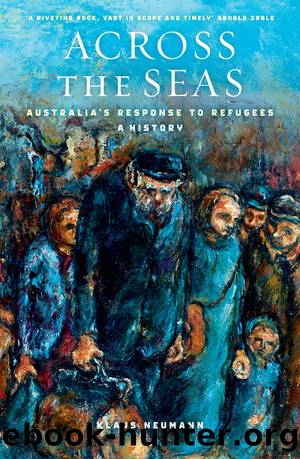
Author:Neumann, Klaus;
Language: eng
Format: epub
Publisher: Black Inc.
4
BORDER CROSSERS, EVACUEES AND POLITICAL REFUGEES
On Australia Day 1966 Harold Holt succeeded Robert Menzies as prime minister. Unlike his predecessor, Holt had a strong interest in immigration policy. For seven years, from 1949 to 1956, he had served as immigration minister under Menzies. He had overseen the continuation of the mass immigration program initiated by Arthur Calwell, but did not share Calwellâs zealous commitment to the White Australia policy. Although the High Court had upheld the Labor governmentâs Wartime Refugees Removal Act 1949, Holt did not make use of the legislation. During his tenure as immigration minister, the most famous victim of Calwellâs hardline stance, former US Army sergeant Lorenzo Gamboa, was finally able to join his wife and children; the Japanese wives of Australian servicemen, who had previously been barred from entering the country, were also allowed to settle in Australia.1 In the mid-1950s Holt oversaw tentative moves to reform the White Australia policy.2 In 1964 immigration minister Hubert Opperman made another, bolder attempt to change Australiaâs discriminatory immigration policy, but failed because Menzies was unsupportive.3
When Holt assumed the prime ministership, he immediately revisited the issue of immigration reform. In his first public statement as prime minister he foreshadowed changes to the White Australia policy to make room for what he called a âspirit of humanityâ.4 He had the support not only of Opperman, but also of the secretary of the Department of Immigration, Peter Heydon. A few days before Menziesâ departure, Opperman met with Heydon and other senior departmental officials to map out a plan for reforms. The public servants were impatient to act; according to Heydon, Opperman felt the need to caution them that âwe must not appear to have been waiting for the old man to goâ.5 On 2 March 1966 Cabinet agreed to significant changes to the White Australia policy, which paved the way for its abolition seven years later. The decision was also a response to a shift in public opinion: by 1966 the majority of Australians wanted to see a liberalisation of the policy.6
After the end of the Menzies era, Australia continued to resettle European refugees. During Holtâs prime ministership, however, the numbers were comparatively small. In a paper published in 1965, Heydon observed: âWhat is called the problem of the âoldâ refugees in Europe has virtually been solved. Apart from residual problem cases and a trickle of refugees, the camps are almost empty.â7 That was not to say that large populations of displaced people were a problem of the past. According to the UNHCR, in 1965 there were some 850,000 refugees in Africa alone.8 Overall, however, in the mid-1960s there were far fewer displaced people globally than there were in the second half of the 1940s â or in the first half of the 2010s, for that matter.
From the 1960s Australia had to contend with growing expectations that it would resettle non-European refugees. Beginning in the middle of the decade, Vietnam emerged as the most obvious country of origin of such people.
Download
This site does not store any files on its server. We only index and link to content provided by other sites. Please contact the content providers to delete copyright contents if any and email us, we'll remove relevant links or contents immediately.
The Secret History by Donna Tartt(19098)
The Social Justice Warrior Handbook by Lisa De Pasquale(12195)
Thirteen Reasons Why by Jay Asher(8916)
This Is How You Lose Her by Junot Diaz(6892)
Weapons of Math Destruction by Cathy O'Neil(6283)
Zero to One by Peter Thiel(5805)
Beartown by Fredrik Backman(5763)
The Myth of the Strong Leader by Archie Brown(5511)
The Fire Next Time by James Baldwin(5452)
How Democracies Die by Steven Levitsky & Daniel Ziblatt(5223)
Promise Me, Dad by Joe Biden(5156)
Stone's Rules by Roger Stone(5089)
A Higher Loyalty: Truth, Lies, and Leadership by James Comey(4965)
100 Deadly Skills by Clint Emerson(4929)
Rise and Kill First by Ronen Bergman(4793)
Secrecy World by Jake Bernstein(4755)
The David Icke Guide to the Global Conspiracy (and how to end it) by David Icke(4721)
The Farm by Tom Rob Smith(4516)
The Doomsday Machine by Daniel Ellsberg(4492)
