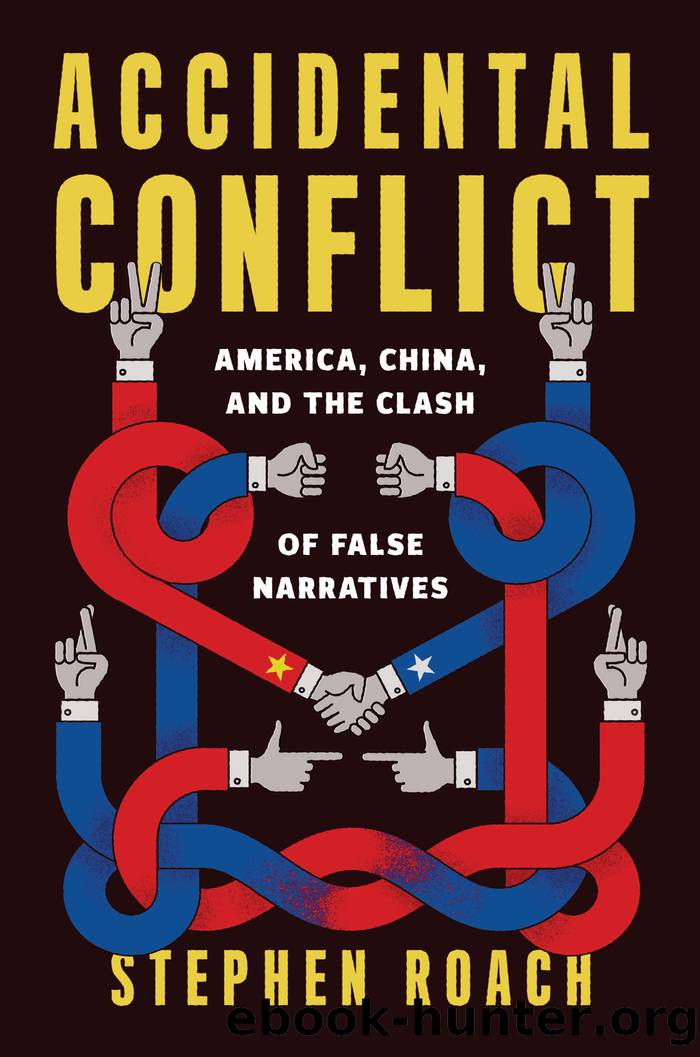
Accidental Conflict by Stephen Roach;
Author:Stephen Roach;
Language: eng
Format: epub
Publisher: Yale University Press
Published: 2022-05-15T00:00:00+00:00
China as a Premature Leader
China is most assuredly a major country. But is it truly ready for global leadership, as its new model of major country relationships seems to presume?
To an important extent, the answer to this question goes back to Chinaâs scale fixation that I stressed in the previous chapter. In making the case for a new relationship, Chinaâs senior leaders seem to be conflating the absolute size of their economy with leadership clout. This makes sense on one level: the larger the economy, the greater its capacity for outlays on military expenditures, foreign direct investment, foreign aid, import demand, consumer spending, and other forms of global power projection. But there is more to clout than scale alone.
As a proxy for the power projection associated with global leadership, military spending is obviously of special significance. In 2020, Chinaâs defense budget was reported to be just 1.7 percent of GDP, far short of the United Statesâ 3.7 percent share.16 But with dollar-based estimates of Chinese GDP on a trajectory to converge with the United States around 2030, the defense spending gap is expected to narrow even if the disparity in the GDP shares of military spending remains wide. This is exactly what has happened over the past fifteen years. Chinaâs defense outlays, despite consistently being a much smaller share of its GDP, rose in US dollar terms from nearly 8 percent of Americaâs total in 2005 to 33 percent by 2020.17
In purchasing-power parity (PPP) terms, a more meaningful metric in many respects, the convergence has been even more dramatic. As we have seen, in large part this is because PPP-based Chinese GDP actually surpassed that of the United States in 2016. As a result, by 2020, despite the significant disparity in the defense spending shares of US and Chinese nominal GDP, the dollar volume of Chinaâs military budget had risen to 54 percent of that in the United States in PPP termsâfully 1.7 times the current-dollar differential of 33 percent.18
With Chinaâs defense spending second only to that of the United States and greater in US dollar terms than the combined defense expenditures of India, Russia, Japan, South Korea, and Taiwan, there can be little doubt of its ascendancy as a global military power.19 In a break from the quantity emphasis that dominates most aspects of Chinaâs ascendancy, here its leaders have also focused on quality. Xi Jinping has long emphasized an information-based modernization of the Peopleâs Liberation Army, drawing heavily on Chinaâs growing AI capabilities. The PLAâs stunning recent progress in the new technologies of modern warfare, from stealth aircraft and laser targeting to breakthroughs in space exploration and, according to recent reports, hypersonic weaponry, dovetails with Xiâs focus on improving the quality of Chinaâs defense capabilities.20
Moreover, there is a consensus that official statistics on Chinese military outlays significantly understate the full extent of the nationâs defense spending. Among other things, they leave out paramilitary forces charged with internal security, the coast guard, and the increasingly impressive Chinese space program.21
Download
This site does not store any files on its server. We only index and link to content provided by other sites. Please contact the content providers to delete copyright contents if any and email us, we'll remove relevant links or contents immediately.
| Arms Control | Diplomacy |
| Security | Trades & Tariffs |
| Treaties | African |
| Asian | Australian & Oceanian |
| Canadian | Caribbean & Latin American |
| European | Middle Eastern |
| Russian & Former Soviet Union |
The Secret History by Donna Tartt(19090)
The Social Justice Warrior Handbook by Lisa De Pasquale(12190)
Thirteen Reasons Why by Jay Asher(8912)
This Is How You Lose Her by Junot Diaz(6887)
Weapons of Math Destruction by Cathy O'Neil(6281)
Zero to One by Peter Thiel(5802)
Beartown by Fredrik Backman(5755)
The Myth of the Strong Leader by Archie Brown(5508)
The Fire Next Time by James Baldwin(5446)
How Democracies Die by Steven Levitsky & Daniel Ziblatt(5219)
Promise Me, Dad by Joe Biden(5154)
Stone's Rules by Roger Stone(5088)
A Higher Loyalty: Truth, Lies, and Leadership by James Comey(4964)
100 Deadly Skills by Clint Emerson(4926)
Rise and Kill First by Ronen Bergman(4789)
Secrecy World by Jake Bernstein(4753)
The David Icke Guide to the Global Conspiracy (and how to end it) by David Icke(4720)
The Farm by Tom Rob Smith(4514)
The Doomsday Machine by Daniel Ellsberg(4490)
