A Rightful Place by Noel Pearson
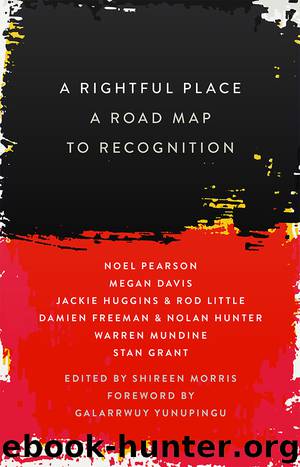
Author:Noel Pearson
Language: eng
Format: epub
Publisher: Schwartz Publishing Pty. Ltd
Ethical loneliness and the injustice of not being heard
The culmination of the Referendum Council’s dialogues with Aboriginal and Torres Strait Islander peoples was the national constitutional convention at Uluru. This meeting did not seek to revisit the work that had been done by the thirteen dialogues in thirteen regions but to endorse the reforms most supported by Aboriginal and Torres Strait Islander peoples. These reforms were: Voice, Treaty and Truth. They include a constitutionally enshrined First Nations voice whose functions are to be left to the parliament but would involve the supervision of section 51(xxvi) and section 122 of the Constitution, and the creation of a Makarrata Commission by legislation and truth-telling – localised truth-telling on a First Nations basis.
The Uluru Statement is a lengthy document that includes the Uluru Statement from the Heart, and a synthesis of the dialogues’ work involving a historical narrative called Our Story, and the model for reform. On 26 May 2017 only the first page, the Uluru Statement from the Heart, was released. It was released as a declaration to the Australian people. Seeking to avoid the heart-wrenching process of engaging our nation’s leaders, who shelve such important documents, the Uluru convention decided to engage the hearts and minds of the Australian people, because it is they who understand the current climate of policy inertia and it is they who ultimately can change the Constitution’s text.
However, some commentators and politicians reacted instantaneously, without waiting for the Referendum Council’s report or the full account of the Uluru Statement and the explanation behind it. Frank Brennan, for example, whose public writings show a predisposition to the minimalist recognition that was overwhelmingly rejected by the dialogues, critiqued the Uluru Statement four days after it was delivered, in the 2017 Lowitja Oration, without waiting to read the Referendum Council’s report and the reasoning for the statement.4 His response was based on the one-page Uluru Statement from the Heart, and prematurely argued for the form the body should take.
Like Brennan, Senator Barnaby Joyce also reacted without waiting for the report.5 He argued that Uluru advocated a ‘third’ chamber of parliament and that this would not work. This misconstrues what is being proposed – it is not a third chamber of parliament.
The failure to pause and reflect on the Uluru Statement and the unwillingness to wait for a detailed explanation to make an informed assessment is not uncommon in the contemporary era where, as Danielle Celermajer puts it, ‘increasingly we become constitutionally ill-disposed to that slow work of listening, reflecting, deliberating’.6 Similarly, Scott Stephens has argued:
With the rise of instantaneous, ‘as it happened’ news coverage, events get fragmented into pieces that the audience then impressionistically reassembles to fit their pre-judgments. But time is precisely what you need to think of things that are new – things that exceed the conventional wisdom.7
Download
This site does not store any files on its server. We only index and link to content provided by other sites. Please contact the content providers to delete copyright contents if any and email us, we'll remove relevant links or contents immediately.
| Anthropology | Archaeology |
| Philosophy | Politics & Government |
| Social Sciences | Sociology |
| Women's Studies |
The Secret History by Donna Tartt(19097)
The Social Justice Warrior Handbook by Lisa De Pasquale(12194)
Thirteen Reasons Why by Jay Asher(8915)
This Is How You Lose Her by Junot Diaz(6891)
Weapons of Math Destruction by Cathy O'Neil(6283)
Zero to One by Peter Thiel(5805)
Beartown by Fredrik Backman(5763)
The Myth of the Strong Leader by Archie Brown(5511)
The Fire Next Time by James Baldwin(5452)
How Democracies Die by Steven Levitsky & Daniel Ziblatt(5221)
Promise Me, Dad by Joe Biden(5155)
Stone's Rules by Roger Stone(5089)
A Higher Loyalty: Truth, Lies, and Leadership by James Comey(4965)
100 Deadly Skills by Clint Emerson(4929)
Rise and Kill First by Ronen Bergman(4793)
Secrecy World by Jake Bernstein(4755)
The David Icke Guide to the Global Conspiracy (and how to end it) by David Icke(4721)
The Farm by Tom Rob Smith(4516)
The Doomsday Machine by Daniel Ellsberg(4492)
