A Redder Shade of Green by Angus Ian;
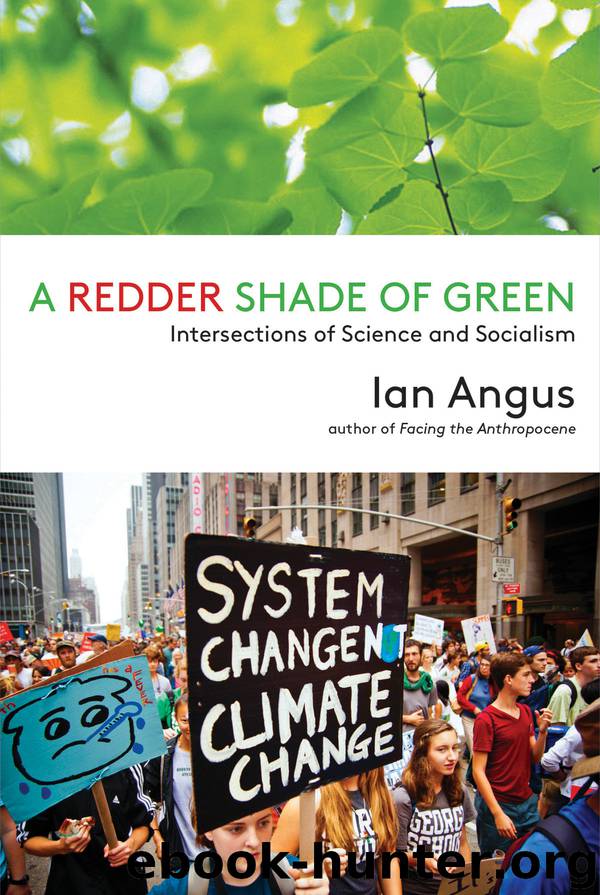
Author:Angus, Ian;
Language: eng
Format: epub
Publisher: Monthly Review Press
Published: 2017-04-07T04:00:00+00:00
1. Populationism identifies an important issue. Some writers on the left have tried to refute populationism by denying that population growth poses any social, economic, or ecological concerns. Such arguments ignore the fact that human beings require sustenance to live, and that unlike other animals, we don’t just find the necessities of life, we use the earth’s resources to make them.
There is a direct relationship between the number of people on earth and the amount of food required to sustain them. That’s a fundamental fact of material existence, one that no society can possibly escape. Socialist planning will have to consider population as an important factor in determining what will be produced, and how.
The populationists’ error is not that they see the number of people as important, but that they assume that there is no alternative to society’s present ways of organizing production and distributing products. In the case of food, they assume that the only way to feed the world’s hungry people is to grow more food. Since modern agriculture is ecologically destructive—which it certainly is—feeding more people will cause more destruction, so the only ecologically sound approach is to stop and reverse population growth.
But, as we show in Too Many People?, ecologically sound agriculture can produce more than enough food to feed the expected population growth.
Existing food production is in fact more than enough to feed many more people. Just by reducing the food wasted or misused in rich countries to reasonable levels, we could feed billions more people. Or, if population doesn’t grow as much as expected, we could help reduce greenhouse gas emissions by reforesting excess farmland.
But such changes will require long-term global planning and coordinated action, which capitalism cannot do.
One of the major tasks facing a post-capitalist society will be to confront and resolve the gross imbalance that capitalism has created between resources and human needs. And that won’t be a one-time task. The relationship between human needs and the resources and ecological services needed to meet them will constantly change, and so the need to monitor and adjust will be constant as well. We can’t possibly ignore population as a factor in this.
Populationists are right that human numbers must be considered, but they are wrong to blame the imbalance between human needs and resources solely or primarily on human numbers, and they are wrong about the measures needed to solve it.
Download
This site does not store any files on its server. We only index and link to content provided by other sites. Please contact the content providers to delete copyright contents if any and email us, we'll remove relevant links or contents immediately.
| Anthropology | Archaeology |
| Philosophy | Politics & Government |
| Social Sciences | Sociology |
| Women's Studies |
The Secret History by Donna Tartt(19351)
The Social Justice Warrior Handbook by Lisa De Pasquale(12248)
Thirteen Reasons Why by Jay Asher(9032)
This Is How You Lose Her by Junot Diaz(6982)
Weapons of Math Destruction by Cathy O'Neil(6381)
Zero to One by Peter Thiel(5888)
Beartown by Fredrik Backman(5870)
The Myth of the Strong Leader by Archie Brown(5568)
The Fire Next Time by James Baldwin(5534)
How Democracies Die by Steven Levitsky & Daniel Ziblatt(5284)
Promise Me, Dad by Joe Biden(5200)
Stone's Rules by Roger Stone(5143)
A Higher Loyalty: Truth, Lies, and Leadership by James Comey(5027)
100 Deadly Skills by Clint Emerson(4981)
Rise and Kill First by Ronen Bergman(4852)
Secrecy World by Jake Bernstein(4816)
The David Icke Guide to the Global Conspiracy (and how to end it) by David Icke(4787)
The Doomsday Machine by Daniel Ellsberg(4572)
The Farm by Tom Rob Smith(4565)
