A Gateway to the Kabbalah by Rabbi Wernick Eugene A.;
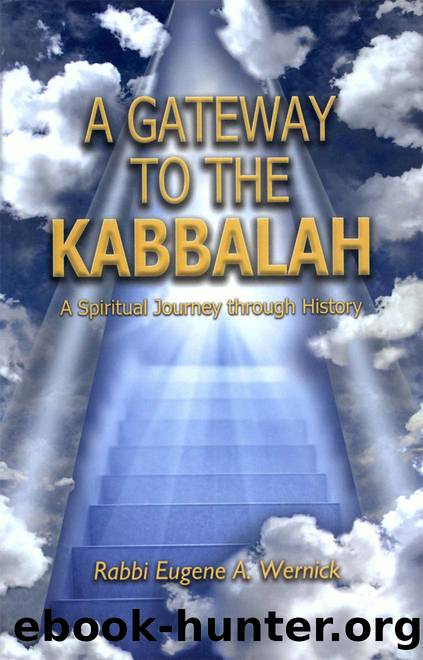
Author:Rabbi Wernick, Eugene A.;
Language: eng
Format: epub
ISBN: 4578332
Publisher: United Synagogue of Conservative Judaism
NOTES
1. See Scholem, Major Trends, 127.
2. Temurah is done easily in Hebrew, because the twenty-two letters of the alphabet are treated as consonants. The most used system of temurah is âATBASH,â in which the first letter is changed to the twenty-second letter, the second letter is changed to the twenty-first letter, and so on. See Fred Skolnik and Michael Berenbaum, eds., Encyclopaedia Judaica, 2nd edition, vol. 7 (New York: Macmillan Reference USA and Jerusalem: Keter Publishing, 2007), âGematria,â 424â447.
3. See Scholem, Major Trends, 138â144.
4. Ibid., 139.
5. A Bodhisattva (a being who has attained the high degree of spiritual perfection immediately below that of a Buddha) is the basis of countless magic forms. By the power generated in a state of perfect concentration of mind, he may at one and the same time show a phantomâthe tulpa (written âsprulpaâ)âof himself in thousands of millions of worlds. He may create not only human forms, but any forms he chooses, even those of inanimate objects. The theory sanctioned in these lines by the highest authority of official Lamaism is identical with that expounded in the Mahayanist literature, where it is said that an accomplished Bodhisattva is capable of effecting ten kinds of magic creations. The power of producing magic formations, tulkus, or less lasting and materialized tulpas, does not, however, belong exclusively to such mystic exalted beings. Any human, divine, or demoniac being may be possessed of it. The only difference comes from the degree of power, and this depends on the strength of the concentration and the quality of the mind itself. See Alexandra David-Néel, Magic and Mystery in Tibet (London: John Lane Company, 1931), 115.
6. See Moshe Idel, The Mystical Experience in Abraham Abulafia, trans. Jonathan Chipman (Albany, New York: SUNY Press, 1988), 179â227, for a full exposition of sexual imagery in the works of Abulafia.
7. Imbibing from Rabbi Eleazar of Worms the use of gematria and notarikon, Abulafia assumed the pen name of Raziel (âsecrets of Godâ), which is the same sum of the Hebrew letters as in the name Abraham. He then replaces and adds letters and gets from the sum of his calculations of the name Abraham the word for limbs in Hebrew (aivarim), which is 248; this is, according to tradition, the number of positive commandments found in the Torah. Since Abraham was the reputed author of Sefer Yetsirah, Abulafia asserts that this is the key to the fundamentals of the Jewish faith. See Amnon Gross, ed., Mâtzaref HaSekhel vâSefer HaOt (Jerusalem: Aharon Barzoni and Son, 2001), http://www.hebrewbooks.org/49748; printed from manuscripts from Hebrew University.
8. See Scholem, op. cit., 146â155. Translated from a manuscript, this is an intimate description of the rapture of an anonymous student of Abulafia. It is well worth the reading for an inside account of the achievement of what Abulafia taught. See also Idel, The Mystical Experience.
Download
This site does not store any files on its server. We only index and link to content provided by other sites. Please contact the content providers to delete copyright contents if any and email us, we'll remove relevant links or contents immediately.
Professional Troublemaker by Luvvie Ajayi Jones(29668)
Empire of the Sikhs by Patwant Singh(23089)
Twilight of the Idols With the Antichrist and Ecce Homo by Friedrich Nietzsche(18638)
Plagued by Fire by Paul Hendrickson(17416)
The Sun and Her Flowers by Rupi Kaur(14526)
Norse Mythology by Gaiman Neil(13372)
A Journey Through Charms and Defence Against the Dark Arts (Harry Potter: A Journey Throughâ¦) by Pottermore Publishing(9276)
Fangirl by Rainbow Rowell(9259)
Adultolescence by Gabbie Hanna(8929)
Wonder by R.J. Palacio(8584)
Tools of Titans by Timothy Ferriss(8402)
Becoming Supernatural by Dr. Joe Dispenza(8223)
How to Bang a Billionaire by Alexis Hall(8160)
Wonder by R. J. Palacio(8115)
Crystal Healing for Women by Mariah K. Lyons(7932)
The Road Less Traveled by M. Scott Peck(7605)
The Lost Art of Listening by Michael P. Nichols(7507)
The Witchcraft of Salem Village by Shirley Jackson(7277)
The Institute by Stephen King(7043)
