The Loud Minority by Daniel Q. Gillion
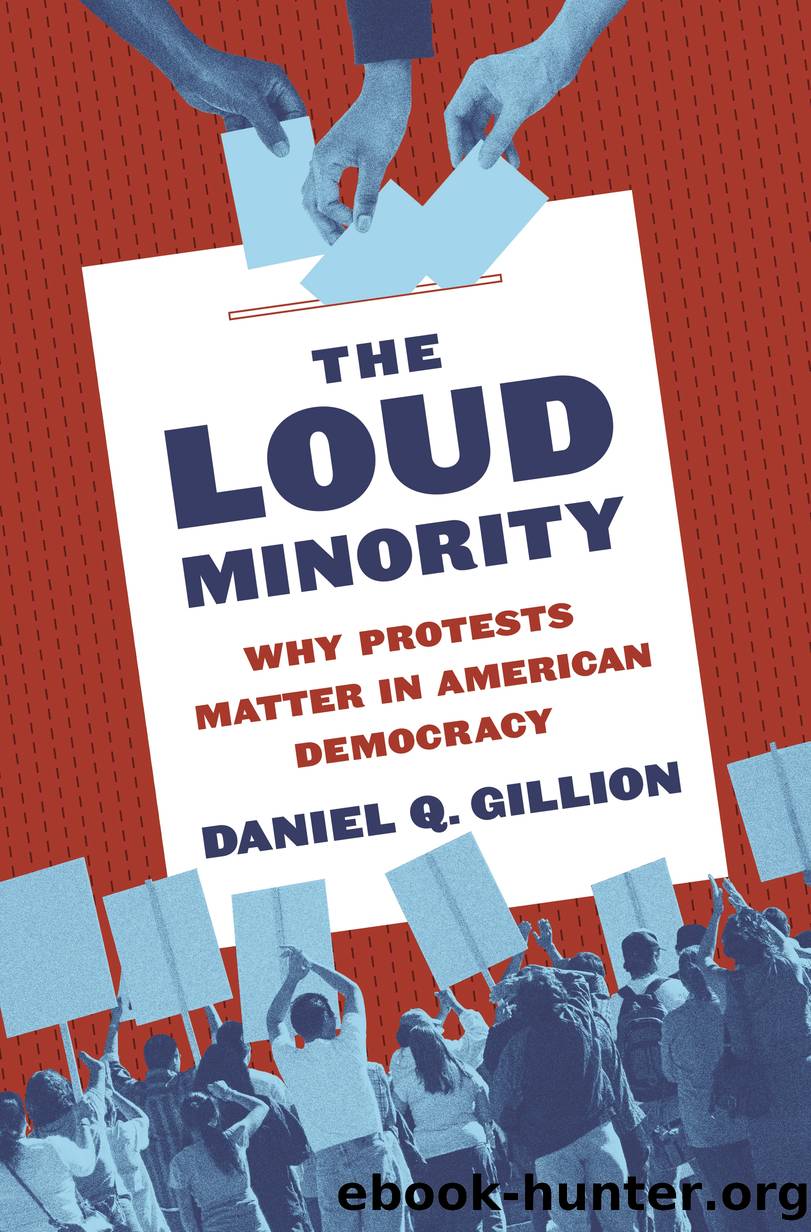
Author:Daniel Q. Gillion
Language: eng
Format: epub
Publisher: Princeton University Press
Published: 2020-01-06T00:00:00+00:00
Why Protests Are Moneymaking Endeavors for Political Campaigns
Local protests work to influence campaign contributions on two fronts. First, political activism provides a source of mobilization for citizens’ engagement generally. Those who are closest to the protests are more likely to be aware of and interested in the issue that activists are addressing because it affects them directly. These informational cues can heighten political interest and make local citizens ideal donors. Political interest in and knowledge of an issue can even be powerful enough to overshadow the consideration of the financial resources that citizens actually have to give to a party (Grant and Rudolph 2002). While the entire nation may be aware of a given protest taking place in a specific area, those who are closest in proximity to it are more likely to be swayed to political action.
On the second front, ideological protest at the local level offers some sense of directionality for what type of candidate citizens should support. Citizens give to obtain personal benefits that can come in the form of material gains, but donations can also be a way to express solidarity with individuals aiding like-minded politicians (Wilson 1973). Similarly, interest groups are more likely to donate money to candidates who share their ideology (Poole and Romer 1985, 65). In this atmosphere, ideological protests provide a guiding light for how individuals should give. They highlight the importance of an issue as well as sound the alarm of urgency for voters to support Democratic candidates during liberal protests and Republican politicians amid periods of heightened conservative protest. These ideological protests also strengthen the link between voters and their preferred candidates. When candidates have strong ideological connections to contributors, the chances of soliciting donations through less traditionally successful means, such as direct mail and telemarketing, increases (Brown, Powell, and Wilcox 1995).
Although local protest is especially effective in motivating individuals to become involved in politics, citizens’ financial support does not necessarily go to the politicians who represent the area in which protest occurs. As a matter of fact, political candidates often receive the bulk of their campaign contributions from citizens who do not reside in their district—by a margin of two to one (Gimpel, Lee, and Pearson-Merkowitz 2008). Political protest spurs giving that can be directed to any political candidate who citizens see advocating for the ideological positions expressed by protesters. A shared ideological link between citizens and political campaigns is a strong impetus for individuals to donate to particular candidates (Barber, Canes-Wrone, and Thrower 2016). This link can move beyond the geographic confines of a congressional district and be shared with protesters from miles away.
Further, to elicit donations, candidates’ positions do not need to match the ideology of campaign donors issue for issue. This is where the party of a political candidate becomes influential, serving as an ideological calling card for the voting public. Liberal voters, inspired by liberal protests, anticipate that their dollars will be better spent on Democratic politicians; Democrats are perceived to be more credible than Republicans when addressing the liberal issues voiced by demonstrators.
Download
This site does not store any files on its server. We only index and link to content provided by other sites. Please contact the content providers to delete copyright contents if any and email us, we'll remove relevant links or contents immediately.
| Anthropology | Archaeology |
| Philosophy | Politics & Government |
| Social Sciences | Sociology |
| Women's Studies |
The Secret History by Donna Tartt(19481)
The Social Justice Warrior Handbook by Lisa De Pasquale(12301)
Thirteen Reasons Why by Jay Asher(9135)
This Is How You Lose Her by Junot Diaz(7077)
Weapons of Math Destruction by Cathy O'Neil(6489)
Zero to One by Peter Thiel(5956)
Beartown by Fredrik Backman(5954)
The Myth of the Strong Leader by Archie Brown(5633)
The Fire Next Time by James Baldwin(5599)
How Democracies Die by Steven Levitsky & Daniel Ziblatt(5339)
Promise Me, Dad by Joe Biden(5239)
Stone's Rules by Roger Stone(5197)
A Higher Loyalty: Truth, Lies, and Leadership by James Comey(5092)
100 Deadly Skills by Clint Emerson(5035)
Rise and Kill First by Ronen Bergman(4914)
Secrecy World by Jake Bernstein(4899)
The David Icke Guide to the Global Conspiracy (and how to end it) by David Icke(4858)
The Doomsday Machine by Daniel Ellsberg(4633)
The Farm by Tom Rob Smith(4614)
