The Day the World Stops Shopping by J.B. MacKinnon
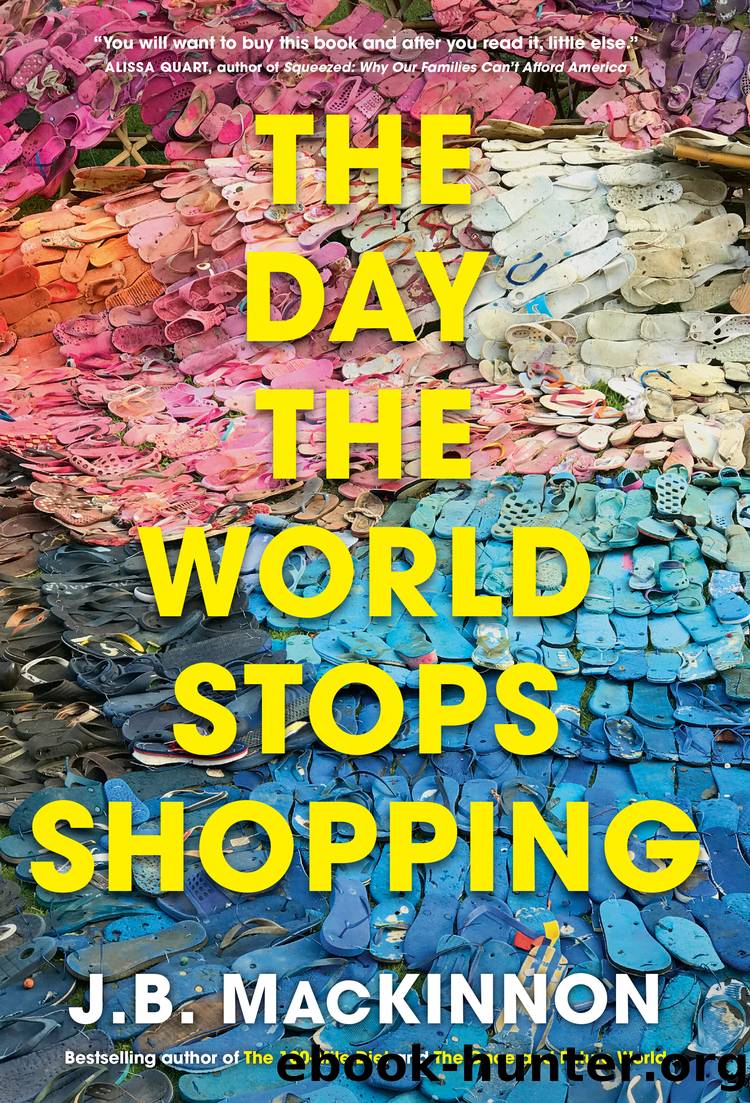
Author:J.B. MacKinnon [Mackinnon, J.B.]
Language: eng
Format: epub
Publisher: Random House of Canada
Published: 2021-05-18T00:00:00+00:00
* * *
â
If fast fashion must fall in a world without shopping, that doesnât mean it would disappear completely. Already, there are hints of what it could become.
Trove, when I visited its global headquarters, was as stereotypical a start-up as you could care to find. It is stationed in a small industrial park wedged between an artificial lagoon and the Bayshore Freeway in the outer orbit of San Francisco. Actual vultures sometimes circled overhead. Andy Ruben, Troveâs founder, seemed to know every employee on the warehouse floor by nameâthough in American bizspeak, we werenât in a warehouse. We were in a Fulfillment Center.
For ten years, Ruben was a wunderkind executive at Walmartâin his own words, the âbelly of the beastâ of consumer culture. As a trailbreaker in sustainability in the worldâs largest retailer, he saw how difficult it was to change the way we consume. He promoted energy-efficient lightbulbs, only to watch the number of bulbs in the typical American home nearly double from thirty-five to more than sixty. He saw that you could offer a long-lasting power drill instead of a made-to-break power drill, but that did not address the inherent wastefulness of having millions of American households own drills, many of them hardly ever put to use. âIt was always three steps forward, sometimes two back, sometimes four,â he told me.
He left Walmart with a specific goal: to reduce new product purchasing by 25 percent. He wanted the world to stop one-quarter of its shopping.
His current business, Trove, works behind the scenes. âIf you cut through everything Iâve learned, again and again itâs friction. If things are too hard, they donât work,â Ruben said. The companyâs clients, such as Nordstrom, Leviâs, Patagonia, REI, and womenâs clothing company Eileen Fisher, work with Trove to build systems that make it easy for customers to bring back products they no longer want. These are shipped to Trove for inspection, cleaning and repair, and go back on sale at a discount through the brandsâ websites and stores.
Despite a lot of hype, the second-hand apparel market remains small: less than 10 percent overall, and thatâs including clothing rental. Still, itâs a thirty-billion-dollar business, and growingâit was one of the industries that increased sales during the pandemic. Reselling clothes is not a new concept, of course. What is new is this: thereâs nothing âusedâ or âsecond-handâ feeling about the goods passing through Trove. The warehouse does not have that thrift-store smell. Itâs another lesson in todayâs consumer culture: clothes now pass through our lives so fleetingly that the difference between second-hand and new is often vanishingly thin.
The brands Trove works with have high standards: Eileen Fisher, for example, would only resell clothes that were in âperfect condition,â without a hint of visible stains, holes or other signs of wear. That was more than half of what they were getting back. Many of the products that come to Trove still have their shop tagsâto call them âusedâ is actually a misnomer. Americaâs closets and basements,
Download
This site does not store any files on its server. We only index and link to content provided by other sites. Please contact the content providers to delete copyright contents if any and email us, we'll remove relevant links or contents immediately.
The Brazilian Economy since the Great Financial Crisis of 20072008 by Philip Arestis Carolina Troncoso Baltar & Daniela Magalhães Prates(338064)
International Integration of the Brazilian Economy by Elias C. Grivoyannis(111491)
The Art of Coaching by Elena Aguilar(53520)
Flexible Working by Dale Gemma;(23337)
How to Stop Living Paycheck to Paycheck by Avery Breyer(19806)
Thinking, Fast and Slow by Kahneman Daniel(12473)
The Acquirer's Multiple: How the Billionaire Contrarians of Deep Value Beat the Market by Tobias Carlisle(12407)
The Radium Girls by Kate Moore(12130)
The Art of Thinking Clearly by Rolf Dobelli(10661)
Hit Refresh by Satya Nadella(9219)
The Compound Effect by Darren Hardy(9109)
Tools of Titans by Timothy Ferriss(8538)
Atomic Habits: Tiny Changes, Remarkable Results by James Clear(8469)
Turbulence by E. J. Noyes(8158)
A Court of Wings and Ruin by Sarah J. Maas(8039)
Change Your Questions, Change Your Life by Marilee Adams(7889)
Nudge - Improving Decisions about Health, Wealth, and Happiness by Thaler Sunstein(7801)
How to Be a Bawse: A Guide to Conquering Life by Lilly Singh(7580)
Win Bigly by Scott Adams(7298)
