Tackling Poverty and Social Exclusion: Promoting Social Justice in Social Work by Pierson John H
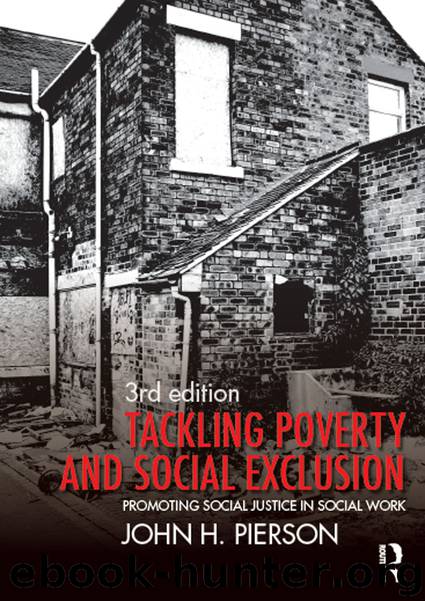
Author:Pierson, John H.
Language: eng
Format: epub
ISBN: 978-1-317-80306-5
Publisher: Taylor & Francis Ltd
Personal budgets and adult social care practice
Such evaluations highlight the complexities for practitioners and adult care coordinators implementing PBs within an inclusionary practice. One study found that on most measures there were no differences in working patterns between care managers with and those without PB holders on their caseload. However, the results do show that – contrary to expectations – more time was spent assessing needs, and that more time generally was required for support planning activities.
There is also some risk in relation to older people with dementia, a group that suffers high rates of financial abuse and exploitation. While the Mental Capacity Act of 2005 offered safeguards when an individual lacks capacity, those who are mildly confused, less vigilant or otherwise vulnerable were not so protected. While there are powers available to the police, the Court of Protection and the Benefits Agency to block the unsuitable and unscrupulous from having influence over a personal budget, in general social workers need to be alert to signs of financial abuse, with regular financial reviews that would highlight inconsistencies in spending (Manthorpe and Samsi 2013).
Moreover, personal budgets when fully rolled out could threaten collective models of social care. For example, an older person living in a housing with care scheme may not choose to spend their individual budget with the scheme’s care provider, thus undermining the funding for this core service – a service from which all the residents in the scheme benefit because of the peace of mind that an in situ carer on the premises provides (Blood 2013). This is the classic ‘free-rider’ dilemma: an individual benefits from an asset that others are paying for – and by not contributing thereby undermining the provision of that asset.
REFLECT AND DECIDE: THE IMPACT OF PERSONAL BUDGETS ON SERVICES
if no one tells you what the budget is or what you can do and what – how, you know what I mean, and if that’s in the budget to cover… no one gives you the information. If you ask for it, they say, ‘We don’t know’.
(Rabiee and Glendinning 2014: 7)
I don’t like complaining. And I won’t complain unless I have to complain… I’ll put up with it. I’m not, you know – I don’t want to cause any trouble, like, you know… But it sometimes – it annoys my husband sometimes, but it can’t be helped… I just go with the flow. It makes it easier, makes it simpler.
(ibid.: 8)
What actions should the practitioner take in response to such statements from users? What practice guidelines would need to be drawn up to ensure there is a balance between individual rights to an individual budget and collective arrangements for social care – that the former would not undermine the latter?
Download
This site does not store any files on its server. We only index and link to content provided by other sites. Please contact the content providers to delete copyright contents if any and email us, we'll remove relevant links or contents immediately.
| Anthropology | Archaeology |
| Philosophy | Politics & Government |
| Social Sciences | Sociology |
| Women's Studies |
The Secret History by Donna Tartt(19377)
The Social Justice Warrior Handbook by Lisa De Pasquale(12265)
Thirteen Reasons Why by Jay Asher(9054)
This Is How You Lose Her by Junot Diaz(7004)
Weapons of Math Destruction by Cathy O'Neil(6409)
Zero to One by Peter Thiel(5897)
Beartown by Fredrik Backman(5878)
The Myth of the Strong Leader by Archie Brown(5587)
The Fire Next Time by James Baldwin(5542)
How Democracies Die by Steven Levitsky & Daniel Ziblatt(5295)
Promise Me, Dad by Joe Biden(5208)
Stone's Rules by Roger Stone(5155)
A Higher Loyalty: Truth, Lies, and Leadership by James Comey(5043)
100 Deadly Skills by Clint Emerson(4993)
Rise and Kill First by Ronen Bergman(4862)
Secrecy World by Jake Bernstein(4825)
The David Icke Guide to the Global Conspiracy (and how to end it) by David Icke(4797)
The Doomsday Machine by Daniel Ellsberg(4583)
The Farm by Tom Rob Smith(4574)
