Suspect Communities by Nicole Nguyen
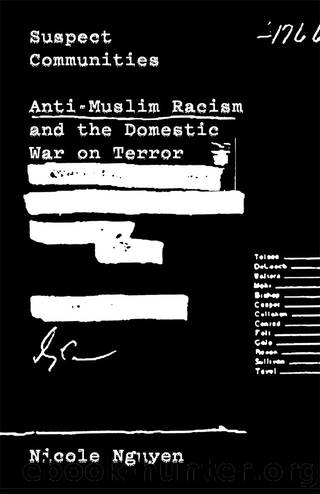
Author:Nicole Nguyen [Nguyen, Nicole]
Language: eng
Format: epub
Tags: SOC031000 Social Science / Discrimination & Race Relations, POL012000 Political Science / Security (national & International), POL004000 Political Science / Civil Rights, SOC004000 Social Science / Criminology
ISBN: 9781517906405
Publisher: University of Minnesota Press
Published: 2019-10-29T07:00:00+00:00
As these demands indicate, the Young Muslim Collective called on Youthprise to make amends for its past harm and to sever all ties with CVE funding, government organizations, and programs. Although some community leaders viewed CVE as a community-led strategy to protect children from terrorist influences, the Young Muslim Collective argued that CVE reaffirmed harmful anti-Muslim narratives and reinforced the criminalization of Black Muslims.
Although federal policymakers have partnered with Muslim leaders and organizations capable of legitimizing local CVE programming, communities often have contested these collaborations. To incentivize participation in this charged context, federal policymakers have rewarded Muslim leaders with additional funds, job promotions, and public appraisals. Minneapolis CVE practitioner Abdimalik Mohamed, for example, rose from program director of a community organization to community outreach specialist for the U.S. Attorneyâs Office to community engagement specialist for DHS. Through their public objections, anti-CVE organizers criticized Muslim leaders like Mohamed for collaborating with federal law enforcement officials, advancing the criminalization of their communities, and personally benefiting from these collaborations. Despite these community contestations, federal policymakers used select Muslim leaders and organizations to portray CVE as a âcommunity-led and -sourcedâ national security strategy. Some Muslim leaders like Mahdi agreed to advance CVE both for personal gains and to protect children from terrorist recruitment.
In this controversial context, Elmi indicted the U.S. security state for stoking social conflict to maintain its power and authority. Rather than contribute to their âinternal destructionâ that only strengthened the U.S. security state, Elmi urged the Somali community to unite in the fight to âstop the governmentâ and guard against âdeceptive solutions.â In his own organizing, Elmi sought to reveal how the U.S. security state used community concerns about past abuses to offer CVE as a viable alternative and conscript Muslims into carrying out its daily operations.
Elmiâs advice follows previous Muslim civic engagement in the United States, which refused to conform to the prevailing interests of the U.S. political establishment. In the 1990s, for example, Muslim leaders âchallenge[d] dominant views seeking to marginalize and stigmatize their constituency and instead assert[ed] counter-narratives that uplift the experiences of an otherwise voiceless minority communityâ (Al-Arian and Kanjwal 2014, para. 9). This political engagement unfolded in a âpiecemeal fashion and largely on the communityâs own terms, which necessarily meant that certain doors were closed to particular groups who carried the unfortunate baggage of representing a community with policy concerns that often conflicted with the accepted line inside the DC beltwayâ (para. 9). In this context, Muslim leaders advanced a more progressive political project, sometimes generating fierce opposition from the political establishment.
After September 11, Muslim institutions in the United States âsought to expand their cooperation with the American political establishment, confront the dominant narrative on Islam and Muslims, and build bridges with other communitiesâ (Al-Arian and Kanjwal 2014, para. 11). Because domestic and foreign operations work together to advance U.S. empire, Muslim leaders were âforced to sync with a highly contested set of foreign policy positions while contending with the rise of a new national security culture at homeâ (para.
Download
This site does not store any files on its server. We only index and link to content provided by other sites. Please contact the content providers to delete copyright contents if any and email us, we'll remove relevant links or contents immediately.
| Anthropology | Archaeology |
| Philosophy | Politics & Government |
| Social Sciences | Sociology |
| Women's Studies |
Born to Run: by Christopher McDougall(7196)
The Leavers by Lisa Ko(7008)
iGen by Jean M. Twenge(5473)
Sapiens by Yuval Noah Harari(5419)
Spare by Prince Harry The Duke of Sussex(5282)
The Kite Runner by Khaled Hosseini(5248)
Machine Learning at Scale with H2O by Gregory Keys | David Whiting(4390)
Bullshit Jobs by David Graeber(4263)
Never by Ken Follett(4061)
Goodbye Paradise(3882)
Livewired by David Eagleman(3840)
Fairy Tale by Stephen King(3472)
Harry Potter 4 - Harry Potter and The Goblet of Fire by J.K.Rowling(3147)
A Dictionary of Sociology by Unknown(3124)
The Social Psychology of Inequality by Unknown(3104)
Will by Will Smith(3001)
The Club by A.L. Brooks(2968)
0041152001443424520 .pdf by Unknown(2904)
Harry Potter and the Deathly Hallows (7) by J.K. Rowling(2779)
