Political Narratives in the Middle East and North Africa by Wolfgang Mühlberger & Toni Alaranta
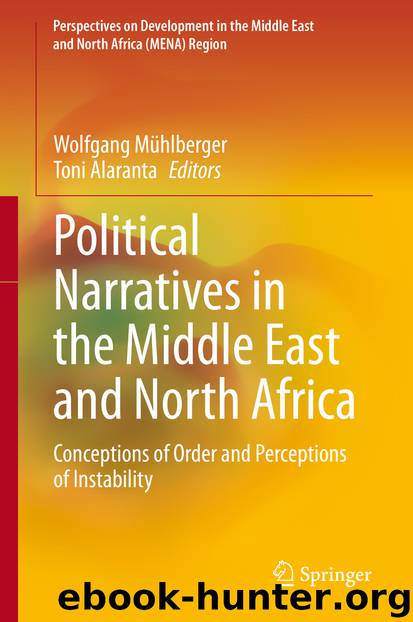
Author:Wolfgang Mühlberger & Toni Alaranta
Language: eng
Format: epub
ISBN: 9783030352172
Publisher: Springer International Publishing
Introduction: From Ideology to the Pragmatic Defence of Interests
The collapse of the Soviet Union brought about substantial change in Russian foreign policy and its priorities. In the early 1990s, for the first time in decades (if not centuries), Russian domestic politics took priority over external policy. It is impossible to consider the foreign policy of Moscow in general, and in the Middle East in particular, without taking the internal specifics into account. As Yevgeny Primakov, Russian Prime Minister in the 1990s, rightly observed: “at that time the Middle East in general was out of the zone of our interests. The most important were relations with the United States. It was clear that the Middle East could not attract Russia’s attention. On the one hand, there was no cold war there, and on the other hand, there was no stability in Russia and the authorities were those who did not believe that Russia could be a great power” (Vasiliev 2018: 364).1
During the post-Soviet period, when all efforts were focussed on the development of market-economy institutions following the end of the Cold War, the situation inside the country conditioned the corresponding tasks of Russian foreign policy. The priority was to gain a foothold in Western political, economic and financial structures. This was confirmed in the “main provisions of the concepts of Russia’s foreign policy” adopted in 1993, according to which the goal was to maximise conditions that would facilitate the successful implementation of “democratic and economic reforms” (MFA of Russia 2018a). Thus, Moscow adopted a stable course of accelerated integration into Euro-Atlantic structures, and attention was given to the Middle East based on the residual principle.
This orientation, in turn, predetermined the extremely pragmatic policy that Moscow began to pursue towards the Middle East. It did not mean that Moscow ceased to pay attention to what was happening in the region: far from it. Everything that was happening in the Middle East mattered to Russia, although it was not immediately relevant. However, one should keep in mind two important aspects that determined Russian foreign policy. First, as Igor Ivanov, the last foreign minister of the Boris Yeltsin era, noted “superpower psychology” was no longer acceptable to the Russian leadership (Vasiliev 2018: 364). Second, a Russian presence anywhere was conditional primarily on the availability of resources. Deputy Foreign Minister Viktor Posuvalyuk assessed the situation in the following way in an interview with “Le Monde diplomatique”: “Indeed, we are now weak, and our financial resources are limited. We can no longer give unlimited credit to our allies. We do not have a mandate from the Russian people to supply an infinite number of weapons” (Gresh 1998: 70).
However strange it might seem at first glance, the new Russia of the 1990s had its advantages over the Soviet Union, among which the rejection of ideology in defining its foreign-policy line should be singled out. As a result, Russia has designated its presence in the Middle East in a fundamentally different way. Of course, there was no question of reviving Soviet influence, and in general there was no need to do so.
Download
This site does not store any files on its server. We only index and link to content provided by other sites. Please contact the content providers to delete copyright contents if any and email us, we'll remove relevant links or contents immediately.
| Anthropology | Archaeology |
| Philosophy | Politics & Government |
| Social Sciences | Sociology |
| Women's Studies |
The Secret History by Donna Tartt(19387)
The Social Justice Warrior Handbook by Lisa De Pasquale(12267)
Thirteen Reasons Why by Jay Asher(9058)
This Is How You Lose Her by Junot Diaz(7008)
Weapons of Math Destruction by Cathy O'Neil(6419)
Zero to One by Peter Thiel(5901)
Beartown by Fredrik Backman(5880)
The Myth of the Strong Leader by Archie Brown(5591)
The Fire Next Time by James Baldwin(5544)
How Democracies Die by Steven Levitsky & Daniel Ziblatt(5299)
Promise Me, Dad by Joe Biden(5208)
Stone's Rules by Roger Stone(5162)
A Higher Loyalty: Truth, Lies, and Leadership by James Comey(5048)
100 Deadly Skills by Clint Emerson(4995)
Rise and Kill First by Ronen Bergman(4864)
Secrecy World by Jake Bernstein(4826)
The David Icke Guide to the Global Conspiracy (and how to end it) by David Icke(4804)
The Doomsday Machine by Daniel Ellsberg(4585)
The Farm by Tom Rob Smith(4574)
