Maritime Safety and Security in the Indian Ocean by Vijay Sakhuja Kapil Narula
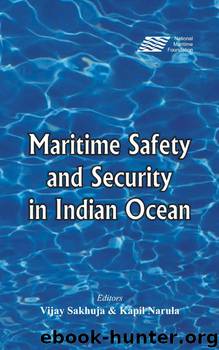
Author:Vijay Sakhuja, Kapil Narula
Language: eng
Format: epub
ISBN: 9789385563799
Publisher: Vij Books India Pvt Ltd
Addressing Transnational Organised Crime: A Whole of Nation Approach
Martin A. Sebastian
Abstract
The measures being undertaken to address maritime security threats are obviously far from effective. The reasons to this statement are that seaborne smuggling of people, goods and wildlife, illegal fishing and piracy and armed robbery are on the rise. Though it is arguable that these measures are lopsided and that while maritime security agencies blame land security agencies for “sea blindness”, maritime security agencies themselves are guilty of “land blindness” where threat assessment and operations are concerned. Lack of coherent measures has impacted intelligence led operations thus raising costs on risk mitigation and crisis response. Inter service rivalry and lack of information sharing has allowed the “big fish to swim in warm waters”. Most law enforcement operations have only targeted symptoms instead of the root causes of these crimes.
Introduction
When addressing maritime security, the first thing we need to look at is ourselves and our institutional cultures in order to identify any systemic impediments to achieving effective and persistent national domain awareness. All countries have unique maritime security governance frameworks, for instance some coast guards are part of the navy, while others are separate, while in other smaller coastal nations, the coast guards are the navy. Still, the common trait in all coastal states is that multiple forces, ministries and agencies all have a strong interest in maritime surveillance, whether it’s the immigration department for illegal migrants, the national police for counter-narcotics, the fisheries department for illegal fishing, the coast guard for search and rescue, or the navy for sovereign presence and when necessary for combat. When these groups are stove- piped, acting separately, guarding their data jealously, and competing against one another for resources and influence, then they collectively do their countries a disservice, and it becomes much easier for adversaries to identify and exploit the vulnerabilities that exist at the inter-agency seams.
Illegal Cross Border Movements People Smuggling
Smuggling of migrants is defined by Article 3 of the Migrant Smuggling Protocol supplementing the United Nations Transnational Organized Crime Convention (UNTOC), as “...the procurement, in order to obtain, directly or indirectly, a financial or other material benefit, of the illegal entry of a person into a state party of which the person is not a national.” The specific nature of the sea-based component of the smuggling journey resulted in a dedicated section on the issue in the Migrant Smuggling Protocol. While smuggling by sea accounts only for a small portion of overall migrant smuggling around the world, the particular dangers of irregular travel at sea make it a priority for response; though more migrant smuggling occurs by air, more deaths occur by sea.
Attempting to isolate the issue of migrant smuggling by sea from other forms of migrant smuggling is in some ways an artificial and potentially misleading exercise. Migrant smuggling by sea generally occurs as part of a wider smuggling process often involving land and/or air movements. Furthermore, the complex nature of criminal migrant smuggling networks and their modus operandi means that
Download
This site does not store any files on its server. We only index and link to content provided by other sites. Please contact the content providers to delete copyright contents if any and email us, we'll remove relevant links or contents immediately.
| Anthropology | Archaeology |
| Philosophy | Politics & Government |
| Social Sciences | Sociology |
| Women's Studies |
The Secret History by Donna Tartt(19387)
The Social Justice Warrior Handbook by Lisa De Pasquale(12267)
Thirteen Reasons Why by Jay Asher(9058)
This Is How You Lose Her by Junot Diaz(7008)
Weapons of Math Destruction by Cathy O'Neil(6419)
Zero to One by Peter Thiel(5901)
Beartown by Fredrik Backman(5880)
The Myth of the Strong Leader by Archie Brown(5591)
The Fire Next Time by James Baldwin(5544)
How Democracies Die by Steven Levitsky & Daniel Ziblatt(5299)
Promise Me, Dad by Joe Biden(5208)
Stone's Rules by Roger Stone(5158)
A Higher Loyalty: Truth, Lies, and Leadership by James Comey(5048)
100 Deadly Skills by Clint Emerson(4994)
Rise and Kill First by Ronen Bergman(4864)
Secrecy World by Jake Bernstein(4826)
The David Icke Guide to the Global Conspiracy (and how to end it) by David Icke(4804)
The Doomsday Machine by Daniel Ellsberg(4585)
The Farm by Tom Rob Smith(4574)
