Leave Me Alone and I'll Make You Rich by Deirdre Nansen McCloskey & Art Carden
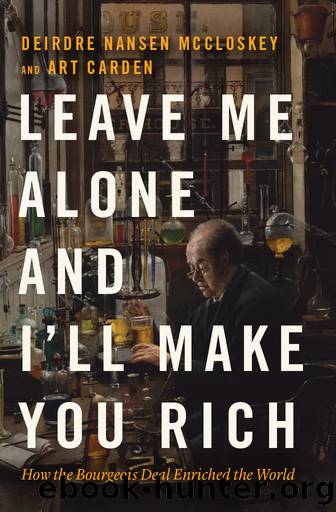
Author:Deirdre Nansen McCloskey & Art Carden [McCloskey, Deirdre Nansen & Carden, Art]
Language: eng
Format: epub
Tags: BUS000000 Business & Economics / General
Publisher: University of Chicago Press
Published: 2020-10-30T00:00:00+00:00
17
It Wasnât Imperialism
Nor was it successful violence of any stripe that made the West rich. Most obviously, it wasnât warfare. As it turns out, aggressions that encourage the killing of your people and their suppliers and demanders are not really very good for you. War, like plague, might have kept wages high by keeping the amount of labor low relative to the available land, but where war flourished mostâthe German lands during the Thirty Yearsâ War (1618â1648), for instance, killing a third of their populationâprosperity did not. Slavery, colonialism, and imperialism donât explain why Walmart cashiers in the United States make so much more than their counterparts elsewhere in the world.
To be clear, we are not suggesting that the evils of war, slavery, imperialism, and colonialism were justified, or anything other than evil. True, it was only bourgeois places, we have noted, that began to end the evil. Until England in the late eighteenth century, war was the usual hobby of kings, imperialism seemed blameless, and hardly anyone objected to the system of slavery. And, true, âeveryoneâ does it: African empires, like ancient Romeâs and Athensâs and Israelâs, were slave societies, and after their hobby wars the African imperialists sold people to the Europeans or Arabs waiting off the coast. The Sioux native Americans were tyrants of other native Americans. Yet such âwhat-aboutâ does not excuse evil.
Or in these cases stupidity. We are saying, to be precise, that war, slavery, imperialism, and colonialism were on the whole economically stupid. Suppose killing people, taking their stuff, and establishing empire could create an âoriginal accumulation of capitalâ that would jump-start the âcapitalist mode of productionâ and thereby create a Great Enrichment. If so, as we have argued repeatedly, it would have happened a long time ago and not in northwestern Europe. Imperialism isnât a new idea. The French liberal Jean-Baptiste Say remarked in 1803, before imperialism became fashionable among the clerisy, âDominion by land or sea will appear equally destitute of attraction, when it comes to be generally understood that all its advantages rest with the rulers, and that the [home] subjects at large derive no benefit whatever.â1 In 1923, in the aftermath of World War I, a later liberal, the Italian economist and future president of Italy Luigi Einaudi wrote, âBefore the [First World] war it was a favorite doctrine with nationalists that new, rising nations . . . were called to high destinies, to conquer territories, to become world Powers. . . . The war of new and rising nations against old and stationary . . . was erroneous both historically and economically.â2
Alas, others disagreed, such as the American Theodore Roosevelt, or the Japanese prime minister Hideki Tojo. âOur nation,â declared Tojo, âstands at a crossroads, one road leading to glory and the other to decline.â3 One still hears such guff. In 1997 the geographer Jared Diamond wrote a brilliant book, Guns, Germs, and Steel: The Fates of Human Societies, which was meant to answer the question of a New
Download
This site does not store any files on its server. We only index and link to content provided by other sites. Please contact the content providers to delete copyright contents if any and email us, we'll remove relevant links or contents immediately.
The Brazilian Economy since the Great Financial Crisis of 20072008 by Philip Arestis Carolina Troncoso Baltar & Daniela Magalhães Prates(340680)
International Integration of the Brazilian Economy by Elias C. Grivoyannis(111498)
The Art of Coaching by Elena Aguilar(53528)
Flexible Working by Dale Gemma;(23341)
How to Stop Living Paycheck to Paycheck by Avery Breyer(19808)
Thinking, Fast and Slow by Kahneman Daniel(12475)
The Acquirer's Multiple: How the Billionaire Contrarians of Deep Value Beat the Market by Tobias Carlisle(12411)
The Radium Girls by Kate Moore(12135)
The Art of Thinking Clearly by Rolf Dobelli(10665)
Hit Refresh by Satya Nadella(9223)
The Compound Effect by Darren Hardy(9111)
Tools of Titans by Timothy Ferriss(8543)
Atomic Habits: Tiny Changes, Remarkable Results by James Clear(8471)
Turbulence by E. J. Noyes(8163)
A Court of Wings and Ruin by Sarah J. Maas(8045)
Change Your Questions, Change Your Life by Marilee Adams(7893)
Nudge - Improving Decisions about Health, Wealth, and Happiness by Thaler Sunstein(7803)
How to Be a Bawse: A Guide to Conquering Life by Lilly Singh(7582)
Win Bigly by Scott Adams(7301)
