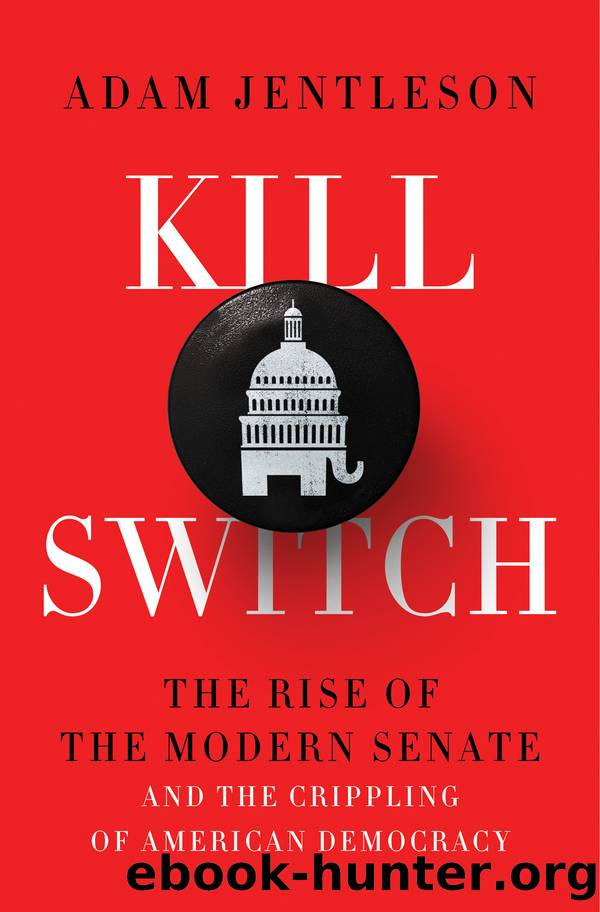
Kill Switch by Adam Jentleson
Author:Adam Jentleson [Jentleson, Adam]
Language: eng
Format: epub
Published: 2020-12-05T00:00:00+00:00
UNTIL 1980, Democratic control of Congress seemed like a fact of life. Starting in 1955, Democrats held unbroken control of the Senate for twenty-six years. The story was similar in the House, but more extreme: between 1933 and 1995 Democrats controlled the House for all but four years. With control of the majority out of sight, and plenty of points of ideological connection across the aisle, Republican senators also tended to assume Democratic control was impossible to dislodge, and focused more on exerting their influence on policy than trying to take back the majority.40 That changed in 1980, when Democrats lost control of the Senate amid the Reagan landslide. That loss inaugurated a new era where the majority frequently changes hands. Between 1980 and 2018, control of the Senate majority has changed hands nine times.
This period, which we are still in today, is defined by what the political scientist Frances E. Lee terms âinsecure majoritiesâ: the majority is always vulnerable to being reclaimed by the other side. With the exception of Democratsâ six-month sojourn with a sixty-vote supermajority from late 2009 to January 2010, since 1980, both sidesâ majorities have usually numbered in the mid- to low fifties. If reclaiming control is not possible in one two-year election cycle, it is usually possible within two cycles. These small margins of control decrease the incentive to help the other side secure accomplishments and dramatically increase the incentive to block themâor âdraw contrasts,â in the common euphemism.41 It also gives leaders a way to keep members in line. Whenever a senator on one side is tempted to cross the aisle and help the other side, a leader can play the trump card: be a team player, they argue. Donât be selfish and put your desire for a career-making policy accomplishment firstâbe selfless, think of your colleagues, and prioritize our ability to take back the majority, a leader might say. This appeal can be couched in noble terms, urging the wavering senator to think about how much greater an impact they could have on policy if they were in the majority. Committee control goes to the majority, so a senator who cares about energy policy, for instance, would have a lot more influence over it as the chair of the Energy Committee. Or they might be urged to think about how the leader, who is asking them for a favor, would have much more power to advance the bills the wavering senator cares about if they were to ascend from minority leader to majority leader. In the era of insecure majorities, versions of these arguments have been made countless times, in pull-asides, phone calls, and candid conversations in the offices of the leaders of both parties.
As taking back the majority started to become the driving ambition, the parties started to operate more like campaigns. The Democratic Senate leader in 1981, Robert Byrd of West Virginia, began to revive some of the tools of control Johnson had used. At that point, press staffers were relatively rare, and Byrd hired his first full-time press staffer for the leaderâs office.
Download
This site does not store any files on its server. We only index and link to content provided by other sites. Please contact the content providers to delete copyright contents if any and email us, we'll remove relevant links or contents immediately.
| Anthropology | Archaeology |
| Philosophy | Politics & Government |
| Social Sciences | Sociology |
| Women's Studies |
The Secret History by Donna Tartt(19465)
The Social Justice Warrior Handbook by Lisa De Pasquale(12290)
Thirteen Reasons Why by Jay Asher(9110)
This Is How You Lose Her by Junot Diaz(7054)
Weapons of Math Destruction by Cathy O'Neil(6464)
Zero to One by Peter Thiel(5937)
Beartown by Fredrik Backman(5927)
The Myth of the Strong Leader by Archie Brown(5623)
The Fire Next Time by James Baldwin(5578)
How Democracies Die by Steven Levitsky & Daniel Ziblatt(5321)
Promise Me, Dad by Joe Biden(5228)
Stone's Rules by Roger Stone(5184)
A Higher Loyalty: Truth, Lies, and Leadership by James Comey(5080)
100 Deadly Skills by Clint Emerson(5023)
Rise and Kill First by Ronen Bergman(4890)
Secrecy World by Jake Bernstein(4864)
The David Icke Guide to the Global Conspiracy (and how to end it) by David Icke(4841)
The Doomsday Machine by Daniel Ellsberg(4617)
The Farm by Tom Rob Smith(4598)
