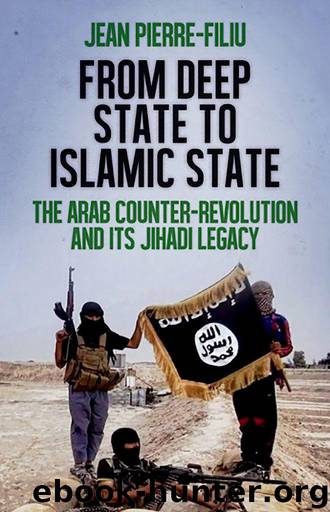
From Deep State to Islamic State by Jean-Pierre Filiu
Author:Jean-Pierre Filiu [Filiu, Jean-Pierre]
Language: eng
Format: epub
Publisher: Oxford University Press
Published: 2015-06-13T22:00:00+00:00
7
THE STORY OF TWO SQUARES IN EGYPT
Husni Mubarak could not but feel supremely confident in his thirtieth year of presidential rule. The November 2010 parliamentary elections were so conspicuously controlled by the security apparatus than all the opposition parties eventually boycotted them. Even the Muslim Brotherhood, which had initially expected to reiterate its 2005 electoral breakthrough, had opted out after the first round, blatantly marred by government manipulation.
Mubarak had succeeded Sadat in 1981 because he was his deputy, but he never designated a vice president himself. He was keeping an alternative open between his son Gamal, a living symbol of crony capitalism, who had built his own base inside the ruling party (NDP/National Democratic Party), and Omar Suleiman, the military head of the General Intelligence Department (GID). The security czar had increased his power through the US-led global war on terror, while ‘Mubarak Junior’ was charming foreign investors and Davos Forum guest stars.
The Egyptian president did not want to choose his own successor, since he had no wish to alienate either constituency (the security apparatus associated with Suleiman or the compradore bourgeoisie rallied behind Gamal). In the Mamluk handbook the safest bet was the spymaster option, because Suleiman combined the domestic and international clout that were key to the ruling clique. But the Egyptian despot was obviously tempted by the dynastic scenario, first implemented at Hafez al-Assad’s death in 2000 on behalf of his son Bashar (in Yemen, Saleh was forcefully pushing in favour of his son Ahmed, commander of the Republican Guard).
Gamal Mubarak’s main weakness in this Mamluk-run world was his lack of any military credentials. That was also what he boasted about when he claimed to be able to reform Egypt. In fact, such ‘reform’ was only intended to maximize the profits of the tiny minority of Egyptian businessmen plugged into the global economy. For the overwhelming rest of the country, it was survival as usual. As economist Samer Suleiman put it: ‘Egypt’s story in the last quarter century had been the story of regime success and state failure.’1
This regime victory over national interests was the main driving force for the takeover of Tahrir Square in the middle of Cairo by tens of thousands of peaceful protesters on 25 January 2011. Inspired by the Tunisian revolution, they shouted that ‘the people want to topple the regime’, and Tahrir (Liberation) became a collective aspiration as much as an urban centre. Despite a violent crackdown involving live ammunition, the opposition activists held their ground and the demonstrations extended countrywide.
Mubarak sacked his prime minister on 28 January 2011, replacing him with Ahmed Shafiq, a former general from the air force like himself. The next day, he appointed Omar Suleiman as vice president. But the police had lost control of the streets and tried to regain them in an unprecedented way: criminals were released from eighteen prisons and dozens of police stations2 in order to scare the population away from revolutionary protests.
On Tahrir Square, waves of police-supported hoodlums, named baltaguiyya, attacked the demonstrators, often on camel or horseback.
Download
This site does not store any files on its server. We only index and link to content provided by other sites. Please contact the content providers to delete copyright contents if any and email us, we'll remove relevant links or contents immediately.
| Anthropology | Archaeology |
| Philosophy | Politics & Government |
| Social Sciences | Sociology |
| Women's Studies |
The Secret History by Donna Tartt(19480)
The Social Justice Warrior Handbook by Lisa De Pasquale(12301)
Thirteen Reasons Why by Jay Asher(9135)
This Is How You Lose Her by Junot Diaz(7062)
Weapons of Math Destruction by Cathy O'Neil(6487)
Zero to One by Peter Thiel(5955)
Beartown by Fredrik Backman(5952)
The Myth of the Strong Leader by Archie Brown(5632)
The Fire Next Time by James Baldwin(5596)
How Democracies Die by Steven Levitsky & Daniel Ziblatt(5338)
Promise Me, Dad by Joe Biden(5238)
Stone's Rules by Roger Stone(5196)
A Higher Loyalty: Truth, Lies, and Leadership by James Comey(5092)
100 Deadly Skills by Clint Emerson(5034)
Rise and Kill First by Ronen Bergman(4908)
Secrecy World by Jake Bernstein(4897)
The David Icke Guide to the Global Conspiracy (and how to end it) by David Icke(4856)
The Doomsday Machine by Daniel Ellsberg(4632)
The Farm by Tom Rob Smith(4614)
