Donald Trump and New Hampshire Politics by Christopher J. Galdieri
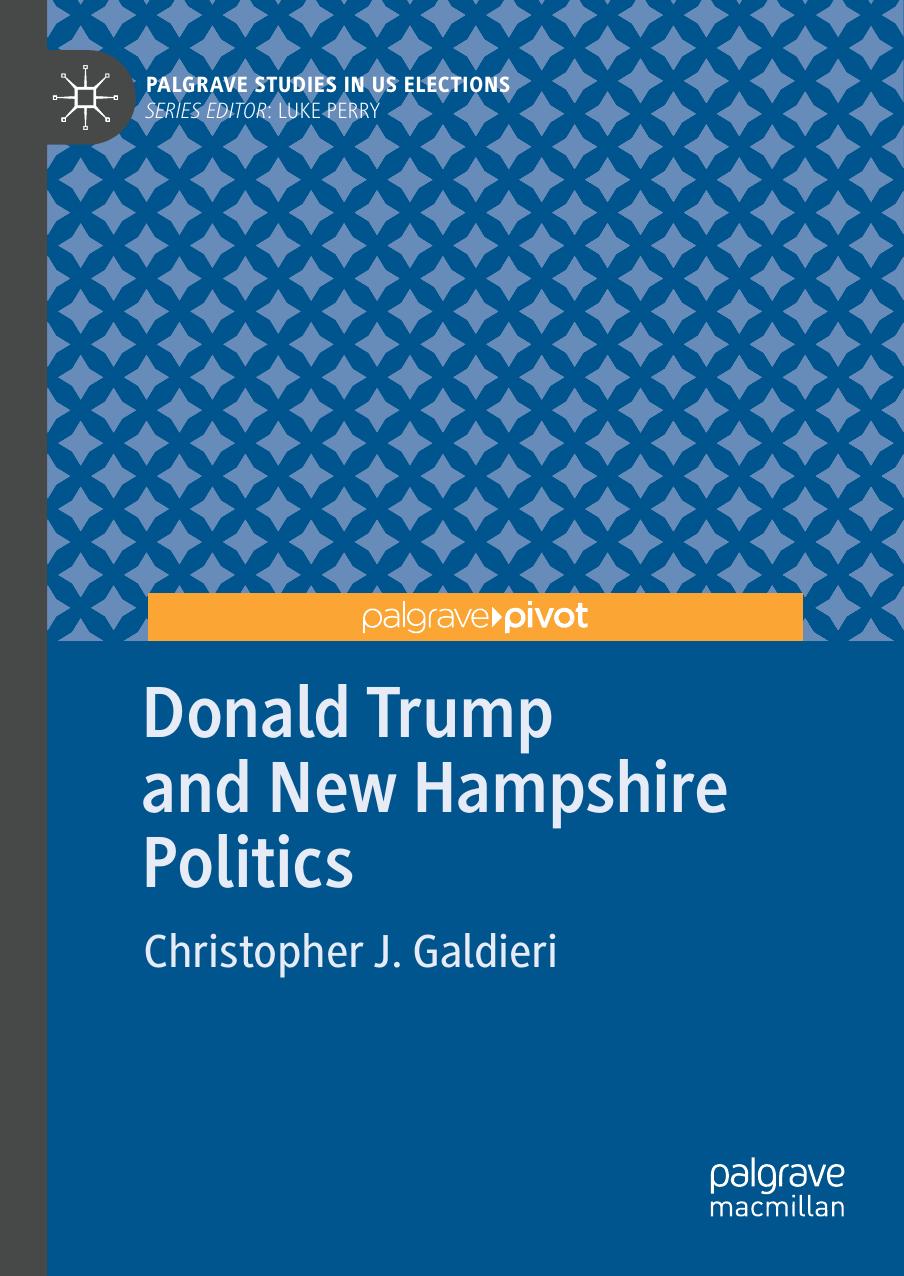
Author:Christopher J. Galdieri
Language: eng
Format: epub, pdf
ISBN: 9783030247973
Publisher: Springer International Publishing
New Hampshire’s Democratic Advantage
In 2016, New Hampshire had the third highest turnout in the nation, with 72.5% of those eligible to vote casting ballots; this was up from 2012, when 70.2% of those eligible cast ballots (DiStaso 2017). Neither candidate set the state’s electorate on fire; more votes were cast in the Senate race than in the presidential race, which suggests that some voters could not bring themselves to vote for Clinton or Trump or any of the independent candidates or write in an alternative (Lucas et al. 2018). Still, enough voters chose Clinton to deliver the state’s four electoral votes to her. Two factors help explain why Clinton’s narrowly won in New Hampshire while she lost other key swing states.
The first is the demography of the state. New Hampshire is notoriously one of the least diverse states in America, with a population that is 94% white (Seelye 2018). This helped make it an attractive state to Trump’s campaign, just as it had for those of previous Republican nominees, since nonwhite voters tend to break for Democrats by wide margins (Arkin 2016). But mostly white is not the same thing as entirely white, and exit polling shows that the state’s small nonwhite population was critical to Clinton’s success. White voters comprised 92% of the state’s electorate in 2016, and Trump narrowly led Clinton among these voters by a margin of 48% to 46%. The nonwhite voters who made up the remaining 8% of the New Hampshire electorate, however, broke overwhelmingly for Clinton, giving her 58% of their votes, while Trump received just 33%. A similar pattern was apparent in the state’s Senate race between Kelly Ayotte and Maggie Hassan; there as in the presidential race, it was nonwhite voters who decisively broke for the Democratic candidate and pushed her to a narrow victory over her opponent (Lucas et al. 2018).
And had the 2016 election taken place entirely in New Hampshire, Hillary Clinton would be president. But the other 49 states and the District of Columbia weighed in, too. The biggest of election night’s surprises took place in Pennsylvania, Michigan, and Wisconsin, competitive states which Democrats had nonetheless managed to win in every presidential election between 1992 and 2012. In 2016, however, Donald Trump carried all three of these states by very narrow margins, and managed to achieve a comfortable majority in the electoral college even while he lost the popular vote by roughly three million votes. Why was Trump able to flip these three swing states, but not New Hampshire? While the political environment in the final weeks of the election changed in ways that favored Trump, the composition of the electorates in those states fundamentally differed from that of New Hampshire’s in key ways. Perhaps the most important difference had to do with the different levels of educational attainment in New Hampshire, the second key factor that explains why Clinton managed to carry the state.
New Hampshire has one of the most well-educated populations in the United States. In 2016, 36.
Download
Donald Trump and New Hampshire Politics by Christopher J. Galdieri.pdf
This site does not store any files on its server. We only index and link to content provided by other sites. Please contact the content providers to delete copyright contents if any and email us, we'll remove relevant links or contents immediately.
| Anthropology | Archaeology |
| Philosophy | Politics & Government |
| Social Sciences | Sociology |
| Women's Studies |
The Secret History by Donna Tartt(19484)
The Social Justice Warrior Handbook by Lisa De Pasquale(12302)
Thirteen Reasons Why by Jay Asher(9136)
This Is How You Lose Her by Junot Diaz(7078)
Weapons of Math Destruction by Cathy O'Neil(6489)
Zero to One by Peter Thiel(5957)
Beartown by Fredrik Backman(5954)
The Myth of the Strong Leader by Archie Brown(5633)
The Fire Next Time by James Baldwin(5599)
How Democracies Die by Steven Levitsky & Daniel Ziblatt(5340)
Promise Me, Dad by Joe Biden(5240)
Stone's Rules by Roger Stone(5198)
A Higher Loyalty: Truth, Lies, and Leadership by James Comey(5092)
100 Deadly Skills by Clint Emerson(5036)
Rise and Kill First by Ronen Bergman(4914)
Secrecy World by Jake Bernstein(4900)
The David Icke Guide to the Global Conspiracy (and how to end it) by David Icke(4858)
The Doomsday Machine by Daniel Ellsberg(4635)
The Farm by Tom Rob Smith(4614)
