Big Hunger by Andrew Fisher
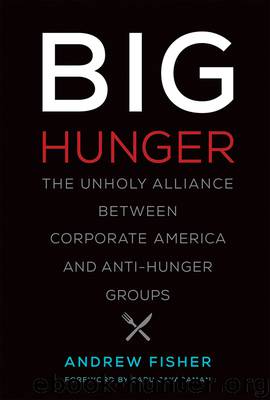
Author:Andrew Fisher
Language: eng
Format: epub
Tags: nutrition; policymaking; malnutrition; food waste; agriculture; food industry; lobbyists
Publisher: The MIT Press
Published: 2017-05-31T04:00:00+00:00
5
Economic Democracy through Federal Food Programs
Food Distribution on the Indian Reservation
On Janie Hipp’s first day as the senior advisor for tribal relations to USDA secretary Tom Vilsack, she met with 175 Indian leaders gathered at the White House for the 2010 Tribal Leaders Conference. Representatives from all 566 federally recognized tribal governments participated in this event; nothing comparable to it had ever been organized by an administration before President Obama took office. The tribal leaders posed their very first question to Ms. Hipp: Why did USDA remove butter from the Food Distribution Program on Indian Reservations (FDPIR) food package without tribal consultation, as required by executive order? They asked, “You have butter in your refrigerator. Why are you prohibiting it in ours?” It took Ms. Hipp a year and a half to get the USDA to reverse the decision made by the Bush administration, to remove butter from FDPIR for health reasons.1
As an alternative to SNAP for those persons living on or near reservations with limited access to a grocery store, FDPIR is of great importance to tribal authorities.2 It provides one of the primary food sources for 88,600 people monthly, people who are among the poorest of the poor living in some of the most remote areas of the country.3 The FDPIR provides households, based on size, a package of predetermined foods. These groceries are acquired by USDA’s purchasing arm, USDA Foods, which procured almost $2 billion in food in 2014 for school lunches and other nutrition programs.
The decision to remove butter had indeed been made, without the required tribal consultation, by federal employees whose decisions regarding the federal food package of FDPIR can and do trump any input by tribal communities and their leaders.4 Butter had been replaced by a “butter substitute,” which arguably was not a healthier product, and the decision deeply affected families in Indian Country. Tribal leaders very clearly stated to Ms. Hipp that in the future they must be consulted before such intimate and critical decisions concerning food access and health are made.
Apart from the butter incident, USDA has, to its credit, worked long and hard with the 276 Indian nations that participate in the FDPIR program to improve the quality of the food package and to meet their desires.5 At the local level, Indian nations manage the program implementation through the leadership of Indian Tribal Organizations (ITOs). These ITOs, along with officials from local, state, and federal governments, provide guidance to the USDA on the foods distributed through FDPIR.6
Not only does USDA make decisions about which foods FDPIR participants receive, but also virtually all items that USDA Foods distributes to FDPIR participants come from off-reservation. For FDPIR, a small portion of overall USDA commodity purchases, USDA has chosen to streamline its procurement in a way that generally does not differentiate this program from other initiatives that serve the broader low-income population. Despite the diversity of Native American foodways, USDA sees FDPIR as a national program, instead of a series of regional efforts tailored to meet tribal dietary preferences.
Download
This site does not store any files on its server. We only index and link to content provided by other sites. Please contact the content providers to delete copyright contents if any and email us, we'll remove relevant links or contents immediately.
| Anthropology | Archaeology |
| Philosophy | Politics & Government |
| Social Sciences | Sociology |
| Women's Studies |
The Secret History by Donna Tartt(19062)
The Social Justice Warrior Handbook by Lisa De Pasquale(12188)
Thirteen Reasons Why by Jay Asher(8896)
This Is How You Lose Her by Junot Diaz(6878)
Weapons of Math Destruction by Cathy O'Neil(6268)
Zero to One by Peter Thiel(5790)
Beartown by Fredrik Backman(5739)
The Myth of the Strong Leader by Archie Brown(5502)
The Fire Next Time by James Baldwin(5433)
How Democracies Die by Steven Levitsky & Daniel Ziblatt(5217)
Promise Me, Dad by Joe Biden(5147)
Stone's Rules by Roger Stone(5082)
A Higher Loyalty: Truth, Lies, and Leadership by James Comey(4955)
100 Deadly Skills by Clint Emerson(4921)
Rise and Kill First by Ronen Bergman(4781)
Secrecy World by Jake Bernstein(4744)
The David Icke Guide to the Global Conspiracy (and how to end it) by David Icke(4710)
The Farm by Tom Rob Smith(4503)
The Doomsday Machine by Daniel Ellsberg(4486)
