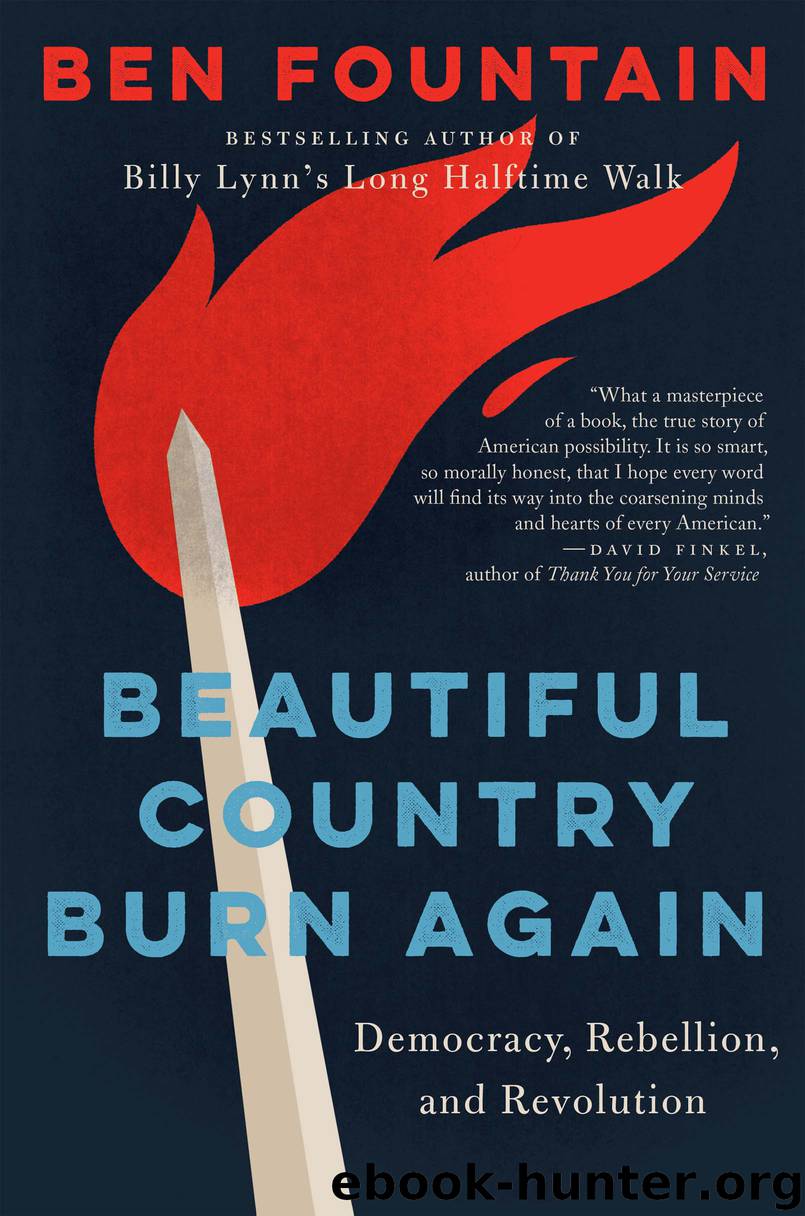
Beautiful Country Burn Again by Ben Fountain
Author:Ben Fountain
Language: eng
Format: epub
Publisher: HarperCollins
Published: 2018-08-03T16:00:00+00:00
Hillary Doesn’t Live Here Anymore
1.
Charlemagne, a.k.a. Charles the Great, king of the Franks, king of the Lombards, emperor of the Romans, father of Europe, and, as he preferred it, “Charles, most serene Augustus crowned by God, the great, peaceful emperor ruling the Roman Empire,” imposed order and stability over his far-flung state by requiring the teaching of . . . rhetoric. Not fancy talk, not the lip-spritz of flounce and folderol, but speaking based on logic, grammar, reasoned argument. The stuff, in other words, of public discourse, the means of useful give-and-take whereby civilization gets on with its proper business of furnishing people a decent shot at living long and happy lives.
For their guide Charlemagne’s cadres looked to Aristotle’s Rhetoric and his “modes of persuasion furnished by the spoken word.” Aristotle identifies three distinct modes. Ethos depends on the character of the speaker, whether he or she appears to be credible. Pathos concerns the emotions that the speaker elicits from the audience. Logos relates to content and argument, the effectiveness of the “proof,” whether it appeals to logical reason. “Persuasion is achieved by the speaker’s personal character when the speech is so spoken as to make us think him credible,” said Aristotle, and the speeches at the Democratic National Convention in Philadelphia, four days’ worth, ten hours or more a day of droning and soaring, might be viewed collectively as an argument for the premise of the entire electoral exercise as much as a case for the election of a particular candidate. There was the candidate herself, of course, the arguments for, the ethos-pathos-logos trifecta deployed for the politics of the moment, but it seemed necessary, in this strangest of election years when someone or something was driving the people of America crazy, to affirm the basic worth of liberal democracy, and, by extension—sometimes implicitly, sometimes overtly—the values and attributes that it requires of us. Tolerance. Reason. Memory. Mutual respect. The tools—both intellectual and emotional—to engage with complexity. An elastic concept of polity and the common good, a sense of community larger than immediate self-interest. “Those bonds of affection,” Obama declared in his convention speech, “that common creed.” “Bonds of trust and respect,” said the nominee herself. “We are all neighbors,” said Tim Kaine, “and we must love neighbors as ourselves.” Michelle Obama: “The vision that our founders put forth all those years ago that we are all created equal, each a beloved part of the great American story.” Cory Booker: “In this city our founders put forth a Declaration of Independence, but let me tell you, they also made a historic declaration of interdependence. They knew that if this country was to survive and thrive, we had to make an unusual and extraordinary commitment to one another.” Obama again: “We have to listen to each other, and see ourselves in each other,” and “democracy doesn’t work if we constantly demonize each other.”
As events would show, a large chunk of the electorate was in no mood to be appealed to in these terms.
Download
This site does not store any files on its server. We only index and link to content provided by other sites. Please contact the content providers to delete copyright contents if any and email us, we'll remove relevant links or contents immediately.
| Anthropology | Archaeology |
| Philosophy | Politics & Government |
| Social Sciences | Sociology |
| Women's Studies |
The Secret History by Donna Tartt(19103)
The Social Justice Warrior Handbook by Lisa De Pasquale(12197)
Thirteen Reasons Why by Jay Asher(8919)
This Is How You Lose Her by Junot Diaz(6894)
Weapons of Math Destruction by Cathy O'Neil(6284)
Zero to One by Peter Thiel(5808)
Beartown by Fredrik Backman(5767)
The Myth of the Strong Leader by Archie Brown(5513)
The Fire Next Time by James Baldwin(5454)
How Democracies Die by Steven Levitsky & Daniel Ziblatt(5225)
Promise Me, Dad by Joe Biden(5157)
Stone's Rules by Roger Stone(5091)
A Higher Loyalty: Truth, Lies, and Leadership by James Comey(4967)
100 Deadly Skills by Clint Emerson(4932)
Rise and Kill First by Ronen Bergman(4797)
Secrecy World by Jake Bernstein(4756)
The David Icke Guide to the Global Conspiracy (and how to end it) by David Icke(4723)
The Farm by Tom Rob Smith(4517)
The Doomsday Machine by Daniel Ellsberg(4493)
