Anchor Babies and the Challenge of Birthright Citizenship by Leo R. Chavez
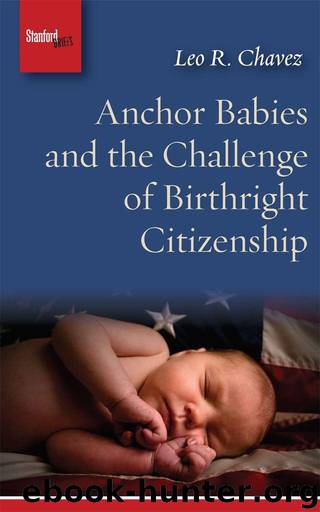
Author:Leo R. Chavez
Language: eng
Format: mobi
Publisher: Stanford University Press
Published: 2017-10-10T07:00:00+00:00
3
DIMINISHED CITIZENSHIP
Sensing an opportunity to take action rather than just talk about anchor babies, Texas in 2013 began denying birth certificates to U.S.-born children if their parents could not provide acceptable proof of identification.1 In July 2015, Hiram Ramirez, a native of Mexico, went to the Texas Vital Statistics office in McAllen to get her daughter her birth certificate, just as she had done for her two older daughters. This time, however, she was told that the rules had changed and she would need to provide an acceptable form of identification: driver’s license, military ID, passport or permanent residence card, or a Mexican electoral card.2 These are often hard to get for undocumented immigrants living in Texas. Importantly, Texas would no longer accept the matriculas consulares, the identification cards issued by Mexican consulates, even though these cards are difficult to falsify, especially now that they are embedded with microchips. One city secretary in McAllen said they were just following state directives and that families have alternatives; they could bring a relative in with proper documentation to apply for the baby’s birth certificate.3 Lost in this explanation, or willingly ignored, is that the birth certificates are for U.S. citizens, not their parents.
Citizens living with families that include undocumented immigrants may be subject to policies that diminish their rights as citizens, or they may face verbal and physically aggressive behavior by individuals who challenge their right to belong in America. They also face the daily threat of deportation that would tear apart their families, often leaving them destitute. State policies that deny birth certificates to U.S.-born children not only affect the individuals so denied; they also underscore that the state can disregard the rights of these so-called anchor babies. Such policies also provide evidence of the power of anchor baby rhetoric to justify policies based on the belief that anchor babies are undeserving citizens.
The ostensible reason that the Texas Vital Statistics unit had been refusing to issue birth certificates in these cases was to prevent identity theft. At the time, Donald Trump was questioning the legitimacy of citizenship for anchor babies and promising he would deny their right to citizenship if he became president.4 Also important was the context for Texas’s new birth certificate rules, including opposition in Texas to President Obama’s executive actions, Deferred Action for Childhood Arrivals (DACA) and Deferred Action for Parents of Americans and Lawful Permanent Residents (DAPA).5 Beginning in June 2012, DACA allowed undocumented immigrants who were brought as children, before age 16, to the United States and who went to school there, or were honorably discharged from the U.S. military, to apply for a two-year renewable relief from deportation. They could also get a Social Security card and work. DACA was not a legalization program, offering only temporary protection from deportation. President Trump could rescind DACA, rendering DACA recipients deportable. DAPA would have provided temporary relief from deportation for undocumented parents of U.S. citizens and lawful permanent residents, thus reducing family separations (discussed in more detail below).
Download
This site does not store any files on its server. We only index and link to content provided by other sites. Please contact the content providers to delete copyright contents if any and email us, we'll remove relevant links or contents immediately.
| Anthropology | Archaeology |
| Philosophy | Politics & Government |
| Social Sciences | Sociology |
| Women's Studies |
The Secret History by Donna Tartt(19388)
The Social Justice Warrior Handbook by Lisa De Pasquale(12269)
Thirteen Reasons Why by Jay Asher(9060)
This Is How You Lose Her by Junot Diaz(7008)
Weapons of Math Destruction by Cathy O'Neil(6419)
Zero to One by Peter Thiel(5903)
Beartown by Fredrik Backman(5880)
The Myth of the Strong Leader by Archie Brown(5595)
The Fire Next Time by James Baldwin(5545)
How Democracies Die by Steven Levitsky & Daniel Ziblatt(5299)
Promise Me, Dad by Joe Biden(5208)
Stone's Rules by Roger Stone(5162)
A Higher Loyalty: Truth, Lies, and Leadership by James Comey(5050)
100 Deadly Skills by Clint Emerson(4996)
Rise and Kill First by Ronen Bergman(4866)
Secrecy World by Jake Bernstein(4827)
The David Icke Guide to the Global Conspiracy (and how to end it) by David Icke(4806)
The Doomsday Machine by Daniel Ellsberg(4585)
The Farm by Tom Rob Smith(4574)
