American Theocracy by Kevin Phillips
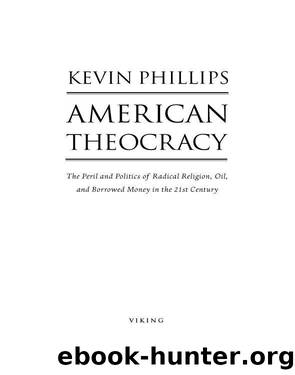
Author:Kevin Phillips
Language: eng
Format: epub
Publisher: Penguin Publishing Group
Published: 2010-06-28T16:00:00+00:00
A Twenty-first-Century American Disenlightenment?
The frequent by-products of religious fervor in the later stages of the previous powersâzealotry, exaltation of faith over reason, too much church-state collaboration, or a contagion of crusader mentalityâshed light on another contemporary U.S. predicament. Controversies that run the gamut from interference with science to biblically inhibited climatology and petroleum geology and demands for the partial reunion of church and state have accompanied the political rise of Christian conservatism. Such trends are rarely auspicious.
The essential political preconditions fell into place in the late 1980s and 1990s with the emergence of the Republican party as a powerful vehicle for religiosity and church influence, while state Republican parties, most conspicuously in the South and Southwest, endorsed so-called Christian-nation party platforms.38 These unusual platforms, as yet nationally un-cataloged, set out in varying degrees the radical political theology of the Christian Reconstruction movement, the tenets of which range from using the Bible as a basis for domestic law to emphasizing religious schools and womenâs subordination to men. The 2004 platform of the Texas Republican party is a case in point. It reaffirms the status of the United States as âa Christian nation,â regrets âthe myth of the separation of church and state,â calls for abstinence instead of sex education, and broadly mirrors the reconstructionist demand for the abolition of a large group of federal agencies and departments, including the Energy Department and the Environmental Protection Agency.39
George W. Bushâs election to the presidency and his unusual choice of former Missouri senator John Ashcroft to head the Justice Department were true milestones. We have already seen Bushâs involvement in intensifying the religiosity of the Republican party and in linking White House policy statements to Scripture and prophecy. When Ashcroft, a longtime favorite of the religious right, had explored seeking the presidency in 1997 and 1998, most of his financial support came from Christian evangelicals such as Pat Robertson.40 Conservatives subsequently mobilized in favor of his selection as attorney general. Son and grandson of Pentecostal preachers, Ashcroft, more than any previous attorney general, viewed law and politics through a religious lens. He made no effort to shade this connection. In Ashcroftâs memoirs, explained one critic, âhe describes each of his many electoral defeats as a crucifixion and every important political victory as a resurrection, and recounts scenes in which he had friends and family anoint him with oil in the manner âof the ancient kings of Israelâ with each new public office.â41 While in the Senate, Ashcroft enjoyed a 100 percent approval rating from both the Christian Coalition and the National Right to Life Committee, pleasing the latter by sponsoring a constitutional amendment that extended protection to the âunbornâ at âevery stage of their biological development, including fertilization,â a breadth that might have criminalized birth control.42 As attorney general, the Missourian was accused of dragging his heels on the prosecution of abortion-clinic bombers.43
Earlier in his political career, Ashcroft had decried the barrier between church and state as âa wall of religious oppression.â Midway through
Download
This site does not store any files on its server. We only index and link to content provided by other sites. Please contact the content providers to delete copyright contents if any and email us, we'll remove relevant links or contents immediately.
| Anthropology | Archaeology |
| Philosophy | Politics & Government |
| Social Sciences | Sociology |
| Women's Studies |
The Secret History by Donna Tartt(19480)
The Social Justice Warrior Handbook by Lisa De Pasquale(12297)
Thirteen Reasons Why by Jay Asher(9134)
This Is How You Lose Her by Junot Diaz(7061)
Weapons of Math Destruction by Cathy O'Neil(6484)
Zero to One by Peter Thiel(5955)
Beartown by Fredrik Backman(5952)
The Myth of the Strong Leader by Archie Brown(5632)
The Fire Next Time by James Baldwin(5592)
How Democracies Die by Steven Levitsky & Daniel Ziblatt(5335)
Promise Me, Dad by Joe Biden(5238)
Stone's Rules by Roger Stone(5196)
A Higher Loyalty: Truth, Lies, and Leadership by James Comey(5092)
100 Deadly Skills by Clint Emerson(5032)
Rise and Kill First by Ronen Bergman(4908)
Secrecy World by Jake Bernstein(4894)
The David Icke Guide to the Global Conspiracy (and how to end it) by David Icke(4854)
The Doomsday Machine by Daniel Ellsberg(4631)
The Farm by Tom Rob Smith(4614)
