Why Does Patriarchy Persist? by Carol Gilligan Naomi Snider & Naomi Snider
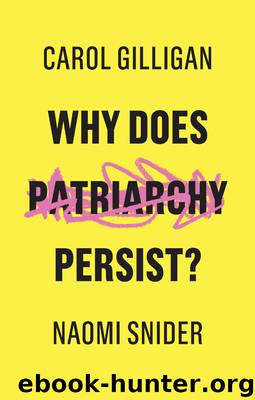
Author:Carol Gilligan,Naomi Snider & Naomi Snider
Language: eng
Format: epub
Publisher: John Wiley & Sons, Inc.
Published: 2018-06-01T16:00:00+00:00
With this searing reflection, hooks reminds us that although race and class differences matter and intersect with gender, there are also common features to patriarchal households.
Bowlby’s work shows us that the point where the psyche stops resisting the loss of connection, the point at which we sacrifice relationship for “relationships,” is the moment when protest seems hopeless and loss inescapable. One only protests when there is hope of repair; without this, a healthy resistance which has taken on characteristics of a political resistance gives way to despair and then to detachment.
But the potential for protest doesn’t go away. Tessie, aged eleven and a participant in one of the studies of girls’ development, explains that “fighting is what makes relationships go on” because that way you learn “how the person feels” and then you know how “not to hurt their feelings.”10 Contrary to stereotypes of girls as either “nice” or “mean,” pre-adolescent girls such as Tessie have a penchant to function like naturalists in the human world. Tessie describes relationships as active—contingent on a process of discovery. You have to learn how someone feels because in that way you will discover—that is come to know—how not to hurt their feelings, but the converse is also true: you have to express what you think and feel so that the other person can come to learn how not to hurt your feelings. Moreover the two are connected: the more honest you are about what you think and how you feel the more likely the other person is to be honest with you. You can also discover how to hurt their feelings, but one senses it wouldn’t shock Tessie to say this. Instead, she might explain that if you want a relationship to go on, hurting someone’s feelings is something you would try to avoid.
From Tessie we learn that expressing one’s real thoughts and feelings, including anger, is crucial for sustaining relationships. We get a very different picture when we turn to the literature on women. A 2008 study entitled “Can an Angry Woman Get Ahead?” concluded that men who become angry are rewarded but that angry women are seen, by both men and women, as incompetent and unworthy of power in the workplace.11 The researchers in this instance didn’t consider the intersections of race and gender, or of gender with class or religion, but the truth is we know that anger in women of color tends to be judged even more harshly, seen as more volatile and unacceptable.12 What the research does do is remind us that even in a culture where we may consciously believe in and advocate for the equality of women and a woman’s right to equal treatment, we may also actively discriminate against women. And particularly women who are perceived as angry.
This is especially true in the political context. A 2010 Harvard study found that when participants saw female politicians as power-seeking and thus having agency they also saw them as having less communality (i.e. being unsupportive and uncaring), and consequently as subject to moral outrage.
Download
This site does not store any files on its server. We only index and link to content provided by other sites. Please contact the content providers to delete copyright contents if any and email us, we'll remove relevant links or contents immediately.
Rewire Your Anxious Brain by Catherine M. Pittman(18743)
Talking to Strangers by Malcolm Gladwell(13481)
The Art of Thinking Clearly by Rolf Dobelli(10650)
Mindhunter: Inside the FBI's Elite Serial Crime Unit by John E. Douglas & Mark Olshaker(9456)
Becoming Supernatural by Dr. Joe Dispenza(8314)
Change Your Questions, Change Your Life by Marilee Adams(7884)
Nudge - Improving Decisions about Health, Wealth, and Happiness by Thaler Sunstein(7793)
The Road Less Traveled by M. Scott Peck(7694)
The Lost Art of Listening by Michael P. Nichols(7575)
Mastermind: How to Think Like Sherlock Holmes by Maria Konnikova(7472)
Enlightenment Now: The Case for Reason, Science, Humanism, and Progress by Steven Pinker(7379)
Win Bigly by Scott Adams(7295)
The Way of Zen by Alan W. Watts(6698)
Daring Greatly by Brene Brown(6579)
Big Magic: Creative Living Beyond Fear by Elizabeth Gilbert(5859)
Grit by Angela Duckworth(5691)
Ego Is the Enemy by Ryan Holiday(5574)
The Laws of Human Nature by Robert Greene(5360)
Men In Love by Nancy Friday(5329)
