The Psalms as Christian Worship: An Historical Commentary by Bruce K. Waltke;James M. Houston
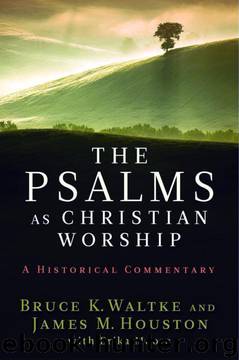
Author:Bruce K. Waltke;James M. Houston
Language: eng
Format: epub
Published: 2011-05-20T23:11:00+00:00
PART I: VOICE OF THE CHURCH
Probably no psalm has generated more diversity of modern interpretation than Psalm 19. For that reason we now focus our survey on interpreters since the introduction of historical Biblical criticism (see pp. 8o-82). Early in the history of HBC, Delitzsch represents an orthodox commentator at the hinge period of the new approach. We then go back to the pastoral Luther and Calvin to show the shift from the allegorical (as impacted by social contextualization) to the plain sense, and draw our survey to conclusion with Aquinas, a monk writing in his cell just prior to the Reformation.
In his Reflections on the Psalms, C. S. Lewis wrote of Psalm 19, "I take this to be the greatest poem in the Psalter and one of the greatest lyrics in the world" Christian poets from Thomas Campion (1567-1620) to Gerard Manley Hopkins and Charles Peguy have given us diverse renderings of this psalm. Haydn's Creation suggests the power this psalm can still express in a work of music. But poetry tends to be suggestive rather than explicit. We feel that understanding Psalm 19 only as a poem fails to grasp its theological unity - its unique character as a psalm of wisdom, thanksgiving, and petition.
By Biblical wisdom we mean that it is God who is the source and giver of knowledge, as applied to life and all its relationships. It is what Augustine calls intellectus Christi, an understanding that only Christ can give us. God then is both the source and premise for the study, and the benefit we may receive in reflecting upon this psalm and discerning its unity. Both creation and torah are expressive of God. But we believe the integration of creation and torah is more profound than previously recognized, even in commentaries that accept the psalm's unity. Orthodox theologians have long recognized the diverse forms of God's general revelation in creation and of his special revelation in Scripture, but they have failed to recognize that without comprehensive knowledge - which only the Creator of all things possesses - absolute or certain knowledge of right and wrong is not possible. Unless one knows ontologically, as only the Creator of all things knows, a mortal's epistemology is at best relative and uncertain. Hence, though unquestionably the psalm has a major break in substance and style at verse 7, shifting from celebrating God as Creator to God as Lawgiver to make mortals wise to salvation, from the psalmist's perspective God's redemptive knowledge revealed in Scripture is absolute and certain because, as the Creator, he is omnicompetent in wisdom/knowledge and power (see commentary). By contrast, introducing alien aspects such as the concept of "nature;' and Pharisaic practices of "the Law," causes tensions in the exegesis of Psalm 19. When the Biblical focus of "I AM" is set before us, both creation and divine revelation together express the same integrated reality in diverse ways. But when unbiblical notions of "nature" and "history" exclude "I AM" as creator and redeemer, then Scripture loses all sense of divine inspiration.
Download
This site does not store any files on its server. We only index and link to content provided by other sites. Please contact the content providers to delete copyright contents if any and email us, we'll remove relevant links or contents immediately.
| Hebrew Bible (Old Testament) | Talmud |
| Torah | Zohar |
The Power of Habit by Charles Duhigg(3128)
Man's Search for Meaning by Viktor E. Frankl(2669)
Mckeown, Greg - Essentialism: The Disciplined Pursuit of Less by Mckeown Greg(2440)
MOSES THE EGYPTIAN by Jan Assmann(2412)
Devil, The by Almond Philip C(2325)
The Complete Dead Sea Scrolls in English (7th Edition) (Penguin Classics) by Geza Vermes(2277)
Unbound by Arlene Stein(2268)
I Capture the Castle by Dodie Smith(2034)
Schindler's Ark by Thomas Keneally(1879)
The Invisible Wall by Harry Bernstein(1799)
The Gnostic Gospel of St. Thomas by Tau Malachi(1793)
The Bible Doesn't Say That by Dr. Joel M. Hoffman(1677)
The Secret Doctrine of the Kabbalah by Leonora Leet(1607)
Political Theology by Carl Schmitt(1577)
The Jewish State by Theodor Herzl(1533)
A History of the Jews by Max I. Dimont(1529)
The Dead Sea Scrolls Bible by Martin G. Abegg(1513)
The Book of Separation by Tova Mirvis(1485)
Oy!: The Ultimate Book of Jewish Jokes by David Minkoff(1369)
