The Curse of the Pharaohs' Tombs by Harrison Paul;
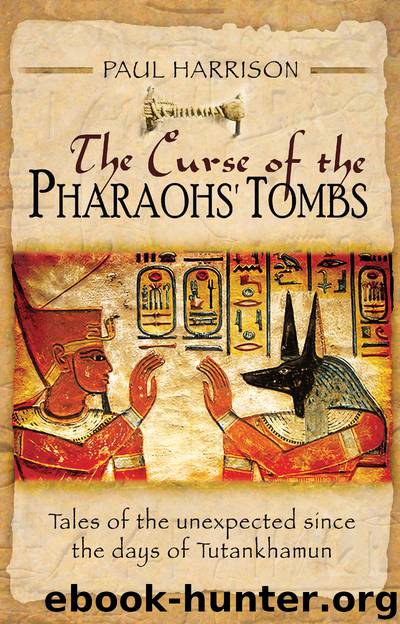
Author:Harrison, Paul;
Language: eng
Format: epub
Publisher: Pen and Sword
Published: 2016-03-25T04:00:00+00:00
Chapter 6
The Dog-Headed Men
The archetypal Western image of an Egyptian god is that of a human form with an animal head, usually that of jackal or dog, like Anubis, although it can be a human with a bird head, such as Thoth. This isn’t an image that has been deliberately inflicted upon us by our modernday culture but rather, through the ancient drawings found inside tombs and at temples that were produced by the Egyptians themselves. There exists a veritable pantheon of such strange and curious looking entities, all of which were worshipped by the people and the great pharaohs themselves. Yet such creatures not only feature in Egyptian culture, but in other civilisations too. The creature we are concerned with here is the dog-headed man, which often appears in tales of curses. A dog-headed creature is sometimes referred to as a cynocephalus, meaning a two-legged human being with the head of a dog. In many cultures such creatures are viewed as savage and a threat. The most infamous of all dog-headed men is the Egyptian god Anubis, yet it was a Greek physician, Ctesias, who first documented such beings in the fifth century BC. He claimed that many such people lived in caves in the mountains of India, communicating by barking at one another and eating nothing but raw meat. He went on to state that these beings kept sheep and fought with swords, bows and spears that were exchanged for amber from fruit trees. He wrote:
The Kynokephaloi living on the mountains do not practise any trade but live by hunting. When they have killed an animal they roast it in the sun. They also rear numbers of sheep, goats, and asses, drinking the milk of the sheep and whey made from it. They eat the fruit of the Siptakhora, whence amber is procured, since it is sweet. They also dry it and keep it in baskets, as the Greeks keep their dried grapes. They make rafts which they load with this fruit together with well-cleaned purple flowers and 260 talents of amber, with the same quantity of the purple dye, and 1000 additional talents of amber, which they send annually to the king of India. They exchange the rest for bread, flour, and cotton stuffs with the Indians, from whom they also buy swords for hunting wild beasts, bows, and arrows, being very skilful in drawing the bow and hurling the spear. They cannot be defeated in war, since they inhabit lofty and inaccessible mountains. Every five years the king sends them a present of 300,000 bows, as many spears, 120,000 shields, and 50,000 swords.
They do not live in houses, but in caves. They set out for the chase with bows and spears, and as they are very swift of foot, they pursue and soon overtake their quarry. The women have a bath once a month, the men do not have a bath at all, but only wash their hands. They anoint themselves three times a month with oil made from milk and wipe themselves with skins.
Download
This site does not store any files on its server. We only index and link to content provided by other sites. Please contact the content providers to delete copyright contents if any and email us, we'll remove relevant links or contents immediately.
| Anthropology | Archaeology |
| Philosophy | Politics & Government |
| Social Sciences | Sociology |
| Women's Studies |
Mysteries by Colin Wilson(3445)
People of the Earth: An Introduction to World Prehistory by Dr. Brian Fagan & Nadia Durrani(2727)
Ancient Worlds by Michael Scott(2682)
The Splendid and the Vile by Erik Larson(2458)
Foreign Devils on the Silk Road: The Search for the Lost Treasures of Central Asia by Peter Hopkirk(2454)
The Memory Code by Lynne Kelly(2396)
Come, Tell Me How You Live by Mallowan Agatha Christie(2249)
The Earth Chronicles Handbook by Zecharia Sitchin(2225)
Lost Technologies of Ancient Egypt by Christopher Dunn(2222)
The Plantagenets by Dan Jones(2085)
Last Chance to See by Douglas Adams(1985)
The Return of the Gods by Erich von Daniken(1929)
Wars of the Anunnaki by Chris H. Hardy(1705)
Keeper of Genesis by Graham Hancock(1642)
Before the Dawn by Nicholas Wade(1600)
The Cygnus Mystery by Andrew Collins(1553)
The Message of the Sphinx by Graham Hancock(1503)
Fragile Lives by Stephen Westaby(1451)
A History of the World in 100 Objects by MacGregor Neil(1364)
