Pushcart prize XXXIV, 2010 : best of the small presses by Henderson Bill 1941-;Pushcart Press & Pushcart Press
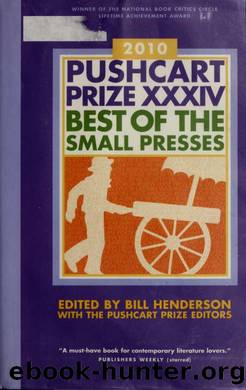
Author:Henderson, Bill, 1941-;Pushcart Press & Pushcart Press
Language: eng
Format: epub
Tags: American literature, American poetry, Small presses, American literature, American poetry, Small presses
Publisher: Wainscott, NY : Pushcart Press ; New York : Distr. by W.W. Norton
Published: 2010-03-15T00:00:00+00:00
small as 4 parts per trillionâan amount equivalent to one drop in 4 million gallons of waterâinduced cancer in rats. In slightly larger doses, the substance brought on virulent symptoms leading to quick death. When barrels of Agent Orange were shown to congress questions about the effects of human exposure began to swell.
By the 1970s, for Vietnamese living and working in spray zones, the answers to these questions had already started to become clear and painful: babies born with massive birth defects, some with skeletons that bended and twisted as they grew, some with organs on the wrong side of skulls and ribs, some with conditions so bad they survived only days. Even though American servicemen came into contact with the toxin over the course of months rather than years, soldiersâparticularly those serving at the apex of Ranch Hand, men dropping on knees to fill canteens with odd-looking water pooled in bomb craters, men walking with handheld weed sprayers around the flanks of base camps, men sleeping on naked groundâstill ran the risk of lethal exposure. The risk was so real, in fact, that as Yale biologist Arthur Gal-ston put it, all soldiers "who worked with Agent Orange or saw duty in the heavily defoliated zones of Vietnam have a legitimate basis for asking the government to look into the state of their health."
Concern about long-term effects on the people and ecology of Vietnam and the health of American G.I.s prompted groups of critical American scientists to publicly denounce the use of Agent Orange and other herbicides as early as the mid-1960s. In 1966 and 1967, a coalition led by the well-respected American Association for the Advancement of Science sent petitions to the Johnson White House calling for an end to all chemical and biological warfare. At the same time, international anxiety was growing. In 1969, after three years of failed attempts, the United Nations succeeded in passingâdespite sustained and often menacing opposition from the U.S.âa resolution declaring Operation Ranch Hand a violation of the 1925 Geneva Convention Protocol limiting the use of chemical weapons. Still, the spraying continued.
Finally, evidence showed up that was too damning to be stonewalled or intimidated away. In late 1969, Matthew Meselson, a broad-shouldered Harvard scientist fond of bow ties and no friend of war boosters, obtained a copy of a National Cancer Institute report confirming the teratogenicityâthe ability of a compound to cause embryonic or fetal malformationâof 2,4,5-T in rats and mice. Meselson convinced Lee DuBridge, his former colleague at the California Insti-
Download
This site does not store any files on its server. We only index and link to content provided by other sites. Please contact the content providers to delete copyright contents if any and email us, we'll remove relevant links or contents immediately.
The Hating Game by Sally Thorne(19238)
The Universe of Us by Lang Leav(15069)
Sad Girls by Lang Leav(14408)
The Lover by Duras Marguerite(7894)
The Rosie Project by Graeme Simsion(6382)
Smoke & Mirrors by Michael Faudet(6184)
Big Little Lies by Liane Moriarty(5790)
The Poppy War by R. F. Kuang(5688)
The Shadow Of The Wind by Carlos Ruiz Zafón(5686)
An Echo of Things to Come by James Islington(4864)
Memories by Lang Leav(4796)
What Alice Forgot by Liane Moriarty(4626)
From Sand and Ash by Amy Harmon(4511)
The Poetry of Pablo Neruda by Pablo Neruda(4098)
The Tattooist of Auschwitz by Heather Morris(3844)
Ficciones by Jorge Luis Borges(3627)
The Rosie Effect by Graeme Simsion(3461)
Guild Hunters Novels 1-4 by Nalini Singh(3460)
THE ONE YOU CANNOT HAVE by Shenoy Preeti(3368)
