Proustian Uncertainties by Saul Friedländer
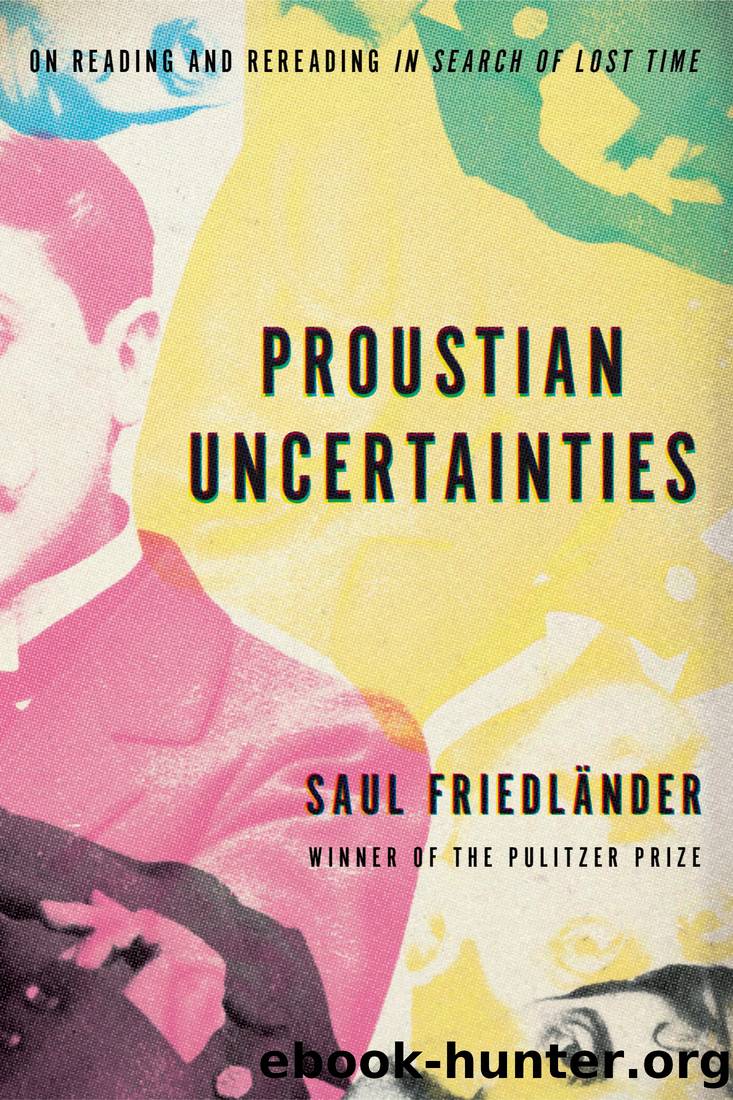
Author:Saul Friedländer [Friedländer, Saul]
Language: eng
Format: epub
Publisher: Other Press
Published: 2020-12-02T00:00:00+00:00
* * *
â
In Proust there is little dying altogether,â Taylor noted, comparing In Search to George Eliotâs Middlemarch, Tolstoyâs War and Peace, and Thomas Mannâs Buddenbrooks. He added: âHaving dramatized the death of the grandmother in The Guermantes Way, heâll dramatize that of Bergotte in The Captive and will then have had enough of dyingâ (Taylor, Proust, 85â86). The remark is not convincing to me. The Narrator may well not describe death on more than the two occasions mentioned by Taylor, but he discusses death in general and his own death at length in several episodes.
It is true that, notwithstanding some deeply felt reflections, the theme is kept within narrow limits, possibly untypical in modern European literature; it may lead us to a general remark about an emotional characteristic of Proustâs chef dâoeuvre: it is a social satire on the grandest scale and an incomparable analysis of complex emotional constructs, but it mostly lacks a sense of tragedy. And here we accede to the wider aspects of this âmoral accounting.â
At some point, in his conversations with Albertine, a chance remark leads the Narrator to a discussion of modern writers, particularly Stendhal, Thomas Hardy, and Fyodor Dostoevsky. This, of course, is but a short conversation on a topic of which Proust was a master, but that Albertine could not have sustained. (For more on Proustâs vast and deep knowledge of classical and modern literature, see his Contre Sainte-Beuve and, among many specialized studies, Anka Muhlsteinâs Monsieur Proustâs Library and Antoine Compagnon, Proust entre deux siècles.)
The main criticism, in the conversation with Albertine, that the Narrator directs to each of the authors aims at proving that from one novel to the next, quasi-identical patterns are used by each of them as symbolic markers and, more concretely, in the description of the main characters. âIsnât the Dostoievsky womanâ¦with her mysterious face, whose engaging beauty changes abruptly, as though her apparent good nature was only play-acting, into terrible insolence (although at heart it seems that she is more good than bad), isnât she always the sameâ¦?â (Search, V, 508).
The Narratorâs remarks may be applicable to some of Dostoevskyâs women, but they do not fit his male characters. Gide devoted a convincing essay to the intrinsic difference between each of the brothers Karamazov (Gideâs essay was published in 1923 but he lectured about it in 1922; Proust could have heard of the argument). In Gideâs essay, while Ivan embodies cold intellect, and Dimitry the world of passion, it is Alyosha, the youngest brother, who represents the religious dimension, the intimation of transcendence.
Let me add that the Narratorâs remark regarding Dostoevskyâs female types is puzzling, as the Narrator himself writes, when reflecting on memory, that he aims at discovering general characteristics under the appearance of diversity: âThere is a feeling for generality which, in the future writer, itself picks out what is general and can for that reason one day enter into a work of artâ (Search, VI, 306).
Notwithstanding the Narratorâs ability to discern under general
Download
This site does not store any files on its server. We only index and link to content provided by other sites. Please contact the content providers to delete copyright contents if any and email us, we'll remove relevant links or contents immediately.
The Hating Game by Sally Thorne(19280)
The Universe of Us by Lang Leav(15083)
Sad Girls by Lang Leav(14431)
The Lover by Duras Marguerite(7908)
The Rosie Project by Graeme Simsion(6421)
Smoke & Mirrors by Michael Faudet(6198)
Big Little Lies by Liane Moriarty(5812)
The Poppy War by R. F. Kuang(5709)
The Shadow Of The Wind by Carlos Ruiz Zafón(5696)
An Echo of Things to Come by James Islington(4888)
Memories by Lang Leav(4806)
What Alice Forgot by Liane Moriarty(4642)
From Sand and Ash by Amy Harmon(4531)
The Poetry of Pablo Neruda by Pablo Neruda(4113)
The Tattooist of Auschwitz by Heather Morris(3850)
Ficciones by Jorge Luis Borges(3642)
The Rosie Effect by Graeme Simsion(3472)
Guild Hunters Novels 1-4 by Nalini Singh(3469)
THE ONE YOU CANNOT HAVE by Shenoy Preeti(3378)
