Primitive Rebels by Eric Hobsbawm
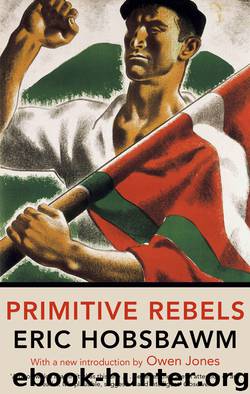
Author:Eric Hobsbawm [Hobsbawm, Eric]
Language: eng
Format: azw3
ISBN: 9780349143002
Publisher: Little, Brown Book Group
Published: 2017-06-01T04:00:00+00:00
Chapter VIII
The Labour Sects
The American and French Revolutions of the 18th century are probably the first mass political movements in the history of the world which expressed their ideology and aspirations in terms of secular rationalism and not of traditional religion. The fact marks a revolution in the life and thought of the common people so profound that its nature is difficult even to appreciate for those of us who have grown up in an epoch when politics is agnostic, whatever the private beliefs of politicians and voters. The modern labour movement is the product of this epoch in two distinct ways. First, because its leading ideology, Socialism (or Communism or Anarchism, which belong to the same family), is the last and most extreme descendant of 18th-century illuminism and rationalism; and second, because the working classes themselves, its supporters, the children of an unprecedented era, were probably as a class less affected by traditional religions than any other social group of men, except for certain limited strata or elite groups such as middle-class intellectuals. This does not mean that workers were or are predominantly agnostic or atheist. It merely means that the historical or individual step from village to town, or from peasant to worker, has in general led to a sharp reduction in the influence of traditional religions and churches. The enquiries which have been made into the religious affiliations and practices of the working classes from the 1840s to the 1950s have almost without exception observed that they are characterized, compared with other classes, by an abnormal degree of religious indifferentism.* Even the exceptions are often more apparent than real for the abnormally religious groups among the working class – in Western Europe they are normally Roman Catholic – are frequently national minorities, such as the Irish in Britain and the Poles in imperial Germany, for whom their specific religion is a badge of nationality as much as anything else. And even they, though more markedly religious than their colleagues, are normally very much less so than their co-religionists at home, who are not members of the working class. As for the leaders and militants of the Socialist movements, they have been almost from the start not merely religiously indifferent, but in general actively agnostic, atheist and anti-clerical.
The characteristic ‘modern’ form of working-class movement is thus purely, if not militantly, secular. However, it would be incredible if the forms and fashions of traditional religion, which had enclosed the lives of the common people from time immemorial, were to have suddenly and completely dropped away. In the early stages of even the strongly secular social and political movements we often observe a sort of nostalgia for the old religions, or perhaps more accurately, an inability to conceive of new ideologies which do not follow the patterns of the old; perhaps with attenuated or transformed gods, perhaps with echoes of the old cults and rituals. The illuminist middle classes themselves had their Masonic Deism, the French Revolution its cults of Reason and the Supreme Being.
Download
This site does not store any files on its server. We only index and link to content provided by other sites. Please contact the content providers to delete copyright contents if any and email us, we'll remove relevant links or contents immediately.
| Anthropology | Archaeology |
| Philosophy | Politics & Government |
| Social Sciences | Sociology |
| Women's Studies |
Mysteries by Colin Wilson(3459)
People of the Earth: An Introduction to World Prehistory by Dr. Brian Fagan & Nadia Durrani(2740)
Ancient Worlds by Michael Scott(2693)
The Splendid and the Vile by Erik Larson(2479)
Foreign Devils on the Silk Road: The Search for the Lost Treasures of Central Asia by Peter Hopkirk(2469)
The Memory Code by Lynne Kelly(2406)
Come, Tell Me How You Live by Mallowan Agatha Christie(2264)
The Earth Chronicles Handbook by Zecharia Sitchin(2235)
Lost Technologies of Ancient Egypt by Christopher Dunn(2227)
The Plantagenets by Dan Jones(2095)
Last Chance to See by Douglas Adams(1995)
The Return of the Gods by Erich von Daniken(1948)
Wars of the Anunnaki by Chris H. Hardy(1718)
Keeper of Genesis by Graham Hancock(1651)
Before the Dawn by Nicholas Wade(1610)
The Cygnus Mystery by Andrew Collins(1563)
The Message of the Sphinx by Graham Hancock(1517)
Fragile Lives by Stephen Westaby(1457)
A History of the World in 100 Objects by MacGregor Neil(1372)
