Nothing Natural Is Shameful by Cadden Joan;
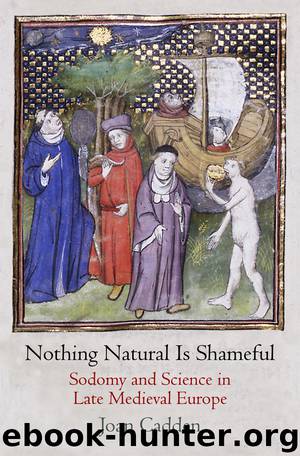
Author:Cadden, Joan;
Language: eng
Format: epub
Publisher: University of Pennsylvania Press
Conclusion: “Less Than Vice” but “More Horrible”
Within the context of Aristotelian ethics, neither the possibility of associating homosexual acts with nail-biting nor the latitude to interpret “beyond the boundaries of vice” as an exemption from responsibility offered a significant cultural haven for men who found themselves described in problema IV.26. Walter Burley struggled with the limitation on the word “vice” or, more literally, “badness,” entailed by Aristotle's argument. First he applied it to unnatural desires, then he excluded people with the very same desires from the spectrum of moral good and bad, and finally, just a few lines later, he reintroduced evil by implicitly postulating a broader, higher, or deeper sort of malitia: “In all these things there can be badness [malitia] beyond the boundaries of human vice [malitia].”117 For Aristotle, this would have pointed to “bad” musicians, but Walter seems to be getting at something else. As Pietro d'Abano's rhetoric has already suggested, his quest for explanations within the parameters of natural philosophy did not cancel his stern disapproval.118 Even those scholars inclined, like Buridan, to represent resistance to unnatural desires as virtually impossible for some people did not erase their associations with cannibalism and matricide. Rather, late medieval intellectuals were likely to agree with Aristotle's evaluation of those who, having lost the powers of reason and choice, have lost the very principle of human virtue: “If bestiality is less than vice, it is, nevertheless, more horrible.”119
Most commentators on the Nicomachean Ethics did, however, note that nature was an elusive standard in moral science, and some confronted directly the difficulties involved in squaring moral responsibility with necessities effected by birth, illness, and even early formed and deeply ingrained habit. Acknowledging the force that these might exercise on an individual opened the gate to explanations of human behavior based on the known principles of the natural world. To varying degrees, commentators regarded this possibility as a danger and took measures to maintain the perimeters. They at least nodded to free will and at most asserted its ability to prevail. In addition, they cordoned off the area in which nature could oppose itself to virtue. When “nature” was taken in its general and primary sense, natural forces, natural order, and natural reason were in complete harmony with each other, and all in turn conformed to moral goodness, divine Providence, and Christian faith. Only local and contingent low-level causes could produce the singular and futureless deformities that might escape the otherwise powerful teleology and stern accountability of moral virtue. Speaking in his Summa of Theology about questions raised by Book VII of the Ethics, Thomas Aquinas summarized the views of many later commentators already encountered above:
For it happens that in a given individual one of the fundamental aspects of the species’ nature is corrupted. And thus what is against the nature of the species becomes natural to that individual by accident—just as water [cold by nature], having been heated, may cause warming. Therefore it happens that what is against the nature of
Download
This site does not store any files on its server. We only index and link to content provided by other sites. Please contact the content providers to delete copyright contents if any and email us, we'll remove relevant links or contents immediately.
Rewire Your Anxious Brain by Catherine M. Pittman(18737)
Talking to Strangers by Malcolm Gladwell(13474)
The Art of Thinking Clearly by Rolf Dobelli(10637)
Mindhunter: Inside the FBI's Elite Serial Crime Unit by John E. Douglas & Mark Olshaker(9450)
Becoming Supernatural by Dr. Joe Dispenza(8303)
Change Your Questions, Change Your Life by Marilee Adams(7875)
Nudge - Improving Decisions about Health, Wealth, and Happiness by Thaler Sunstein(7775)
The Road Less Traveled by M. Scott Peck(7685)
The Lost Art of Listening by Michael P. Nichols(7568)
Mastermind: How to Think Like Sherlock Holmes by Maria Konnikova(7459)
Enlightenment Now: The Case for Reason, Science, Humanism, and Progress by Steven Pinker(7369)
Win Bigly by Scott Adams(7285)
The Way of Zen by Alan W. Watts(6689)
Daring Greatly by Brene Brown(6576)
Big Magic: Creative Living Beyond Fear by Elizabeth Gilbert(5850)
Grit by Angela Duckworth(5686)
Ego Is the Enemy by Ryan Holiday(5563)
The Laws of Human Nature by Robert Greene(5350)
Men In Love by Nancy Friday(5325)
