Is There Anything Good About Men?: How Cultures Flourish by Exploiting Men by Roy F. Baumeister
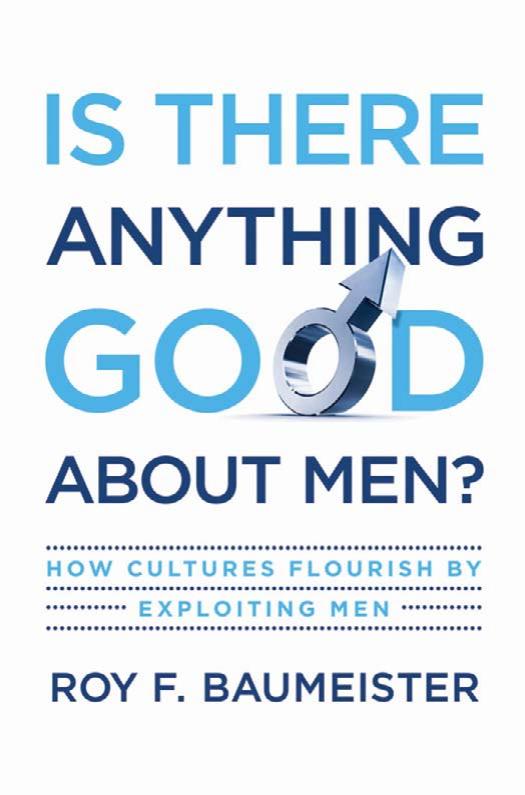
Author:Roy F. Baumeister [Baumeister, Roy F.]
Language: eng
Format: epub, pdf
ISBN: 9780195374100
Barnesnoble:
Publisher: Oxford University Press, USA
Published: 2010-08-12T04:00:00+00:00
C H A P T E R 8
Expendable Beings, Disposable Lives
PROGRESS DOES HAVE its ugly side. Chapter 7 focused on the positive side of culture, including how progress gradually makes life better for one and all. People got healthier, happier, richer, as the march of culture brought one innovation after another. But there have certainly been negative aspects.
The Industrial Revolution started in Great Britain and helped propel it to a position as one of the world’s greatest powers. But the factories that were essential for manufacturing, as well as people’s homes, needed energy, and coal was the primary source. Hence the coal mines became crucial to the nation’s success.
Coal mines were dirty, dangerous places back then. They are undoubtedly better now, but they are still much dirtier and more dangerous than most workplaces.
Complaints and problems about conditions in the mines attracted some attention in England early in the 1800s. A leading statesman, Lord Shaftesbury, was active in trying to make work everywhere more humane, and at his urging Parliament sponsored an investigation into working conditions in the mines. The report was published in 1842. It shocked the public. Hours were long. Accidents were common. Brutal treatment of miners, including small children who pushed the carts and performed other menial services deep in the mines for long hours every day, was found. Lung diseases were linked with working in mines. Immoral behavior was seen also.
Driven by public outrage, the British government, like many others, decided that something needed to be done. And that something was to try 159
160 Is There Anything Good About Men?
to reduce the human toll of suffering, injury, and death. The ideal might have been to prevent anyone from doing such dangerous work. But that wasn’t feasible: The nation needed coal. And so a partial measure was needed. Somehow the country had to balance the need to save valuable lives against the demands of the workplace. The work was risky, but somebody had to do it. The only solution was to leave the work to the most expendable beings in the society.
Men.
The Mines Act of 1842 stipulated that henceforth no children below the age of 10 would be sent to work in the mines. Also no girls or women of any age. That meant that henceforth this dirty, dangerous work would be done exclusively by men, loosely defi ned as males past the age of 10. (Later they raised this to 12.)
In this case, it also meant relatively poor men. Very few rich men would spend much time down in the coal mines. That case is not unusual. The culture values men’s lives quite differently, some far more than others.
Rich men’s lives are valued more than poor men’s lives. Right now U.S.
society is struggling with this in terms of race: If you kill a white person, your prison time tends to be longer than if you kill a black person. This violates the American sense of fair play, which means that all lives should be valued equally. It
Download
Is There Anything Good About Men?: How Cultures Flourish by Exploiting Men by Roy F. Baumeister.pdf
This site does not store any files on its server. We only index and link to content provided by other sites. Please contact the content providers to delete copyright contents if any and email us, we'll remove relevant links or contents immediately.
| Administration & Medicine Economics | Allied Health Professions |
| Basic Sciences | Dentistry |
| History | Medical Informatics |
| Medicine | Nursing |
| Pharmacology | Psychology |
| Research | Veterinary Medicine |
The Art of Thinking Clearly by Rolf Dobelli(10652)
The 5 Love Languages: The Secret to Love That Lasts by Gary Chapman(9958)
Mindhunter: Inside the FBI's Elite Serial Crime Unit by John E. Douglas & Mark Olshaker(9459)
Becoming Supernatural by Dr. Joe Dispenza(8315)
Nudge - Improving Decisions about Health, Wealth, and Happiness by Thaler Sunstein(7794)
The Road Less Traveled by M. Scott Peck(7695)
Mastermind: How to Think Like Sherlock Holmes by Maria Konnikova(7472)
Enlightenment Now: The Case for Reason, Science, Humanism, and Progress by Steven Pinker(7380)
Win Bigly by Scott Adams(7295)
The Way of Zen by Alan W. Watts(6698)
Factfulness: Ten Reasons We're Wrong About the World – and Why Things Are Better Than You Think by Hans Rosling(4817)
The State of Affairs by Esther Perel(4793)
Gerald's Game by Stephen King(4745)
Man's Search for Meaning by Viktor Frankl(4687)
The Confidence Code by Katty Kay(4331)
Thinking in Bets by Annie Duke(4309)
The Healing Self by Deepak Chopra(3681)
Hidden Persuasion: 33 psychological influence techniques in advertising by Marc Andrews & Matthijs van Leeuwen & Rick van Baaren(3612)
The Worm at the Core by Sheldon Solomon(3537)
