Hard-Boiled by Jack Adrian & Bill Pronzini
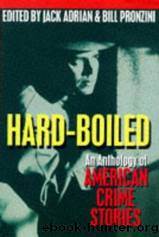
Author:Jack Adrian & Bill Pronzini [Adrian, Jack & Pronzini, Bill]
Language: eng
Format: epub
ISBN: 0195084993
Publisher: Oxford University Press
Published: 1995-05-17T21:00:00+00:00
ELMORE LEONARD
(b. 1925)
The traditional Western story and the hard-boiled crime story are more closely allied than might be apparent at a glance. As is pointed out in the Introduction, hard-boiled fiction can be traced back to the early days of nineteenth-century American life and letters. Viewed in that context, the justice-seeking twentieth-century private eye is a direct descendant not only of James Fenimore Cooperâs Natty Bumppo, but of the frontier lawman and the hard-nosed Pinkerton detective of the last century. The subject matter of the Western story and the contemporary noir story is similar: murder, murder for hire, bank and other types of robbery, kidnapping, extortion. Even such Western-fiction staples as cattle rustling and range wars have present-day counterparts and have been utilized in hard-boiled fiction.
The fundamental kinship between the two genres is one reason that so many writers have worked in both. Carroll John Daly was one of the first âcrossoversâ; Two-Gun Gerta (1926), written in collaboration with C. C. Waddell, chronicles the Mexican border adventures of silent-movie cowboy Red Connors. In the 1920s, when Black Mask regularly featured frontier fiction, Erle Stanley Gardner published several short stories about adventurer Bob Larkin that may be classified as Western; and in the 1930s, he wrote a series of Western-style stories set in the deserts of the Southwest. W. T. Ballard, Norbert Davis, John D. MacDonald, Fredric Brown, and Cornell Woolrich are just a few of the early crossover writers. Contemporary crossovers include Ed Gorman, Loren D. Estleman, Robert J. Randisi, Bill Crider, and Bill Pronzini.
No one, however, has been more successful in both genres than Elmore Leonard. Before he turned to the production of such outstanding urban crime thrillers as Fifty-Two Pickup (1974), Unknown Man No. 89 (1977), and City Primeval (1980), Leonardâs fictional output was confined to Westerns. His early pulp stories, which began appearing in the late 1940s in such magazines as Dime Western, Zane Greyâs Western Magazine, and Argosy, are of uniformly high quality. One of his frontier novels, Hombre (1961), can be found on numerous lists of the best traditional Westerns. Almost as fine are The Bounty Hunters (1953) and Valdez Is Coming (1970). Indeed, and despite the critical acclaim and bestseller status that his later crime novels have brought him, a strong case can be made that his most accomplished and memorable works are Westerns.
Certainly, âThree-Ten to Yuma,â which appeared in Dime Western in March 1953, is Leonard at his best and ranks with Hombre as a Western classic. (The 1957 film version, starring Van Heflin and Glenn Ford, is likewise considered by many to be a classic of its type.) But this tense account of a deputy marshal who undertakes the deadly task of delivering a killer to the Yuma penitentiary is also a distinguished noir story, with all the elements of character, plot, incident, and suspense of the best contemporary thriller. With a few alterations, it might well have been written and published as a tale of the 1990s rather than the 1890s.
B.P.
Download
This site does not store any files on its server. We only index and link to content provided by other sites. Please contact the content providers to delete copyright contents if any and email us, we'll remove relevant links or contents immediately.
The Secret History by Donna Tartt(19066)
Shot Through the Hearth by Kate Carlisle(18770)
Who'd Have Thought by G Benson(16577)
The Betrayed by David Hosp(12779)
Red by Erica Spindler(12566)
Kathy Andrews Collection by Kathy Andrews(11819)
Scorched Eggs by Childs Laura(11346)
Thirteen Reasons Why by Jay Asher(8897)
(2T) A Bone to Pick by Harris Charlaine(7807)
Two Kinds of Truth by Michael Connelly(7439)
Heavenfield: A DCI Ryan Mystery (The DCI Ryan Mysteries Book 3) by LJ Ross(7135)
Small Great Things by Jodi Picoult(7124)
The Thirst by Nesbo Jo(6937)
The Space Between by Michelle L. Teichman(6934)
Pandemic (The Extinction Files Book 1) by A.G. Riddle(6533)
The Rosie Project by Graeme Simsion(6388)
The Vegetarian by Han Kang(6293)
Assassin’s Fate by Robin Hobb(6203)
Vow of Obedience by Veronica Black(5924)
