Freud Encyclopedia by Erwin Edward
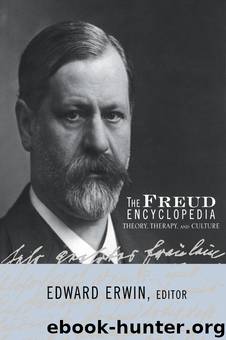
Author:Erwin, Edward
Language: eng
Format: epub
ISBN: 978-1-135-95026-2
Publisher: Routledge
L
Lacan, Jacques (1901-1981)
Jacques Lacan is, arguably, the most important psychoanalytic theorist since Sigmund Freud himself. Lacan is best known for initiating what could be described as a “linguistic turn” in relation to Freudian metapsychology. The statement most often associated with Lacan—in the same way that the thought of Descartes is inextricably linked to the phrase “Cogito, ergo sum”—is “the unconscious is structured like a language” (l’inconscient est structuré comme un langage.) However, his sizable oeuvre, spanning the years 1932 to 1980, cannot be adequately encapsulated by this single claim extracted from a particular period of his teaching. Rather than being a homogeneous set of dogmatic assertions, Lacan’s work represents an ongoing, evolving interrogation of what it means to be a subject in light of the discovery of the unconscious.
Lacan’s first major text to appear was his 1932 doctoral thesis in psychiatry: De la psychose paranoïaque dans ses rapports avec la personnalité (Of Paranoid Psychosis in Its Relations with the Personality.) In his thesis, the young Lacan (who, at this early stage in his career, was just beginning to grapple with Freud from within the context of French medical psychiatry) advanced the viewpoint that various mental pathologies are not reducible to an explanation/diagnosis based on organic criteria alone; that is to say, for certain mental illnesses, the underlying causal mechanisms are not brain lesions or any sort of physical defect. Instead, he proposed that specific pathological states are the result of certain (dys)functions in the structure of the “personality,” and he proceeded to redefine the very concept of personality in conjunction with this proposal. Foreshadowing much of his later work (but couched within a prestructuralist and non-Freudian parlance), Lacan spoke of the subject’s personality as a dense, multilayered apparatus constructed out of a diverse group of linguistic, imagistic, and sociocultural elements.
In 1936, one of the most famous Lacanian concepts was unveiled: the mirror stage. At the fourteenth international congress of the International Psychoanalytic Association held at Marienbad, Czechoslovakia, Lacan delivered a paper whose title, as recorded in the minutes of the congress meetings, was “The Looking Glass Phase.” Evidently, as accounts have it, Lacan, ten minutes into his presentation, was interrupted by Ernest Jones (then the presiding president of the IPA). No written record remains of the 1936 version of the paper (only the 1949 version of the mirror stage essay is available, this being the one published in the 1966 Écrits.) In the published version, drawing upon various influences (such as Freud, Henri Wallon, and Alexandre Kojève), Lacan presented a detailed account of the origins and essence of the psychoanalytically conceived ego. Supplementing Freud’s own analyses of this psychical agency (most notably, as presented in such texts as On Narcissism: An Introduction [1914], Mourning and Melancholia [1917], Group Psychology and the Analysis of the Ego [1921], The Ego and the Id [1923], and The Splitting of the Ego in the Process of Defense [1938]), Lacan argued that the nucleus of the ego consists in the “Imaginary imago,” namely, in the reflected images that the individual comes to identify as a “self (i.
Download
This site does not store any files on its server. We only index and link to content provided by other sites. Please contact the content providers to delete copyright contents if any and email us, we'll remove relevant links or contents immediately.
Rewire Your Anxious Brain by Catherine M. Pittman(18638)
Talking to Strangers by Malcolm Gladwell(13342)
The Art of Thinking Clearly by Rolf Dobelli(10443)
Mindhunter: Inside the FBI's Elite Serial Crime Unit by John E. Douglas & Mark Olshaker(9313)
Becoming Supernatural by Dr. Joe Dispenza(8196)
Change Your Questions, Change Your Life by Marilee Adams(7753)
Nudge - Improving Decisions about Health, Wealth, and Happiness by Thaler Sunstein(7689)
The Road Less Traveled by M. Scott Peck(7592)
The Lost Art of Listening by Michael P. Nichols(7487)
Mastermind: How to Think Like Sherlock Holmes by Maria Konnikova(7313)
Enlightenment Now: The Case for Reason, Science, Humanism, and Progress by Steven Pinker(7305)
Win Bigly by Scott Adams(7183)
The Way of Zen by Alan W. Watts(6594)
Daring Greatly by Brene Brown(6501)
Big Magic: Creative Living Beyond Fear by Elizabeth Gilbert(5752)
Grit by Angela Duckworth(5598)
Ego Is the Enemy by Ryan Holiday(5412)
Men In Love by Nancy Friday(5231)
The Laws of Human Nature by Robert Greene(5166)
