Criminology Goes to the Movies: Crime Theory and Popular Culture by Nicole Rafter & Michelle Brown
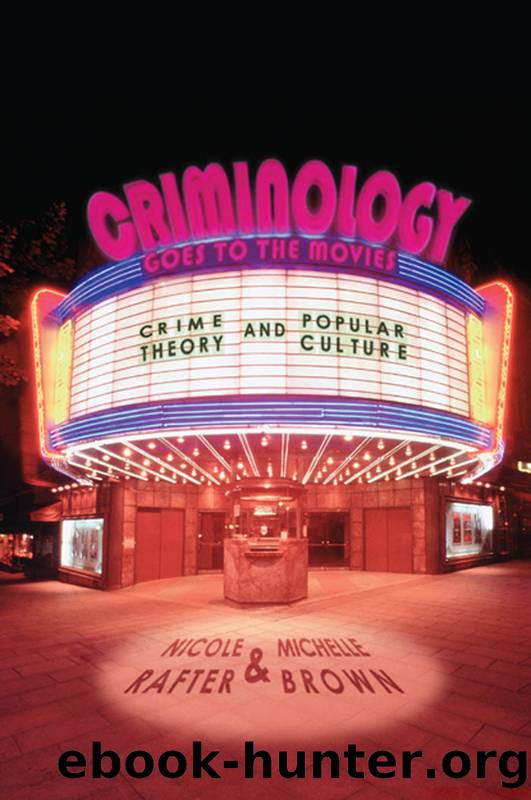
Author:Nicole Rafter & Michelle Brown [Rafter, Nicole & Brown, Michelle]
Language: eng
Format: epub
Tags: law, Criminal Law, General, Media & the Law
ISBN: 9780814776513
Google: ISEVCgAAQBAJ
Publisher: NYU Press
Published: 2011-09-15T00:10:43.845523+00:00
Sutherland and the Cinema: Life Histories and White-Collar Crime
We have been discussing cinematic examples of subcultural theory, movies that extend the work of Sutherland and other Chicago school scholars. In the next section we discuss ways in which film has extended two other aspects of Sutherlandâs research, his life-history approach to the study of crime and his innovative research on white-collar offending.
Criminal Life Histories
The life-history approach to understanding criminal behavior began in 1930, when Clifford Shaw, a leader of the Chicago school, published The Jack-Roller, the biography of a young parolee (called Stanley in the book).31 Delinquency specialists had been collecting case histories for many years, but The Jack-Roller was a unique and riveting work. It validated a new method in criminological researchâthe âown storyâ approach to the study of delinquencyâand it was inherently sensational: a jack roller supports himself by assaulting homosexual men and stealing their money. Stanley had been arrested twenty-six times by the age of ten for offenses including truancy, begging, âbad sex habits,â and shoplifting as well as jack rolling. The Jack-Roller offered what came to be dubbed âsociology noir,â a work of gritty immediacy and underworld allure.32 Shaw saw a number of advantages to the life-history approach, including the light it could throw on the causes of delinquency and the guidance it could provide for individualizing treatment.33 The Jack-Roller remains a high-profile memoir; in 2007 the journal Theoretical Criminology ran an entire issue of articles on Shawâs classic.34
Seven years later, Sutherland published The Professional Thief: By a Professional ThiefâBroadway Jones, to whom Sutherland gave the pseudonym Chic Conwell.35 Although The Jack-Roller doubtless gave Sutherland a sense of direction, he was less concerned to produce a biography than to study the phenomenon of professional theft (highly polished stealing by expert thieves) per se. Conwellâs story comprises part I of The Professional Thief, but it was edited and annotated by Sutherland, and part II, âInterpretation and Conclusion,â is entirely Sutherlandâs work. The Professional Thief inaugurated the behavior-system approach to the study of specific offense types that persists unabated today. It also influenced later work on career criminals and life-course criminology.
Sutherland builds The Professional Thief on his usual assumption that criminal behavior is normal, a type of activity that, like all behaviors, is learned in interaction with others. âDifferential association,â he writes, âis characteristic of the professional thieves, as of all other groups.â36 He also shows that professional thieves constitute a subculture: âThe thief is a part of the underworld and in certain respects is segregated from the rest of society.â37 Sutherland maintains that Conwell came from a middle-class background (âhis family was in comfortable circumstancesâ),38 a claim that reinforces Sutherlandâs contention that poverty does not cause crime. And in showing how Conwell learned to be a professional thief, Sutherland supports what he came to call his differential social organization thesis.39 A critic has questioned some of The Professional Thiefâs data, arguing, for instance, that Jones/Conwell was probably working-class in origin.40 Moreover, despite Sutherlandâs claim that âthe thief
Download
This site does not store any files on its server. We only index and link to content provided by other sites. Please contact the content providers to delete copyright contents if any and email us, we'll remove relevant links or contents immediately.
Kathy Andrews Collection by Kathy Andrews(12018)
The remains of the day by Kazuo Ishiguro(9131)
Spare by Prince Harry The Duke of Sussex(5301)
Paper Towns by Green John(5269)
The Body: A Guide for Occupants by Bill Bryson(5220)
Industrial Automation from Scratch: A hands-on guide to using sensors, actuators, PLCs, HMIs, and SCADA to automate industrial processes by Olushola Akande(5104)
Machine Learning at Scale with H2O by Gregory Keys | David Whiting(4400)
Be in a Treehouse by Pete Nelson(4123)
Never by Ken Follett(4077)
Harry Potter and the Goblet Of Fire by J.K. Rowling(3940)
Goodbye Paradise(3892)
The Remains of the Day by Kazuo Ishiguro(3498)
Into Thin Air by Jon Krakauer(3494)
Fairy Tale by Stephen King(3484)
The Cellar by Natasha Preston(3415)
The Genius of Japanese Carpentry by Azby Brown(3368)
120 Days of Sodom by Marquis de Sade(3347)
Reminders of Him: A Novel by Colleen Hoover(3312)
The Man Who Died Twice by Richard Osman(3152)
