Committed Action in Practice by Daniel J. Moran
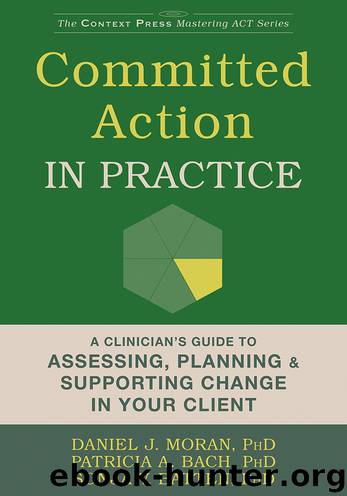
Author:Daniel J. Moran
Language: eng
Format: epub
Publisher: New Harbinger Publications
Published: 2018-09-18T22:52:20+00:00
The goal of this exercise is to gain a refreshed, personal experience of what it’s like to commit to a personally relevant goal, so that when you ask clients to engage in similar processes, you do so more from a stance of shared experience. This exercise can also help you generate hypotheses about barriers that may be getting in the way of clients’ committed actions—although it’s always important to remember that everyone’s experience is different. Therefore, use your own experience to approach such conversations in a compassionate way, without making assumptions about clients’ experiences. Such conversations generally go best if the therapeutic relationship allows the client to openly disagree with your suggestions and interpretations and to share her own understanding of what hampered or facilitated her committed actions.
The Therapeutic Relationship as the Context for Committed Action
At times, it can be extremely powerful for therapists to actively model and demonstrate committed action in session. One way to do this is to be on the lookout for a stuck point in the therapeutic process or the therapeutic relationship and then openly talk with the client about the therapist’s own experience of feeling stuck (or disappointed, or sad, and so on). After nonjudgmentally describing the situation, the therapist can then work on identifying instances when the precipitating circumstance arises in session and openly noticing whatever shows up for him in those moments. Then he can talk through the choice point he’s encountering and model in real time how to choose an action in line with one’s values in the face of a difficult moment or situation.
For example, imagine a therapist who’s had a very hectic day at work so far, who didn’t sleep well the previous night because his daughter was sick, and who feels like he’s coming down with a head cold. He realizes about five minutes into a session that he’s distracted by his own mental and physical experiences and not paying very close attention to what his client is saying. In the context of a strong therapeutic relationship, he might say: “I’m sorry. I have to pause the conversation here for a moment. I’m just noticing that I’m not at my best today. I didn’t sleep well and have had such a chaotic day that I haven’t even fully gotten into the room so that I can be present with you and what you need today. And, what’s important to me is to make good use of our time together and really focus on this moment and listening carefully to you. If it’s okay with you, I’d like it if we could do a brief mindfulness activity together first. And then, when we come back to what you were talking about, my commitment is to stay present in the moment with you. And when I inevitably find myself getting distracted by my own busy mind or tired body, I commit to noticing that, taking a deep breath, and then coming back to our work together.”
A therapeutic move like this might
Download
This site does not store any files on its server. We only index and link to content provided by other sites. Please contact the content providers to delete copyright contents if any and email us, we'll remove relevant links or contents immediately.
Rewire Your Anxious Brain by Catherine M. Pittman(18711)
Talking to Strangers by Malcolm Gladwell(13440)
The Art of Thinking Clearly by Rolf Dobelli(10598)
Mindhunter: Inside the FBI's Elite Serial Crime Unit by John E. Douglas & Mark Olshaker(9420)
Becoming Supernatural by Dr. Joe Dispenza(8277)
Change Your Questions, Change Your Life by Marilee Adams(7847)
Nudge - Improving Decisions about Health, Wealth, and Happiness by Thaler Sunstein(7758)
The Road Less Traveled by M. Scott Peck(7662)
The Lost Art of Listening by Michael P. Nichols(7548)
Mastermind: How to Think Like Sherlock Holmes by Maria Konnikova(7432)
Enlightenment Now: The Case for Reason, Science, Humanism, and Progress by Steven Pinker(7354)
Win Bigly by Scott Adams(7262)
The Way of Zen by Alan W. Watts(6671)
Daring Greatly by Brene Brown(6557)
Big Magic: Creative Living Beyond Fear by Elizabeth Gilbert(5833)
Grit by Angela Duckworth(5673)
Ego Is the Enemy by Ryan Holiday(5527)
The Laws of Human Nature by Robert Greene(5325)
Men In Love by Nancy Friday(5292)
