Cities That Shaped the Ancient World by John Julius Norwich
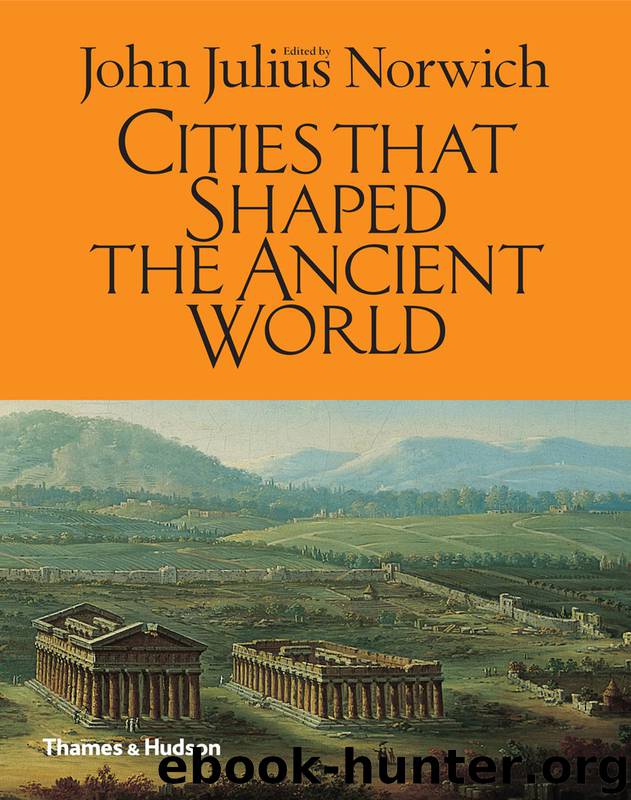
Author:John Julius Norwich
Language: eng
Format: epub
Publisher: Thames & Hudson
Published: 2017-02-21T05:00:00+00:00
Athena and Poseidon on a red-figure krater from south Italy. Traditionally the two deities fought for ‘ownership’ of Athens – Athena eventually winning out. By linking the city to the port of Piraeus via its long walls in the 5th century BC, Athenians also ensured they kept the god of the sea on side.
Gianni Dagli Orti/Musée du Louvre, Paris/The Art Archive.
The Agora was no longer the home of the dead, but of life. A place where fountains were untapped, where musical recitals were held, where soldiers drilled, where offerings were made to immortals at fragrant altars and where administrators met to standardize the business of democratic living. During the 6th and 5th centuries the market here developed, slaves were sold alongside pyramids of figs and opiates, fresh fish, woven cloth straight off the loom, and aromatic oils from the east. The tang of newly excavated minerals, newly minted silver coins would have been in the air, the taste of exotically seasoned stews, cooked on outdoor stoves, on the tongue.
We think of Athens as a city of marble and stone yet at its height there was something distinctly floral about the place. Men and women flooded in from the hills and plains of Attica, and the craftsmen, stonemasons and painters – whether consciously or not – brought rus in urbe. Lilies unfurled on masonry, on vases olive trees were shaken, and architraves were shaded with a canopy of carved green. The lost rivers, the Eridanos and the Illyssos (today blocked underground), flowed free. At rituals across the city and during the Mysteries of Eleusis, maidens wreathed in laurel and vines, or carrying pungent, flaming pine-torches, adored and honoured the turn of the seasons. In the Agora protecting rows of plane trees were planted. All around the city forests of stelae (carved stone blocks) sprang up, inscribed with the workings and decisions of the democratic assembly.
And of course the imperial influence brought with it seeds of intellect: scientists from the west coast of Asia Minor, rhetoricians from Sicily, philosophers from Thessaly and Macedonia. Just imagine the hubbub – the Athenians had a name for it even – the thorubos – the buzz of opinion and dissent in the streets, the council chambers, the assembly, the Agora, and at those famous symposia that Plato, Aristophanes et al. have immortalized, where wit and wine flowed, where poetry was sung and schemes of self-advancement were hatched.
Download
This site does not store any files on its server. We only index and link to content provided by other sites. Please contact the content providers to delete copyright contents if any and email us, we'll remove relevant links or contents immediately.
| Africa | Americas |
| Arctic & Antarctica | Asia |
| Australia & Oceania | Europe |
| Middle East | Russia |
| United States | World |
| Ancient Civilizations | Military |
| Historical Study & Educational Resources |
Underground: A Human History of the Worlds Beneath Our Feet by Will Hunt(12101)
Sapiens by Yuval Noah Harari(5375)
Navigation and Map Reading by K Andrew(5161)
The Sympathizer by Viet Thanh Nguyen(4398)
Barron's AP Biology by Goldberg M.S. Deborah T(4159)
5 Steps to a 5 AP U.S. History, 2010-2011 Edition (5 Steps to a 5 on the Advanced Placement Examinations Series) by Armstrong Stephen(3737)
Three Women by Lisa Taddeo(3437)
Water by Ian Miller(3192)
The Comedians: Drunks, Thieves, Scoundrels, and the History of American Comedy by Nesteroff Kliph(3082)
Drugs Unlimited by Mike Power(2602)
A Short History of Drunkenness by Forsyth Mark(2302)
DarkMarket by Misha Glenny(2214)
And the Band Played On by Randy Shilts(2213)
The House of Government by Slezkine Yuri(2210)
The Library Book by Susan Orlean(2073)
Revived (Cat Patrick) by Cat Patrick(1994)
The Woman Who Smashed Codes by Jason Fagone(1976)
The Absolutely True Diary of a Part-Time Indian by Sherman Alexie(1916)
Birth by Tina Cassidy(1908)
