Can American Capitalism Survive? by Steven Pearlstein
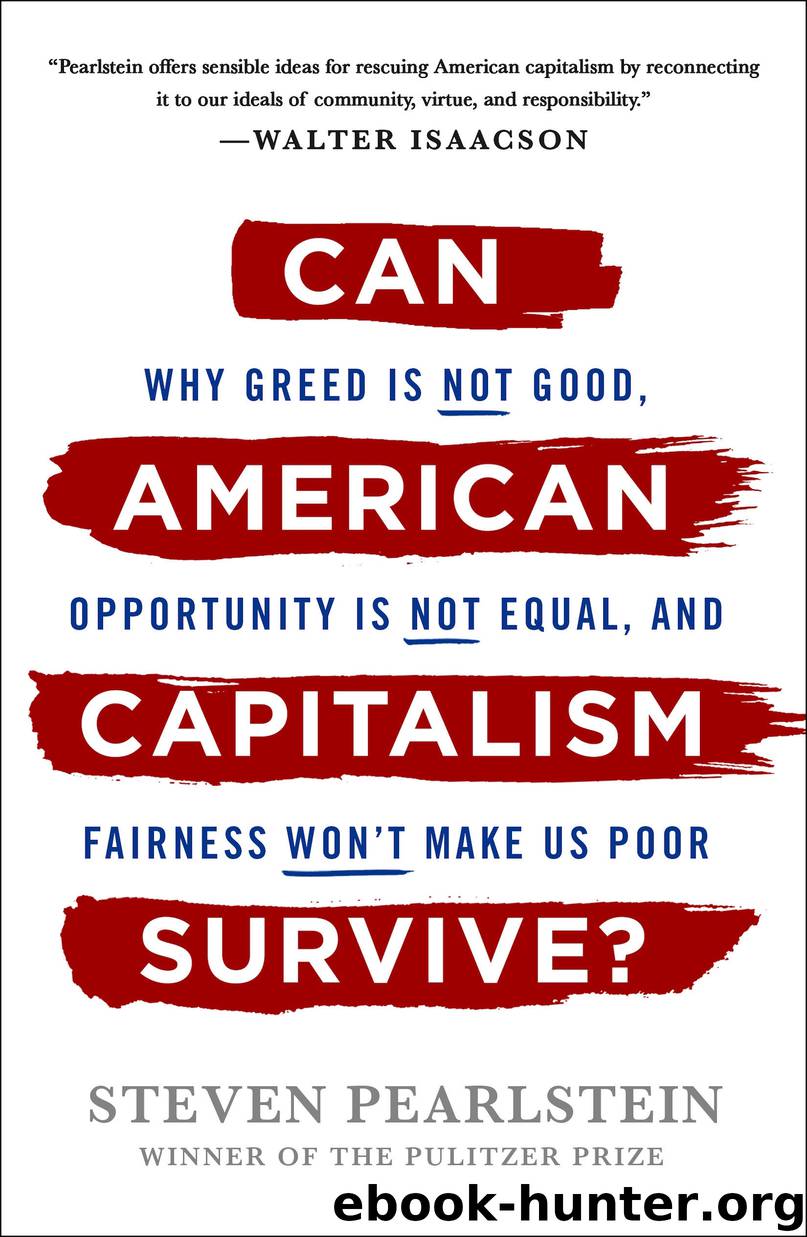
Author:Steven Pearlstein
Language: eng
Format: epub
Publisher: St. Martin's Press
4
Fairness and Growth—A False Choice
Before and after the state of Israel was founded in 1948, a small but important segment of its economy was organized around kibbutzim, socialist collectives in which the land, housing, buildings and equipment were owned by all residents, who shared equally in what was produced and how the commune was governed.
Initially, the kibbutzim were successful in helping to make the desert bloom and lay the foundation for a successful society and a successful economy. But in time—or so the standard story goes—their egalitarian solidarity began to erode. The most productive workers came to resent carrying those who were less talented or hardworking, so they moved to the cities where they would get a better reward. As they did, the average productivity and standard of living back on the kibbutzim began to decline, prompting the next-most-productive workers to defect. Eventually, this vicious cycle led many kibbutzim to close as all but the most ideologically committed members concluded they could do better in the more market-like economy.1
Among defenders of free markets, the story of the kibbutzim is a parable of the failure of egalitarian income distribution. The lesson they draw from it—and more broadly from the failure of communist and socialist economies during the twentieth century—is that without significant differences in income, the productive will expect no extra reward for their dedication and creativity and the unproductive no punishment for their sloth and lack of ambition. Inequality, they believe, and a good amount of it, is the inevitable consequence of an incentive structure that rewards the hard work, innovation, risk-taking, skills development, savings and investment that raise everyone’s standard of living. By that standard, the distribution of income in a market economy must be judged to be fair and just.
As students of philosophy have long recognized, however, the utilitarian criterion of creating the greatest good for the greatest number demands more than just producing the largest economy. Overall well-being would also be increased if money were redistributed from those who had more than enough to satisfy their worldly needs and desires to those whose needs were still unmet. After all, the last dollar of income earned by Bill Gates will do much less to improve his happiness than it would for a working single mom struggling to feed her children. And, if that is the case, providing the greatest good for the greatest number also must involve redistributing at least some income from those who have so much to those who have so little.
This tension between wanting to generate a bigger pie and wanting to cut the slices more equally has long bedeviled both moralists and economists—“the big tradeoff,” as economist Arthur Okun famously called it.2 We can either have faster growth and higher incomes by allowing the market to reward individual effort, however unequal the distribution, or we can have a more equal distribution of income that better comports with our other moral intuitions about fairness and need. Our dilemma, identified long ago by Bernard Mandeville and
Download
This site does not store any files on its server. We only index and link to content provided by other sites. Please contact the content providers to delete copyright contents if any and email us, we'll remove relevant links or contents immediately.
50 Economics Classics by Tom Butler-Bowdon(2610)
Why Nations Fail: The Origins of Power, Prosperity, and Poverty by Daron Acemoglu & James Robinson(2332)
Six Billion Shoppers by Porter Erisman(2330)
No Time to Say Goodbye(2145)
Red Notice by Bill Browder(2112)
Currency Trading For Dummies by Brian Dolan(1956)
The Economist [T6, 22 Thg9 2017] by The Economist(1941)
Thank You for Being Late by Thomas L. Friedman(1796)
Bitcoin: The Ultimate Guide to the World of Bitcoin, Bitcoin Mining, Bitcoin Investing, Blockchain Technology, Cryptocurrency (2nd Edition) by Ikuya Takashima(1718)
Amazon FBA: Amazon FBA Blackbook: Everything You Need To Know to Start Your Amazon Business Empire (Amazon Empire, FBA Mastery) by John Fisher(1593)
Coffee: From Bean to Barista by Robert W. Thurston(1579)
The Future Is Asian by Parag Khanna(1508)
The Great Economists by Linda Yueh(1479)
Grave New World by Stephen D. King(1452)
How Money Got Free: Bitcoin and the Fight for the Future of Finance by Brian Patrick Eha(1445)
Pocket World in Figures 2018 by The Economist(1442)
Capitalism Without Capital: The Rise of the Intangible Economy by Jonathan Haskel(1427)
The Sex Business by Economist(1404)
Cultural Intelligence by David C. Thomas(1314)
