Born to Be Wild: Why Teens Take Risks, and How We Can Help Keep Them Safe by Jess Shatkin
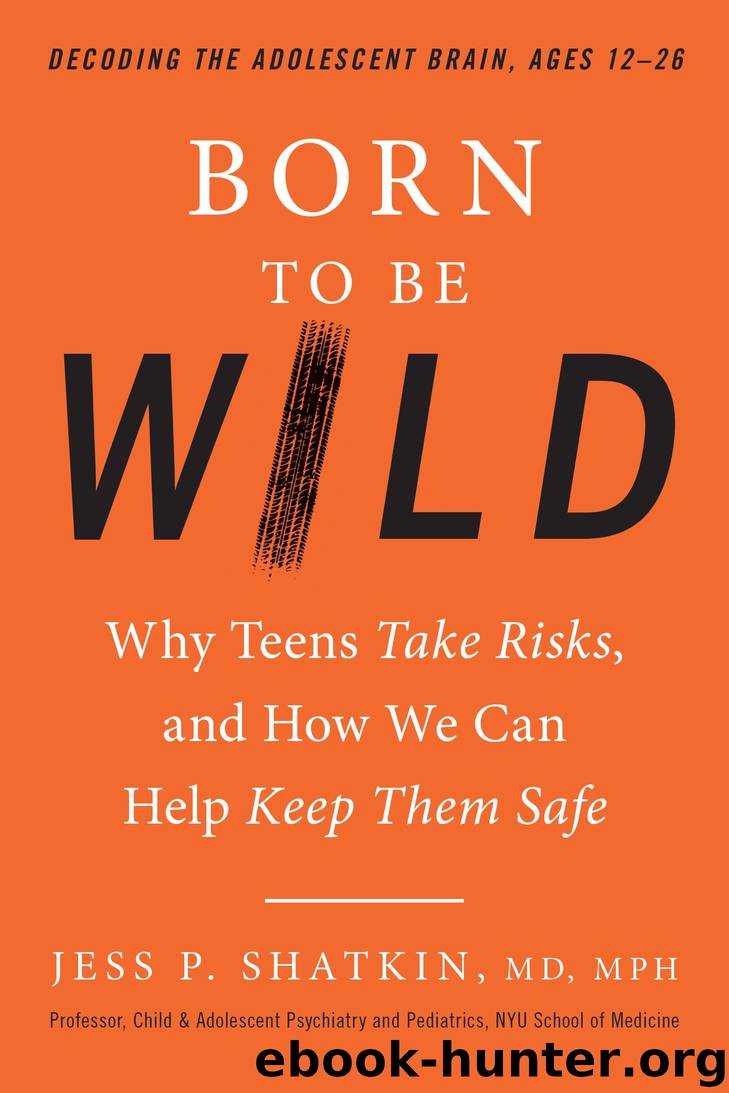
Author:Jess Shatkin
Language: eng
Format: epub
Publisher: Penguin Publishing Group
Published: 2017-10-03T04:00:00+00:00
Fuzzy Trace
Right about here, I hit a snag in my research: How do we reconcile the seeming contradiction that adults know much more than adolescents, have better and more streamlined mental processing, and have more advanced analytic thinking, but preferentially use less of that sophisticated processing power, not more, when making decisions in risky situations? So let’s take a closer look.
One of the most important thinkers in child development in the past century was the Swiss psychologist Jean Piaget. I remarked in chapter 5 that at the core of Piaget’s developmental schema was the growth of cognition and reasoning. He believed that adolescents eventually arrive at the ability to abstract and explain their thinking, at which time they are developmentally mature. Piaget’s ideas run hand in hand with the development of Daniel Kahneman’s System 1 and System 2, as we discussed in chapter 6, and other Cartesian dualist models of cognitive development; that is, when we’re young, we function innately via fast System 1 (automatic thinking), and as we age, we become more conscious and aware of our own thought processes, acting more deliberately via slow System 2 (effortful thinking). This model also parallels the neurodevelopmental model we discussed in chapter 3: The emotional, or limbic, brain and primitive reward systems develop early, while the prefrontal cortex, or cognitive control system (the brain’s CEO), develops later. However, experimental evidence has thrown us a curveball. We now know from studies of firefighters and pilots and critical care nurses and doctors and other high-risk professions that mature decision makers rarely stop to deliberate at a moment of high-stakes risk; rather, they act based upon an internalized sense of what to do without consciously considering all of the possibilities one by one. Clearly, being able to explain your thinking isn’t the same thing as being able to act effectively at a moment of risk, but most of us tend to think it is.
“To most people, being rational means that we can solve logic problems,” Valerie Reyna, professor of human development and psychology at Cornell University, told me. “So we think that more advanced cognition is abstract and allows for rational thought; this is just part of Western philosophy. But the development of logic simply doesn’t come to grips with how adolescents make decisions around risk. In fact, they can be too logical.”
To explain how it is that our logic and abstract thinking improve with age while our decision making in high-risk situations becomes less analytical, Valerie Reyna and her colleague Charles Brainerd developed “fuzzy-trace theory.” The essential idea is that adults have a preference for “fuzzy processing,” or relying upon the least precise mental representation needed to make a decision. Said another way, adults tend to base their decisions less upon precise details and more upon general meanings.
Fuzzy-trace theory posits the existence of two thought processes, labeled “verbatim” and “gist.” Unlike traditional Cartesian dualist theories, however, fuzzy trace suggests that people of every age form both types of mental representations, verbatim and gist,
Download
This site does not store any files on its server. We only index and link to content provided by other sites. Please contact the content providers to delete copyright contents if any and email us, we'll remove relevant links or contents immediately.
Rewire Your Anxious Brain by Catherine M. Pittman(18733)
Talking to Strangers by Malcolm Gladwell(13465)
The Art of Thinking Clearly by Rolf Dobelli(10632)
Mindhunter: Inside the FBI's Elite Serial Crime Unit by John E. Douglas & Mark Olshaker(9444)
Becoming Supernatural by Dr. Joe Dispenza(8295)
Change Your Questions, Change Your Life by Marilee Adams(7872)
Nudge - Improving Decisions about Health, Wealth, and Happiness by Thaler Sunstein(7769)
The Road Less Traveled by M. Scott Peck(7677)
The Lost Art of Listening by Michael P. Nichols(7563)
Mastermind: How to Think Like Sherlock Holmes by Maria Konnikova(7453)
Enlightenment Now: The Case for Reason, Science, Humanism, and Progress by Steven Pinker(7361)
Win Bigly by Scott Adams(7280)
The Way of Zen by Alan W. Watts(6681)
Daring Greatly by Brene Brown(6571)
Big Magic: Creative Living Beyond Fear by Elizabeth Gilbert(5846)
Grit by Angela Duckworth(5681)
Ego Is the Enemy by Ryan Holiday(5553)
The Laws of Human Nature by Robert Greene(5349)
Men In Love by Nancy Friday(5322)
