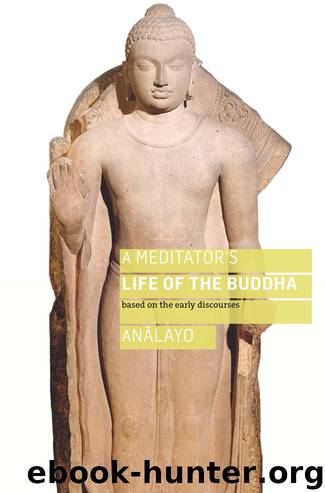
A Meditator's Life of the Buddha by Analayo
Author:Analayo
Language: eng
Format: epub
Publisher: Windhorse Publications
A minor difference is that in the Saṃyutta-nikāya discourse the Buddha does not explicitly tell the monastics in his audience that they should make an effort in cultivating the awakening factors, although the same can safely be assumed to be implicit.
For such cultivation, the instructions in the Sabbāsava-sutta and its parallel point to a recurring mode in which these seven awakening factors should be developed in order to ripen in awakening. In my study Perspectives on Satipaṭṭhāna I discussed this in more detail from a practical viewpoint.11 The account of the Buddha’s progress to awakening provides further depth to these instructions, as the four aspects of seclusion, dispassion, cessation, and letting go/liberation to some extent seem to correspond to key elements of the report of what happened on the night of the Buddha’s awakening.
In the case of the Buddha’s progress to awakening, the precondition for the three higher knowledges was his attainment of the fourth absorption, which establishes a supremely firm degree of seclusion. In fact the notion of seclusion is explicitly mentioned already in the standard account of the first absorption, which is secluded from sensuality and unwholesome states and results in the experience of joy and happiness born of such seclusion.
The first higher knowledge of recollecting his own former lives would have functioned as a catalyst for dispassion. Of course dispassion towards saṃsāra is a continuous theme throughout the Buddha’s whole quest, but this trajectory could well have reached its culmination point when he recalled all his various former existences and witnessed the various ups and downs he had experienced in the past.
The second higher knowledge of the divine eye completed his direct insight into the working mechanism of karma, showing this to be a general principle applicable to living beings. This knowledge stands in close relationship to the principle of dependent arising, which is fully understood with the cessation of its links. The inclination of the Buddha-to-be towards achieving the cessation mode of dependent arising seems a significant implication of this part of the night of his awakening.
Such inclining would have been based on his insight into the reciprocal conditioning between consciousness and name-and-form, which he would have gained with the first and the second higher knowledge. This insight would have made it clear to him that he had to find a way of going beyond both consciousness and name-and-form, in order to achieve the cessation of ignorance that fuels their continuous interplay from one life to the next. In other words, he had to find a way of going beyond the whole gamut of experience in order to step out of the reciprocal conditioning relationship between consciousness and name-and-form.
Clearly, the solution could not be found by refining or subduing perception, comparable to what he had done when training under his two teachers Āḷāra Kālāma and Uddaka Rāmaputta. Any such approach does not transcend the limits of the conditionality of consciousness and name-and-form. Instead, he now had to let go of perception altogether, allowing it to cease
Download
This site does not store any files on its server. We only index and link to content provided by other sites. Please contact the content providers to delete copyright contents if any and email us, we'll remove relevant links or contents immediately.
The Way of Zen by Alan W. Watts(6600)
Ego Is the Enemy by Ryan Holiday(5413)
The Art of Happiness by The Dalai Lama(4125)
The Book of Joy by Dalai Lama(3976)
Why Buddhism is True by Robert Wright(3446)
Spark Joy by Marie Kondo(3298)
Shift into Freedom by Loch Kelly(3193)
Happiness by Matthieu Ricard(3040)
A Monk's Guide to a Clean House and Mind by Shoukei Matsumoto(2908)
The Lost Art of Good Conversation by Sakyong Mipham(2650)
The Meaning of the Library by unknow(2564)
The Unfettered Mind: Writings from a Zen Master to a Master Swordsman by Takuan Soho(2306)
The Third Eye by T. Lobsang Rampa(2257)
Anthology by T J(2206)
Red Shambhala by Andrei Znamenski(2193)
The Diamond Cutter by Geshe Michael Roach(2058)
Thoughts Without A Thinker: Psychotherapy from a Buddhist Perspective by Epstein Mark(2012)
Twilight of Idols and Anti-Christ by Friedrich Nietzsche(1892)
Advice Not Given by Mark Epstein(1878)
