What Is Classical Liberal History? by Michael J. Douma
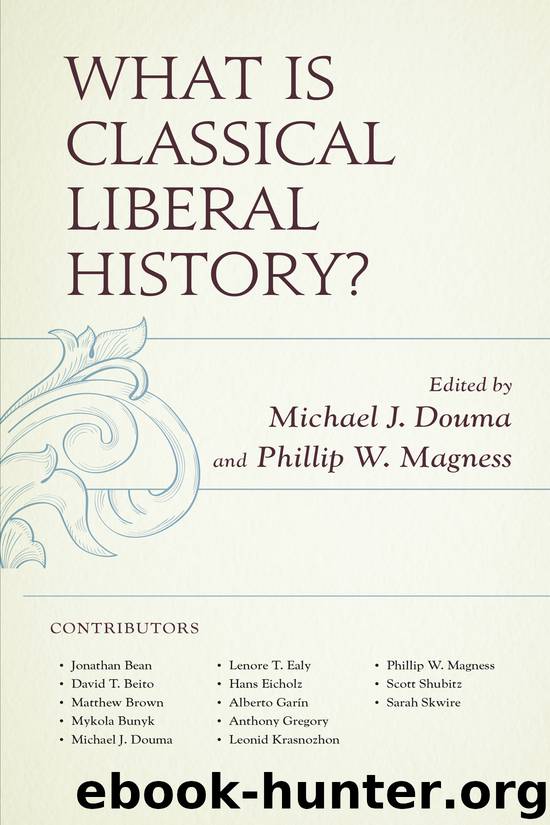
Author:Michael J. Douma
Language: eng
Format: epub
ISBN: 9781498536110
Publisher: Lexington Books
Chapter 6
A Manifesto for Liberty
Toward a New History of Civil Rights in U.S. History
Jonathan Bean
INTRODUCTION
To say that left-liberals and leftists dominate the study and teaching of American history, particularly civil rights, is an understatement.1 The academic Left utterly dominates this field. Classical liberal and conservative views in U.S. history are not systematically taught in American universities. If classical liberalism is discussed at all, it is often in the context of critiques of “neoliberalism” and globalization.2 The situation is arguably worse at the research universities producing the next generation of historians.
This chapter makes a case for studying the classical liberal tradition of civil rights, with its emphasis on natural rights, individual freedom, color-blind law, and the embrace of market capitalism as a liberating force for minorities in U.S. history. Part I examines recent scholarly trends merging left-wing activism with race history. Marxists and postmodernists have searched for a past with political uses for the present. This has led to the study of neglected figures on the Left, yet rarely have such scholars shown interest in figures who were not on the Left. Part II outlines my interpretive framework for understanding the classical liberal tradition of civil rights (drawn from my Race and Liberty in America: The Essential Reader, which is a good place for researchers to begin building a classical liberal literature).3 Part III offers original topics for further research.
In short, most American historians studying civil rights are ignorant of traditions outside the orbit of left-wing ideologies. The historians who dominate this field write with a political agenda seeking a “usable past.” This is not objectionable per se but it is limiting, and there is room for competing perspectives that may contribute a deeper/more nuanced view. As it stands, “Who controls the past controls the future; who controls the present controls the past.” And the Left controls the teaching and presentation of the past.
I. CURRENT TRENDS IN CIVIL RIGHTS HISTORIOGRAPHY
The study of race and civil rights history is at a crossroads. Historians have exercised extraordinary imagination in exploring left-wing activism in the civil rights movements of African American and other minorities.4 Yet the topics being pursued have become more obscure and overlook criticisms of progressive ideas. The glorification of unionism, for example, ignores the negative role unions often played with regard to race.5 Likewise, works emphasizing the American struggle for civil rights leave Communist activists “off the hook” for aligning with an ideology inimical to human rights.
The overemphasis played upon the Communist role in civil rights activism is striking. One oft-cited work is Robin D. G. Kelley, Hammer and Hoe: Alabama Communists during the Great Depression (1990).6 Kelley, like others, is driven by the belief that “we needed a revolutionary socialist movement committed to antiracism and antisexism.”7 He describes himself as a “Marxist Surrealist feminist.”8 New Left activist-scholar Mark Naison’s Communists in Harlem during the Depression (1983) is also widely cited in the historiography of race.9 Naison asserts that “No socialist organization has ever had a more profound effect on black life than the Communist Party did in Harlem during the Depression.
Download
This site does not store any files on its server. We only index and link to content provided by other sites. Please contact the content providers to delete copyright contents if any and email us, we'll remove relevant links or contents immediately.
| Africa | Americas |
| Arctic & Antarctica | Asia |
| Australia & Oceania | Europe |
| Middle East | Russia |
| United States | World |
| Ancient Civilizations | Military |
| Historical Study & Educational Resources |
The Innovators: How a Group of Hackers, Geniuses, and Geeks Created the Digital Revolution by Walter Isaacson(3470)
In Cold Blood by Truman Capote(3434)
Steve Jobs by Walter Isaacson(2946)
All the President's Men by Carl Bernstein & Bob Woodward(2408)
And the Band Played On by Randy Shilts(2266)
Lonely Planet New York City by Lonely Planet(2259)
The Room Where It Happened by John Bolton;(2199)
Being George Washington by Beck Glenn(2195)
The Poisoner's Handbook by Deborah Blum(2178)
The Innovators by Walter Isaacson(2148)
The Murder of Marilyn Monroe by Jay Margolis(2136)
Lincoln by David Herbert Donald(2030)
A Colony in a Nation by Chris Hayes(1964)
Under the Banner of Heaven: A Story of Violent Faith by Jon Krakauer(1842)
Dirt by Bill Buford(1732)
Amelia Earhart by Doris L. Rich(1721)
The Unsettlers by Mark Sundeen(1720)
Zeitoun by Dave Eggers(1698)
Birdmen by Lawrence Goldstone(1691)
