The Old Magic of Christmas: Yuletide Traditions for the Darkest Days of the Year by Linda Raedisch
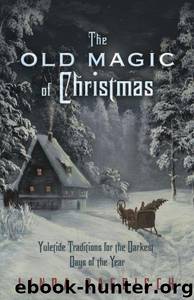
Author:Linda Raedisch [Raedisch, Linda]
Language: eng
Format: epub
Tags: Non-Fiction
ISBN: 9780738733340
Google: R_BhmAEACAAJ
Amazon: 0738733342
Goodreads: 17436868
Publisher: Llewellyn Publications
Published: 2013-10-08T04:00:00+00:00
CHAPTER EIGHT
A Christmas Bestiary
A bestiary was a book of animals: not a catalogue of accu-
rate descriptions, but a flight of medieval fancy in which the reader was supposed to draw Christian lessons from
the habits and aspects of all sorts of creatures from lions to roosters to mermaids. There is no such moralizing in
this chapter, though there is plenty of fancy. The fancies are not mine but those of our ancestors who, unlike the clerical bestiary author locked in his scriptorium, all had up-close, personal encounters with the animals in question: the horse, the goat, the pig or boar, the cat, the wolf and the dog.
The names of four of these creatures—I suppose you
could call them monsters—are preceded by the world
“Yule.” In the case of the Yule Buck and Yule Cat, these
are direct translations from the various Scandinavian lan-
guages. I use the names “Yule Horse” and “Yule Boar” as
generic terms encompassing a variety of costumes, charac-
ters and phenomena. Of the four, the Yule Boar is certainly 131
132 A Christmas Beastiary
the most confounding, for within the tradition we find not just a spectral Christmas pig but also a boar-shaped loaf of bread (or marzipan) and the unquiet ghost of a child. One
might not immediately associate the spectral dog or the
werewolf with Christmas, but they each once held a place
therein, back in the days when the streets were not yet festooned with lights during the Twelve Nights of Christmas
and one could never be sure what moved among the shad-
ows.
Medieval bestiaries were often elaborately illuminated.
As you read, you might wish to imagine the Black Dog
chasing the grizzled Yule Cat round an ornamental capi-
tal or the Lair Bhan cropping the grass in the margin. You might want to hold the book at arm’s length when you
arrive at the Whisht Hounds, and do not be surprised if the sparks thrown from the Gloso’s bristling back burn a few holes in the parchment.
The Yule Horse
Had Hansel and Gretel ventured into the forest surround-
ing the Ilsenstein at Christmastime instead of at Midsum-
mer as they do in Engelbert Humperdinck’s opera, they
might have run into the Habersack. As Yuletide horse get-ups go, the Habersack is one of the easiest to make. All
you need is a broom, a forked branch to hold the bristled
end up and a white sheet to hide under. Since the effect is more that of a horned beast than a horse, the north German Habersack may originally have been a goat like the
Scandinavian Yule Buck. In Yorkshire, no Christmas used
to be complete without a ram, namely, the Old Derby Tup,
A Christmas Beastiary 133
while not far away, chimerical Oosers and Woosets stalked
the moors, walking upright and wearing both beards and
antlers. But the most enduring Christmas animal disguise
is the horse.
Hobi in Old French is a robust little horse. A hobby-horse is a carved wooden horse’s head set on a wooden
frame covered by a cloth or caparison. It is indeed smaller than the average, real-life horse. The “rider” stands inside the framework so that he appears to be mounted on the
horse.
Download
This site does not store any files on its server. We only index and link to content provided by other sites. Please contact the content providers to delete copyright contents if any and email us, we'll remove relevant links or contents immediately.
Becoming Supernatural by Dr. Joe Dispenza(8204)
Crystal Healing for Women by Mariah K. Lyons(7928)
The Witchcraft of Salem Village by Shirley Jackson(7257)
Inner Engineering: A Yogi's Guide to Joy by Sadhguru(6785)
The Four Agreements by Don Miguel Ruiz(6745)
The Power of Now: A Guide to Spiritual Enlightenment by Eckhart Tolle(5760)
Secrets of Antigravity Propulsion: Tesla, UFOs, and Classified Aerospace Technology by Ph.D. Paul A. Laviolette(5368)
The Wisdom of Sundays by Oprah Winfrey(5153)
Room 212 by Kate Stewart(5105)
Pale Blue Dot by Carl Sagan(4996)
Fear by Osho(4728)
The David Icke Guide to the Global Conspiracy (and how to end it) by David Icke(4709)
Animal Frequency by Melissa Alvarez(4463)
Rising Strong by Brene Brown(4451)
How to Change Your Mind by Michael Pollan(4355)
Sigil Witchery by Laura Tempest Zakroff(4238)
Man and His Symbols by Carl Gustav Jung(4131)
The Art of Happiness by The Dalai Lama(4125)
Real Magic by Dean Radin PhD(4121)
