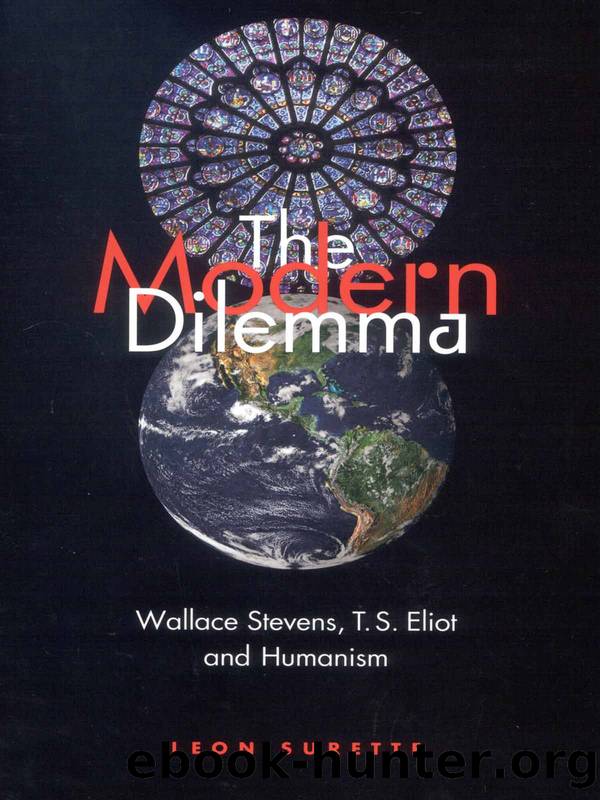
The Modern Dilemma by Leon Surette;
Author:Leon Surette; [Surette;, Leon]
Language: eng
Format: epub
Tags: LIT000000
ISBN: 9780773575059
Publisher: McGillQueensUP
Published: 2008-09-15T05:00:00+00:00
The Fiktion of Aphorism 34 is the commonplace idea that the world exists only in the mind. So considered it is an unreal thing, in which logic does not have a place. Since an Urheber [âoriginatorâ] is a projection of logic, it is easy to dispose of him by disposing of logic ...
This is quite a different fiction from that of the NOTES, even though it is present in the NOTES. We are confronted by a choice of ideas: the idea of God and the idea of man. The purpose of the NOTES is to suggest the possibility of a third idea: the idea of a fictive being, or state, or thing as the object of belief by way of making up for that element in humanism which is its chief defect. (21 April 1943 Huntington, WAS 3512. âNOTESâ is his Notes Toward a Supreme Fiction.â My emphasis)25
Stevens quite reasonably takes the Humanist argument to be that we must choose between God and man, and further that the only rational choice is man. But he refuses their either/or, and embraces instead a âthird idea,â that of âa fictive being or stateâ as âthe object of belief.â His point seems to be a phenomenological one, that is to say, it is the state of âbelieving inâ that is all-important, not the existence or non-existence of that in which we believe. As long as our belief is genuinely held, it does not matter if there is a reality conforming to our beliefs.
Described in this way, Stevensâ position sounds like solipsism. His âfictionâ is not defined by its character of being an invention and therefore not âtrue.â The truth or falsity of the fiction is not what matters. Its defining characteristic is that it is an âobject of belief.â The tacit assumption is that some of our beliefs are true and some are false, but we cannot know incorrigibly which is which. Like pragmatism, then Stevensâ philosophical posture rests on a fundamental agnosticism â not the denial that we can have knowledge of a transcendent reality, but the denial that we can have incorrigible knowledge of anything. Today nearly everyone26 acknowledges that human beings do not have incorrigible knowledge of the world, but only mediated, inferential, and therefore, qualified knowledge. All of our knowledge is, in that sense, a fiction, a constructed picture or manifold. Since we have no incorrigible means of adjudicating between truth and falsehood, we are always at risk of believing what is not true. In this way the sharp line that positivism draws between empirical (scientific) knowledge and emotional belief is breached.
Accepting the sceptical view that we cannot know anything incorrigibly, Stevens turns it on its ear. Instead of concluding â as Derrida and his followers do â that since nothing is certain, everything is equally untrue, Stevens concludes that unwarranted beliefs may, after all, be well founded; our fictions might turn out to be true, much as Newman claimed in the passage cited by Fernandez. A Stevensian fiction, then, is not a chimera; it is not a fantasy, but simply an hypothesis or invention.
Download
This site does not store any files on its server. We only index and link to content provided by other sites. Please contact the content providers to delete copyright contents if any and email us, we'll remove relevant links or contents immediately.
The Universe of Us by Lang Leav(15125)
The Sun and Her Flowers by Rupi Kaur(14573)
Adultolescence by Gabbie Hanna(8967)
Whiskey Words & a Shovel II by r.h. Sin(8052)
Love Her Wild by Atticus(7795)
Smoke & Mirrors by Michael Faudet(6235)
Wiseguy by Nicholas Pileggi(5844)
The Princess Saves Herself in This One by Amanda Lovelace(5003)
Love & Misadventure by Lang Leav(4884)
Memories by Lang Leav(4847)
Milk and Honey by Rupi Kaur(4778)
Bluets by Maggie Nelson(4607)
Too Much and Not the Mood by Durga Chew-Bose(4392)
Pillow Thoughts by Courtney Peppernell(4332)
Good morning to Goodnight by Eleni Kaur(4263)
The Poetry of Pablo Neruda by Pablo Neruda(4173)
Algedonic by r.h. Sin(4097)
HER II by Pierre Alex Jeanty(3641)
Stuff I've Been Feeling Lately by Alicia Cook(3494)
