The End of Illness by David B. Agus
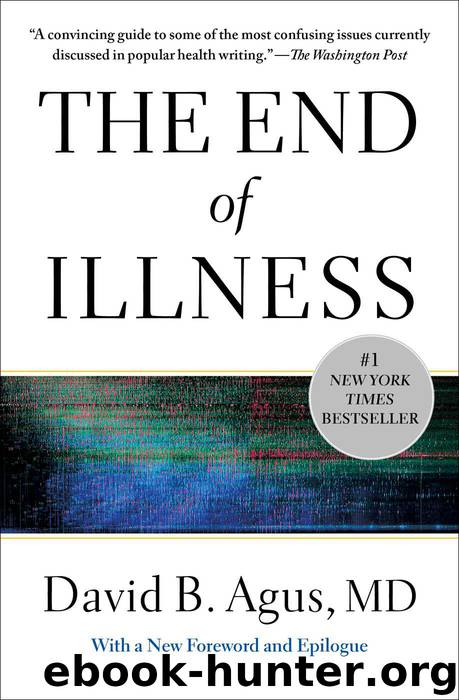
Author:David B. Agus [Agus, David B.]
Language: eng
Format: azw3, epub
Publisher: Free Press
Published: 2012-01-17T05:00:00+00:00
Striking the Balance
Even though supplements have not proven beneficial in avoiding heart problems, foods that are sources of antioxidants are still recommended by health practitioners, myself included. Getting vitamins in food has benefits that don’t necessarily occur when they are taken as supplement. For one, phytochemicals, which are naturally occurring compounds in plants that may have disease-fighting properties that can protect our health, are best delivered to the body through real foods. I don’t think we may ever find a study that proves you can overdose on whole fruits and vegetables to the point you absorb a toxic or unhealthy level of certain nutrients.
Other questions are worth asking. Do we ever really know what’s in our vitamins, how they are created, and whether they say what they actually are? For example, vitamin E exists in eight different forms in nature, four tocopherols and four tocotrienols. The ratio and amounts in foods are very different from those found in most pills. Just a quarter cup of sunflower seeds contains 90.5 percent of the daily value for vitamin E, yet people who take vitamin E supplements tend to consume much more than that. You only need about 22.4 IU a day, but most vitamin-E-only supplements provide more than 100 IU of the nutrient.
The vitamin and supplement industry is largely unregulated, and many trusted brands have come under fire in recent years for miserably failing quality control. Supplement and natural-food sources are not the same; the naturally occurring folate in your spinach is not the same as the synthetic folic acid in your vitamin pill. Similarly, you’ll find names of chemicals and substances on supplement bottles and won’t have a clue as to what they are, not to mention why you need them. When you see boron, nickel, vanadium, and manganese listed on a vitamin supplements label, for example, do you ever ask yourself if consuming these extra amounts artificially is really necessary?
We tend to assume that what a label tells us actually delivers on its promise, and that said promises are meaningful. But I implore you to question whether vitamin supplements can ever live up to Mother Nature’s creations. Do we know, for instance, how to extract the good oils from a fish? Consider that to get the same amount of fish oil you would from a single serving of salmon—which is in the ballpark of three to four ounces—you would have to consume the equivalent of twenty to thirty fish-oil capsules. You should also note that not only is salmon an excellent source of omega-3 fatty acids, the good fats that inspire people to take fish-oil capsules to begin with, but it’s also a great, natural source of vitamin D, selenium, protein, niacin, vitamin B12, phosphorous, magnesium, and vitamin B6. I’d rather that you obtain your nutrition from natural foods that pack a multidimensional punch than from supplements or pills that you just cannot ensure pass the QA test or even contain anything beneficial for your body.
The vitamin craze today is particularly troubling to me given how relatively easy it is to eat well in America.
Download
This site does not store any files on its server. We only index and link to content provided by other sites. Please contact the content providers to delete copyright contents if any and email us, we'll remove relevant links or contents immediately.
Inner Engineering: A Yogi's Guide to Joy by Sadhguru(6800)
The Power of Now: A Guide to Spiritual Enlightenment by Eckhart Tolle(5790)
Fear by Osho(4743)
Ikigai by Héctor García & Francesc Miralles(4279)
The Art of Happiness by The Dalai Lama(4133)
The Ultimate Bodybuilding Cookbook by Kendall Lou Schmidt(3950)
Yoga Therapy by Mark Stephens(3750)
The Little Book of Hygge by Meik Wiking(3698)
The Healing Self by Deepak Chopra(3588)
Why Buddhism is True by Robert Wright(3459)
The Hatha Yoga Pradipika (Translated) by Svatmarama(3353)
Being Aware of Being Aware by Rupert Spira(3283)
Shift into Freedom by Loch Kelly(3203)
Wild Words from Wild Women by Stephens Autumn(3157)
Work Clean by Dan Charnas(3131)
Happiness by Matthieu Ricard(3054)
More Language of Letting Go: 366 New Daily Meditations by Melody Beattie(3034)
Yoga Body & Mind Handbook by Jasmine Tarkeshi(2882)
Why I Am Not a Feminist by Jessa Crispin(2764)
