Thai Herbal Medicine by Jacobsen Nephyr; Salguero C Pierce;
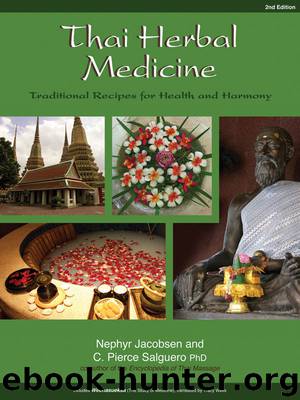
Author:Jacobsen, Nephyr; Salguero, C Pierce;
Language: eng
Format: epub
Publisher: Findhorn Press
Appendices
APPENDIX 1
Wetchasueksa Phaetsatsangkhep Translated by Tracy Wells
Translator’s Introduction
The following is a partial translation of the first volume of a Thai medical text called The Study of Medicine, Summary of Medical Science (Wetchasueksa phaetsatsangkhep เวชศึกษา แพทย์ศาสตร์สังเขป), a three-volume set published by the School of Traditional Medicine at Wat Phra Chetuphon (commonly known as “Wat Pho” or “Wat Po”). Compiled in the mid-19th century, and first published in 1909, it is a summary of the main texts that form the theoretical foundation of Thai Traditional Medicine (TTM). This text was originally used as a teaching aid in schools where TTM was being taught alongside Western medicine. It is still being used in traditional medical schools in Thailand today. As TTM becomes more well known outside Thailand, there is increasing interest in the history, theory, and practice of this healing art. It is important that the main texts related to the practice of TTM be translated and used as the foundation for understanding TTM theory, since they are an integral part of the tradition.
Stating that skillful medical practitioners must have knowledge of four primary matters, this particular text is divided into four main sections: Pathogenesis of Disease, Identification of Disease, Pharmacology, and Administration of Treatment. Each of these sections offers an opportunity to become familiar with the vocabulary and basic concepts of TTM. Although some sections contain detailed descriptions, often, the text reads more like an outline. This is due to the fact that, traditionally, this material would have been handed down orally. Therefore, a text such as this was probably originally intended to serve as a memory device that would aid students in recalling key concepts encountered while studying directly with a practitioner. This sort of direct experience is the only way to develop a thorough understanding of the concepts presented in the text and to begin to appreciate their practical applications.
As for this translation, my main goal was to stay as true as possible to the source material. The integrity of the original text’s outline structure is for the most part maintained. All of the main sections are numbered according to the system used in the original. However, some subheadings and lists contained within the body of the text that do not have numerical designations in the original are numbered here for the sake of clarity. Additionally, some of the longer lists were converted to table form for the same reason. I have also added footnotes for explanatory purposes that do not appear in the original. I have occasionally added information that is missing from the charts or tables in Volume 1 of the source text, when such information can be found in other volumes; those instances have been noted. The inclusion of any other material that does not appear in the original text is indicated by the use of editor’s brackets.
There are several challenges inherent in any translation such as this, the largest being to find the right balance between translating word for word (where the inherent meaning often gets lost) and translating for meaning (where the original wording may be sacrificed).
Download
This site does not store any files on its server. We only index and link to content provided by other sites. Please contact the content providers to delete copyright contents if any and email us, we'll remove relevant links or contents immediately.
Becoming Supernatural by Dr. Joe Dispenza(8226)
Crystal Healing for Women by Mariah K. Lyons(7936)
The Witchcraft of Salem Village by Shirley Jackson(7283)
Inner Engineering: A Yogi's Guide to Joy by Sadhguru(6801)
The Four Agreements by Don Miguel Ruiz(6770)
The Power of Now: A Guide to Spiritual Enlightenment by Eckhart Tolle(5791)
Secrets of Antigravity Propulsion: Tesla, UFOs, and Classified Aerospace Technology by Ph.D. Paul A. Laviolette(5374)
The Wisdom of Sundays by Oprah Winfrey(5168)
Room 212 by Kate Stewart(5130)
Pale Blue Dot by Carl Sagan(5013)
Fear by Osho(4743)
The David Icke Guide to the Global Conspiracy (and how to end it) by David Icke(4724)
Animal Frequency by Melissa Alvarez(4478)
Rising Strong by Brene Brown(4468)
How to Change Your Mind by Michael Pollan(4362)
Sigil Witchery by Laura Tempest Zakroff(4251)
Man and His Symbols by Carl Gustav Jung(4143)
Real Magic by Dean Radin PhD(4134)
The Art of Happiness by The Dalai Lama(4133)
