Tarot Triumphs by Gilchrist Cherry;
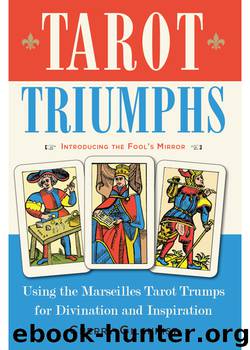
Author:Gilchrist, Cherry;
Language: eng
Format: epub
ISBN: 4612447
Publisher: Red Wheel Weiser
12. The Hanged Man
The Hanged Man may look alarming on first viewing. He is often taken to be a dead man, a criminal who has been hung, or a traitor suspended by his feet according to the Italian custom, and his name at first (Le Pendu in French) seems to support that theory.35 But the way he is depicted suggests that he is in fact an acrobat. In nearly every version, he looks calm and happy, a man who is in control of what he's doing. Reverse the usual meaning, and you will find a man studying the world in reverse!
There are historical accounts of acrobats and gymnasts who did tricks very much like this, suspended from a rope or a pole. Sometimes they performed high up on the rooftops to entertain visiting dignitaries in Paris or London, astounding them with feats of balance, which included upside-down contortions.36 An eye-witness account passed on to me in modern times reports seeing an itinerant acrobat in France holding himself in just the same position as the hanged man of the Tarot. There is also a seventeenth-century engraving of acrobats in training, which shows one of them “hanging by one leg with his head downward” from a rope.37 In a different context, we can find the Tarlà of Girona, a festival still current in northeastern Spain, which involves hanging a life-size dummy dressed as a jester from a pole placed high across the street. He is said to commemorate the dark days of the Black Death in the medieval period, when citizens were confined to their quarters to sit out the plague. To relieve the fear and the tedium, a young acrobat, Tarlà, entertained them with displays of swinging and hanging from these poles.38 Given that Girona is close to the French border and not too far from Marseilles by sea, it's quite possible that this event was well known along that part of the Mediterranean in Renaissance times.
So in this interpretation of the Hanged Man, we see a figure who chooses to be upside-down and has trained himself to do so. Children love to look at the world the other way up; as a little girl, I used to hang head down off my bed, getting a vivid new perspective of the lino and the fluff balls lying beneath. I've also seen kittens playing similar games. In this light, the main meaning of the card becomes that of skill and balance, and it indicates a willingness to let the usual viewpoint fall away and enter the world of topsy-turvy. The Hanged Man frees himself from conventions. He is also—but not historically, perhaps, in terms of Tarot—the shaman on a vision quest, relinquishing normality to receive gifts of prophecy and healing. This is similar to the description of the ordeal that the Norse god Odin underwent, hanging upside-down from the sacred world tree for nine days and nights, sacrificing himself in order to acquire divine knowledge. Ideas of acrobat and shaman do combine well here, for both are entrusting themselves to a reversal.
Download
This site does not store any files on its server. We only index and link to content provided by other sites. Please contact the content providers to delete copyright contents if any and email us, we'll remove relevant links or contents immediately.
Becoming Supernatural by Dr. Joe Dispenza(8221)
Crystal Healing for Women by Mariah K. Lyons(7932)
The Witchcraft of Salem Village by Shirley Jackson(7276)
Inner Engineering: A Yogi's Guide to Joy by Sadhguru(6797)
The Four Agreements by Don Miguel Ruiz(6766)
The Power of Now: A Guide to Spiritual Enlightenment by Eckhart Tolle(5785)
Secrets of Antigravity Propulsion: Tesla, UFOs, and Classified Aerospace Technology by Ph.D. Paul A. Laviolette(5372)
The Wisdom of Sundays by Oprah Winfrey(5164)
Room 212 by Kate Stewart(5127)
Pale Blue Dot by Carl Sagan(5011)
Fear by Osho(4740)
The David Icke Guide to the Global Conspiracy (and how to end it) by David Icke(4720)
Animal Frequency by Melissa Alvarez(4474)
Rising Strong by Brene Brown(4464)
How to Change Your Mind by Michael Pollan(4357)
Sigil Witchery by Laura Tempest Zakroff(4247)
Man and His Symbols by Carl Gustav Jung(4137)
The Art of Happiness by The Dalai Lama(4131)
Real Magic by Dean Radin PhD(4129)
