Taken in Faith by Pinkerton Helen;Steele Timothy;
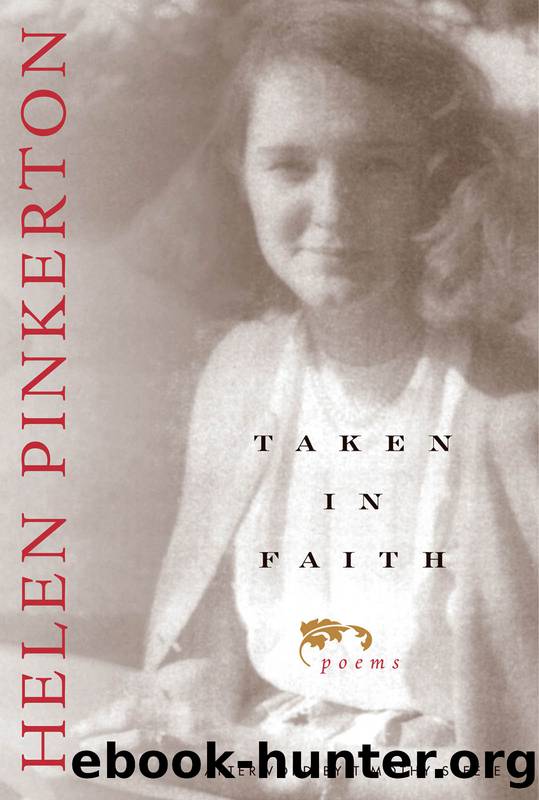
Author:Pinkerton, Helen;Steele, Timothy;
Language: eng
Format: epub
Publisher: Ohio University Press
Published: 2002-08-15T00:00:00+00:00
Alike and Yet Unlike: General Richard Taylor Writes to Henry Adams
For C. Q. D.
Washington, D.C., January 1879
We spoke last evening of your work and mine,
Of your first novel, of my little essay,
A venture into history, remote
Seemingly, and yet near my heart these days
When none remember what we were, or what
We might have been, had the war never come.
Your manuscript held me from sleep all night,
For it seemed hardly fiction but the truth
About a generation without honor.
And yet I wonder that you do not see
That the corruption you so well depict
Follows as night the day the venal motives
That fired and drove the engine of the war,
The railroads, mills, the arms and armament.
You set the thing in motion with your cause.
It consumed us and now consumes your best.
Even Grant, who acted with Old Army honor
At Appomattox, now has stained his name.
You show him as a simple-minded fool
And show the Union, for which your noblest died,
The foul and rotten Vanity Fair it is.
Itâs well they are not here to see or know
The end of all their sacrifice, that rabble
Like these rule a democracy of thieves.
Better the quiet grave and unsullied fame!
My illness will excuse, I hope, my anger.
Reading your work, sensing your misery,
I like to think of how it might have been.
You, child of diplomats, skillful with suave words,
And I, of soldiers and the sword, together,
We might have lived, God willing, a happier story.
And I dream, too, without the war, I might
Have been something of an historian,
Had I had quiet hours with documents
To trace out to their hearts our Southern men
As I have Mason, and you, Gallatin.
My little sketch remains, at least, to show
How much we are alike and yet unlike.
With peace we might have built a true republic.
But you did not trust us, did not trust me.
I knew that when, as a boy, I paced the streets
Of wintry Cambridge and heard the cultured sneer
That my soft Southern speech evoked. I read
Your Puritansâ serpent-tongued anathemas
And chose the warmer voices of New Haven,
Though it no haven for a Southern boy.
Though seldom with my father after my childhood,
Even then I had, bred in my bones and sinews,
Ancestral habit of battle, my fatherâs gift,
Latent the while I studied it in books.
Last night when you lamented that your schooling
Failed to engage your life, it came to me,
Afterward, that you missed the best of schools,
The one your friends all chose in Sixty-Oneâ
Nick Anderson, Ben Crowninshield, your brother,
Your Southern friends, Jim May, and Julius Alston,
And Rooney Lee. In war they learned a truth
Fitted for life because it was of death,
A comradeship at once sublime and useful:
Arm touching arm, bayonets ranked in rows,
Only the thin gray wool, or blue, as armor
Between their frail flesh and the iron hail.
You never heard the shell nor felt the groundâs
Motion under the iron cannonâs blow,
Nor sensed the hornetâs hum about your ears,
Nor forced your trembling horse into the volley,
Nor, like young Alston, tasted dirt and sand,
Blinding your eyes for hours behind your guns.
The wonder of it still catches my breath
When I recall it!
Your friends learned how to die, surely a lesson
Most valuable for life.
Download
This site does not store any files on its server. We only index and link to content provided by other sites. Please contact the content providers to delete copyright contents if any and email us, we'll remove relevant links or contents immediately.
The Universe of Us by Lang Leav(15068)
The Sun and Her Flowers by Rupi Kaur(14509)
Adultolescence by Gabbie Hanna(8918)
Whiskey Words & a Shovel II by r.h. Sin(8008)
Love Her Wild by Atticus(7749)
Smoke & Mirrors by Michael Faudet(6183)
Wiseguy by Nicholas Pileggi(5769)
The Princess Saves Herself in This One by Amanda Lovelace(4966)
Love & Misadventure by Lang Leav(4842)
Memories by Lang Leav(4795)
Milk and Honey by Rupi Kaur(4741)
Bluets by Maggie Nelson(4547)
Too Much and Not the Mood by Durga Chew-Bose(4337)
Pillow Thoughts by Courtney Peppernell(4271)
Good morning to Goodnight by Eleni Kaur(4231)
The Poetry of Pablo Neruda by Pablo Neruda(4097)
Algedonic by r.h. Sin(4056)
HER II by Pierre Alex Jeanty(3605)
Stuff I've Been Feeling Lately by Alicia Cook(3448)
