Star in the East: Krishnamurti, the Invention of a Messiah by Roland Vernon
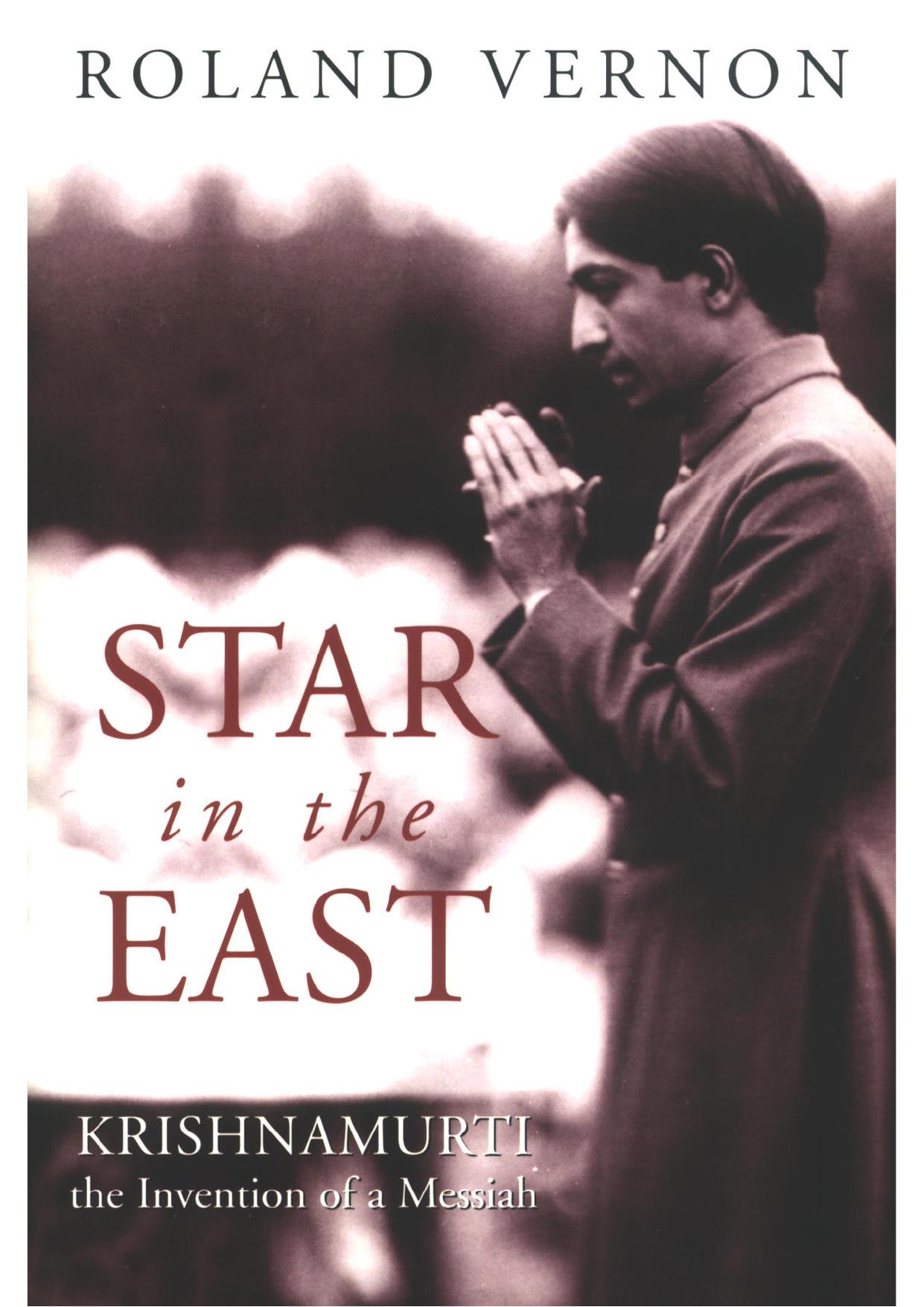
Author:Roland Vernon
Language: eng
Format: mobi, epub, pdf
Publisher: Sentient Publications
Published: 2017-05-29T04:00:00+00:00
I worshipped,
I prayed,
But the gods were silent.
I could weep no more.
I sought him in all things,
In every clime.
… And then,
In my search,
I beheld Thee,
O Lord of my heart;
In thee alone
I saw the face of my brother.17
This revelation offered him consolation and immense strength.
On a physical level, Krishna derived comfort from Helen, who arrived with Leadbeater and a party of seventy, including Rosalind, from Sydney. Helen wrote that he ‘arrived in Adyar a changed person – older, colder, more restrained. The boy in him was gone … the loss of his brother killed something in him … Something inside him turned to steel.’18 It was the beginning of the end of their relationship. Whether it was Nitya’s death, Krishna’s new spiritual life, with its disdain of possessive love, or Helen’s recent passion for socialism (which entailed a disapproval for the extravagance of Krishna’s lifestyle), they were never to be close again. She returned, for a spell, to Australia and her own new interests, he to his role as budding World Teacher, and within a few years the letters between them dried up. Helen later married the American socialist, writer and environmentalist, Scott Nearing, and lived happily with him for fifty-three years until his death at the age of a hundred. She herself, like Krishnamurti, lived to be ninety-one, finally dying in a car accident in 1995.
Nitya’s death affected everyone closely involved with the World Teacher project. Some thought he had possessed characteristics better suited to the messianic role than his older brother: bookish intellect, an awareness of current affairs, humanity, immediate charm, wit and warmth. Krishna’s airy spirituality was charismatic on one level, but for some followers he lacked the requisite definition and grounding that his global role might demand. From his fortress of high, uncompromising standards, he placed little value on the type of diplomatic sensitivity so well displayed by his younger brother. Helen described Nitya as ‘the finest second fiddle who ever played’.
After the experience of Sydney, earlier in the year, followed by the events at Huizen and Ommen, Krishna’s belief in the standard rhetoric of Theosophy was bruised, to say the least. Nitya’s death now caused him to re-evaluate his attitude towards the Society’s principal tenet: that the world and its events were governed by a hierarchy of semi-divine Masters. The result of his discovery was that he felt suddenly and joyously released from an absurd illusion. His total volte face was to cause obvious difficulties for Theosophists who, up until now, had been encouraged, or even compelled, to accept the occult teachings of Leadbeater. Were they now to believe that this had all been a grand deceit, and that the Masters were merely figments of Leadbeater’s imagination?
It would be a mistake to leap to the conclusion that the old bishop was a deliberate liar, and that what he maintained had no substance. One of the basic principles of esotericism is the role of mediation between the human and divine worlds, effected by angels, spirits, or, in Theosophy’s case, Masters.
Download
Star in the East: Krishnamurti, the Invention of a Messiah by Roland Vernon.epub
Star in the East: Krishnamurti, the Invention of a Messiah by Roland Vernon.pdf
This site does not store any files on its server. We only index and link to content provided by other sites. Please contact the content providers to delete copyright contents if any and email us, we'll remove relevant links or contents immediately.
Becoming Supernatural by Dr. Joe Dispenza(8204)
Crystal Healing for Women by Mariah K. Lyons(7928)
The Witchcraft of Salem Village by Shirley Jackson(7257)
Inner Engineering: A Yogi's Guide to Joy by Sadhguru(6785)
The Four Agreements by Don Miguel Ruiz(6745)
The Power of Now: A Guide to Spiritual Enlightenment by Eckhart Tolle(5758)
Secrets of Antigravity Propulsion: Tesla, UFOs, and Classified Aerospace Technology by Ph.D. Paul A. Laviolette(5367)
The Wisdom of Sundays by Oprah Winfrey(5153)
Room 212 by Kate Stewart(5105)
Pale Blue Dot by Carl Sagan(4996)
Fear by Osho(4727)
The David Icke Guide to the Global Conspiracy (and how to end it) by David Icke(4709)
Animal Frequency by Melissa Alvarez(4462)
Rising Strong by Brene Brown(4451)
How to Change Your Mind by Michael Pollan(4355)
Sigil Witchery by Laura Tempest Zakroff(4238)
Man and His Symbols by Carl Gustav Jung(4131)
The Art of Happiness by The Dalai Lama(4125)
Real Magic by Dean Radin PhD(4121)
