Scribble, Scribble, Scribble by Simon Schama
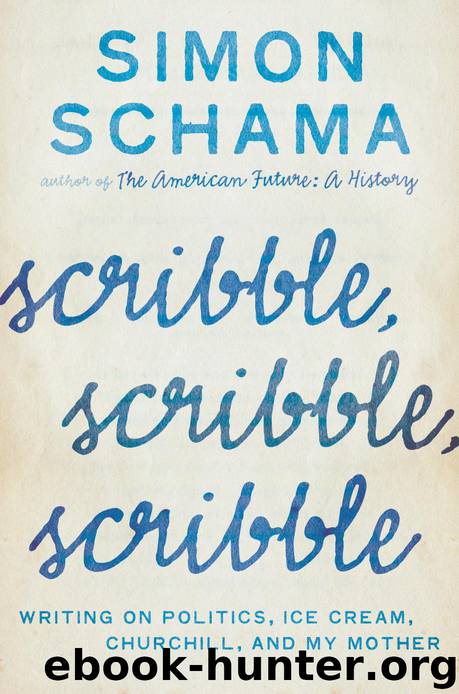
Author:Simon Schama
Language: eng
Format: mobi, epub
Publisher: HarperCollins
Published: 0101-01-01T00:00:00+00:00
Dutch Courage
Guardian, 23 June 2007
Feeling conjugally challenged? Look at Frans Hals’s double portrait of Isaac Massa and Beatrix van der Laen in the National Gallery’s forthcoming Dutch Portraits show and, instantly, all will be right with your corner of the world. The graceful painting, silvery with intimate affection, documents one of the great changes in the history of European marriage: the possibility of the shared smile – the glimlach revolution. Not that lipwork had hitherto been out of the question for portraiture. But La Joconde she isn’t. Leonardo’s thinly knowing smirk implies private knowledge, to be decoded only through the proprietorial collusion of patron and painter. But Hals’s newly married couple, Beatrix sporting both betrothal and wedding rings on her right hand, advertise their mutual pleasure openly for our shared celebration. They incline to each other and, through their self-identification as a harmonious pair, radiate that sympathy outwards through the picture plane towards us. Behold, the painting says, as Isaac holds his hand to his heart, the very picture of proper Christian marriage in which duty also happens to be pleasure.
To gauge the magnitude of that alteration you can look at Jan Claesz’s twin portraits in the exhibition of a married couple from the first decade of the seventeenth century. The figures are still rigid with conventions of social duty, above all that of engendering, the human bond entirely subsumed by the obligations of decorum.
Precisely because, during the seventeenth century, the Dutch travelled that journey from iconic formalism, through a period of easygoing naturalism, back to refined family ensembles dressed to display patrician rank and classical taste, the National Gallery show is an opportunity to reflect on the evolution of the genre itself. As patrons reminded painters (including Rembrandt) whom they thought had been altogether too free with artistic licence, likeness was their first duty. But as Richard Brilliant argued in his elegant book, Portraiture, the artist has often interpreted that job as the likeness of an idea, a sense of a person, rather than the laborious imitation of physiognomic detail. Roger Fry complained of a Sargent portrait of a British general that he couldn’t see the man for the likeness. He was commenting at a time when a portrait was thought to be the capture of a bundle of psychological characteristics stamping the unique quality of a person, which could be read through facial expression and body language, and then transcribed on to the canvas as a sign of essential self. This was no more than a subjective hunch about a person, masquerading as some deeper objective reality. But it meant that modern portraiture has generally been imitation complicated by interpretation.
Centuries earlier, before the Romantics inaugurated the cult of the unrepeatable self, the work of the portraitist was to represent the imagined mask of, say, the scholar (Holbein’s Erasmus), the Doge (Titian’s Andrea Gritti) or the virtuoso courtier (Raphael’s Castiglione); all of them personifications rather than revelations. But between the normative icon of the Renaissance and the naked ego-show
Download
This site does not store any files on its server. We only index and link to content provided by other sites. Please contact the content providers to delete copyright contents if any and email us, we'll remove relevant links or contents immediately.
The Rules Do Not Apply by Ariel Levy(4946)
Bluets by Maggie Nelson(4541)
Too Much and Not the Mood by Durga Chew-Bose(4324)
Pre-Suasion: A Revolutionary Way to Influence and Persuade by Robert Cialdini(4205)
The Motorcycle Diaries by Ernesto Che Guevara(4078)
Walking by Henry David Thoreau(3946)
Schaum's Quick Guide to Writing Great Short Stories by Margaret Lucke(3368)
What If This Were Enough? by Heather Havrilesky(3302)
The Daily Stoic by Holiday Ryan & Hanselman Stephen(3292)
The Day I Stopped Drinking Milk by Sudha Murty(3184)
The Social Psychology of Inequality by Unknown(3011)
Why I Write by George Orwell(2942)
Letters From a Stoic by Seneca(2785)
A Short History of Nearly Everything by Bryson Bill(2679)
A Burst of Light by Audre Lorde(2586)
Insomniac City by Bill Hayes(2535)
Feel Free by Zadie Smith(2473)
Upstream by Mary Oliver(2382)
Miami by Joan Didion(2362)
