Science and Psychic Phenomena by Chris Carter
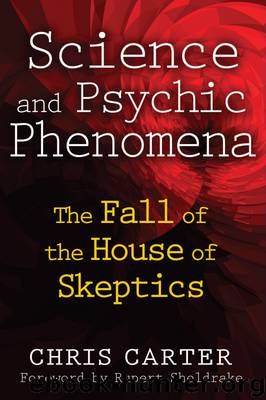
Author:Chris Carter
Language: eng
Format: epub
Publisher: Inner Traditions / Bear & Company
Published: 2012-02-12T16:00:00+00:00
The most ancient of these beliefs is dualism, found as it is in the old shamanistic religions around the world. Although the first formal statement of dualism was by Descartes, one of the earliest written references to dualist thinking may be found in Plato’s description of the last hours of Socrates, in which Socrates ridicules the notion that purposeful behavior can be explained in physical terms. Plato made a sharp distinction between mind and body, holding that the mind could exist both before and after its residence in the body and could rule the body during that residence. An even earlier reference to a form of dualism may be found in a lecture given by Hippocrates on epilepsia (epilepsy), in which the brain is described as “the messenger to consciousness” and as “the interpreter for consciousness.” Modern dualists can count among their ranks several distinguished modern philosophers and brain scientists.t
Materialism in all its varieties also has an ancient history, going back at least as far as Democritus, who back in the fifth century BC wrote that “nothing exists, but atoms and the void.” It had a powerful and influential advocate in the nineteenth century in the form of Darwin’s close friend Thomas Huxley, who proposed the thesis that animals and men are automata. Huxley did not deny the existence of mental events, but he maintained that the relationship between mind and body was strictly one-sided, with the mental having no effect on the physical. Huxley described mental events as mere epiphenomena, or just useless by-products of brain activity. So men and animals for him were just automata, even if conscious ones. This is still the position of many philosophers, biologists, and neuroscientists.
Materialism was popular in psychology in the 1950s, as part of a movement known as “behaviorism,” and the doctrine of behaviorism is still adhered to by some neuroscientists and psychologists. But in the 1960s, the concept of mentalism began to spread in acceptance among cognitive scientists, mostly due to the writings of neurobiologist Roger Sperry. Sperry, who won the 1981 Nobel Prize in medicine for his work on the functions of the two hemispheres of the brain, rightly recognized that the profound mystery of consciousness makes a choice between the alternatives difficult:
Once we have materialism squared off against mentalism in this way, I think we must all agree that neither is going to win the match on the basis of direct, factual evidence. The facts do not simply go far enough. Those centermost processes of the brain with which consciousness is presumably associated are simply not understood. They are so far beyond our comprehension at present that no one I know of has been able even to imagine their nature.22
Apart from the dwindling number of pure materialists who still deny the existence of consciousness, and the dwindling number of researchers in the field of artificial intelligence still trying to raise money for the construction of “thinking machines,”u this position is reflected in the writings of most serious scientists. Nobel
Download
This site does not store any files on its server. We only index and link to content provided by other sites. Please contact the content providers to delete copyright contents if any and email us, we'll remove relevant links or contents immediately.
Personalized inhaled bacteriophage therapy for treatment of multidrug-resistant Pseudomonas aeruginosa in cystic fibrosis by unknow(213221)
CONSORT 2025 statement: updated guideline for reporting randomized trials by unknow(102512)
Critical evaluation of the ProfiLER-02 study design and outcomes by Vivek Subbiah & Razelle Kurzrock(102038)
Cardiac gene therapy makes a comeback by Oliver J. Müller & Susanne Hille & Anca Kliesow Remes(101831)
Whisky: Malt Whiskies of Scotland (Collins Little Books) by dominic roskrow(74615)
Unveiling the design rules for tunable emission in graphene quantum dots: A high-throughput TDDFT and machine learning perspective by Şener Özönder & Mustafa Coşkun Özdemir & Caner Ünlü(50995)
A yeast-based oral therapeutic delivers immune checkpoint inhibitors to reduce intestinal tumor burden by unknow(40370)
Covalent hitchhikers guide proteins to the nucleus by Alexander F. Russell & Madeline F. Currie & Champak Chatterjee(40294)
Meet the Authors: Christopher R. Mansfield and Emily R. Derbyshire by Christopher R. Mansfield & Emily R. Derbyshire(40204)
Alkaline-earth metals promote propane dehydrogenation with carbon dioxide through geometric effects: Altering the reaction pathway by unknow(32812)
Induced iron vacancies boosting FeOOH loaded on sustainable Fenton-like collagen fiber membrane for efficient removal of emerging contaminants by unknow(32607)
Efficient electric-field-assisted photochemical conversion of methane to n-propanol exclusively over penetrated TiO2Ti hollow fibers by Guanghui Feng(32527)
Bi2SiO5 nanosheets as piezo-photocatalyst for efficient degradation of 2,4-Dichlorophenol by Hangyu Shi & Yifu Li & Lishan Zhang & Guoguan Liu & Qian Zhang & Xuan Ru & Shan Zhong(32463)
A novel NDIPTA organic heterojunction photocatalyst with built-in electric field for efficient hydrogen production by Jiahui Yang & Baojun Ma & Yongfa Zhu(32437)
Enhanced conversion of methane to liquid-phase oxygenates via hollow ferrite nanotube@horseradish peroxidase based photoenzymatic catalysis by Jun Duan & Shiying Fan & Xinyong Li & Shaomin Liu(32403)
Ordered macroporous superstructure of defective carbon adorned with tiny cobalt sulfide for selective electrocatalytic hydrogenation of cinnamaldehyde by Xiao-Shi Yuan & Sheng-Hua Zhou & San-Mei Wang & Wenbo Wei & Xiaofang Li & Xin-Tao Wu & Qi-Long Zhu(32330)
What's Done in Darkness by Kayla Perrin(27245)
Topological analysis of non-conjugated ethylene oxide cored dendrimers decorated with tetraphenylethylene: Insights from degree-based descriptors using the polynomial approach by A Theertha Nair & D Antony Xavier & Annmaria Baby & S Akhila(26627)
Investigation of mechanical and self-healing properties of hydroxyl-terminated polybutadiene functionalized with 2-ureido-4-pyrimidinone by Mohsen Kazazi & Mehran Hayaty & Ali Mousaviazar(26552)
