Patterns of Religious Narrative in the Canterbury Tales by Roger Ellis;
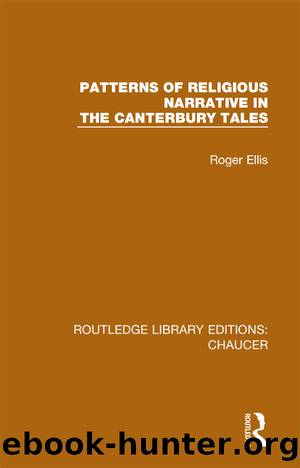
Author:Roger Ellis;
Language: eng
Format: epub
Publisher: Taylor & Francis (CAM)
Published: 1986-01-15T00:00:00+00:00
Notes
1. Green (p. 159) goes further than SA (p. 455) was ready to do and finds PrT âclearly taken from a Latin life of Hugh of Lincolnâ. For a more judicious estimate, see Wenzel, SP, 73, 142: âwe find analogues to PrT in a surprisingly large number of works in Chaucerâs England that are directly related to preaching.â
2. On links between Mandeville and CT, see Zacher, chs 5-6; on the influence of Mandeville on CT, ibid., p. 130.
3. This work is still largely unedited. For an edition of the relevant portion, see SA, pp. 165-81; for a translation, Originals and analogues of some of Chaucerâs CT, ed. F.J. Furnivall etal., Ch. Soc. 2nd series, 1, ed. E. Brock, hereafter OA (London, 1872), I, 2-53 (and cf. Ill, 222-50). For the suggestion that the Cronicles influenced not only MLT but also PardT, see R.A. Pratt, âChaucer and Les cronicles of Nicholas Trevetâ, Studies in Language, Literature and Culture of the Middle Ages and Later, ed. E.B. Atwood and A. A. Hill (Austin, Texas, 1969), pp. 303-11, and particularly p. 306, n.4. For comment on Trevet and the Cronicles see R. Dean, âNicholas Trevet, historianâ, in Medieval Learning and Literature: essays presented to R. W. Hunt, ed. J.J.G. Alexander and M.T. Gibson (Oxford, 1976), pp. 328-52; and P. Clogan, âThe narrative style of MLTâ, M&H, NS 8 (1977), 222.
4. On motives for conversion to Islam, see D. Metlitzki, The Matter of Araby in Medieval England (New Haven and London, 1977), p. 233, quoting Mandeville (see Mandevilleâs Travels, ed. M.C. Seymour (Oxford, 1967), p. 103).
5. See comment above ch. 2, nn. 20-21; and in M.R. Pauli, âThe influence of the saintâs legend genre in MLTâ, ChR, 5 (1970-71), 183.
6. The links between romance and hagiography both in general and in relation to MLT have often been noted. See e.g. Mehl, pp. 12, 17, 26, 255; Burlin, p. 138; Kean, II, 114; Clogan, M&H, NS 8, 219, 226 (the latter tacitly opposing Mehl, p. 26 on identification of audience with the protagonists of the story); and Payne, p. 161. See also Wood (p. 195) for an interesting view of MLT as a saintâs legend transformed by the style of its narration into a romance.
7. On St Cecilia, see above ch. 4; on St Katharine, ch. 4, n. 9; on St Ursula, Ryan-Ripperger, pp. 627-31.
8. SA (p. 167): âla purueaunce dieu ni faili poynt, qi en tribulacioun ia ne faut a ceaus qi ount en lui esperaunce.â
9. SA (p. 168): âdieu estoit son marinerâ.
10. On the role of the bystanders in, for instance, the revelations of Julian of Norwich, see Ellis, Christian, 6, 63-5.
11. The copy of the Cronicles in Oxford MS Bodleian Rawlinson B 178 indicates this feature of the text by the creation of separate rubrics for the English material.
12. For a stronger statement of this position see Burlin, p. 138: MLT âhas a generic conflict inherited from its source.â See also Mehl (pp. 20-1) on the distinction between romance and chronicle. (NPT will playfully appropriate the distinction: see below p.
Download
This site does not store any files on its server. We only index and link to content provided by other sites. Please contact the content providers to delete copyright contents if any and email us, we'll remove relevant links or contents immediately.
The Universe of Us by Lang Leav(15083)
The Sun and Her Flowers by Rupi Kaur(14529)
Adultolescence by Gabbie Hanna(8931)
Whiskey Words & a Shovel II by r.h. Sin(8024)
Love Her Wild by Atticus(7763)
Smoke & Mirrors by Michael Faudet(6198)
Wiseguy by Nicholas Pileggi(5795)
The Princess Saves Herself in This One by Amanda Lovelace(4985)
Love & Misadventure by Lang Leav(4853)
Memories by Lang Leav(4806)
Milk and Honey by Rupi Kaur(4754)
Bluets by Maggie Nelson(4566)
Too Much and Not the Mood by Durga Chew-Bose(4353)
Pillow Thoughts by Courtney Peppernell(4290)
Good morning to Goodnight by Eleni Kaur(4239)
The Poetry of Pablo Neruda by Pablo Neruda(4113)
Algedonic by r.h. Sin(4066)
HER II by Pierre Alex Jeanty(3614)
Stuff I've Been Feeling Lately by Alicia Cook(3460)
